
How to Get to Paraty: Airports, Transfers & the Drive from Rio
Which airport to fly into, how long the drive really takes, when to consider an air taxi into Paraty's own airstrip, and how to make the famous Rio-Santos coast road work for you instead of against you.
Paraty does not have an airport you can fly into. That single fact decides almost everything about how you get there, so it is worth saying plainly up front. The town sits about 250 kilometers down the coast from Rio de Janeiro, on a stretch of the Costa Verde — the Green Coast — that runs between Rio and São Paulo. There is a small airfield two kilometers from the historic center, but it handles private and charter aircraft only, with no scheduled flights. For almost everyone, getting to Paraty means flying into a big-city airport and then traveling overland for three and a half to four and a half hours along one of the prettier, twistier coastal roads in Brazil.
That sounds like a hassle. It mostly is not. The drive is genuinely scenic, the logistics are simple once you know the moving parts, and the road is the reason Paraty stayed small and intact while flashier beach towns up the coast filled with high-rises. This guide walks through every realistic way in — which airport to choose, what the drive is actually like, when to take a private transfer versus the bus versus a chartered light plane, how the rainy season changes the math, and what happens once you arrive in a town where you can't drive a car into the center anyway. The aim is to make the choice obvious for your trip and save you from the two or three mistakes first-timers usually make.
In this guide
- The basics: no airport, one famous road
- Which airport to fly into
- Driving the Rio–Santos: the BR-101
- The private transfer
- The bus from Rio
- Air taxi and Paraty's airport
- Coming from the São Paulo side
- Getting around once you're here
- When traffic and roads are worst
- A sample door-to-door journey
- Common questions
The basics: no airport, one famous road
Here is the shape of it. Paraty is a municipality in the state of Rio de Janeiro, roughly midway between the cities of Rio and São Paulo. It is not on a flight network of its own. The big international gateways that feed it are in those two cities, and from any of them you reach Paraty by road, along the Rodovia Rio–Santos — the BR-101 coastal highway, opened in the 1970s, which threads along the base of the mountains where the Atlantic Forest tumbles into the sea.
So your journey has two legs almost every time: a flight to a major airport, then ground transport down the coast. The flight is the easy part — Brazil's domestic network is busy and competitive, and the international hubs at Rio and São Paulo connect to most of the world. The second leg is where the real choices live, and there are four practical ones:
- Private transfer — a door-to-door chauffeured car or SUV from the airport to your accommodation. The simplest option, and the one most villa guests take.
- Intercity bus — a comfortable coach from Rio's main bus terminal to Paraty's. Budget-friendly and surprisingly civilized.
- Self-drive — a rental car you pilot yourself down the Rio–Santos. Rewarding if you like driving; not for the nervous, and not after dark.
- Air taxi / charter — a light aircraft into Paraty's little airfield, skipping the road entirely. Pricey, weather-sensitive, but a real answer when the coast road floods.
Whichever you choose, budget for the second leg taking the better part of an afternoon. The drive is commonly quoted at "around four hours," and that is a fair average, but it is an average — traffic out of Rio, a slow truck on a mountain curve, or rain can push it past five. Plan the day so you are not racing the clock, and you will enjoy the trip rather than endure it.

Which airport to fly into
Four airports realistically serve Paraty — two in Rio, two in São Paulo. They are all roughly the same distance away as the crow flies, but they differ in what flights they carry, how easy the connection is, and how the drive shakes out. Here is the honest comparison.
Rio de Janeiro / Galeão (GIG) is the one most international travelers will use. Officially Aeroporto Internacional Tom Jobim, it is Rio's main international gateway, and it sits on the north side of the city — which, counterintuitively, can make it a touch closer to the Rio–Santos road than the more central airport. Reckon on about 241 kilometers and roughly three hours and twenty minutes to three hours and fifty minutes by car, traffic depending. If you are flying in from abroad, GIG is almost certainly your landing point, and starting the drive straight from arrivals is clean and common.
Rio de Janeiro / Santos Dumont (SDU) is the small, central airport hugging Guanabara Bay downtown — beautiful on approach, but largely domestic. If you connect through São Paulo or another Brazilian city and the cheapest onward leg lands at SDU, you'll be fine; it's about 251 kilometers and roughly three hours and forty-five minutes to Paraty. The catch is that SDU is in the thick of the city, so the first half hour of your transfer is spent escaping Rio traffic before you reach open road.
São Paulo / Guarulhos (GRU) is the other major international gateway, and the busiest airport in South America. If your inbound flight routes through São Paulo, you may land here. The drive to Paraty is the longest of the four big options — around 254 kilometers but closer to four hours because of how you thread out of greater São Paulo and over to the coast. It's a perfectly workable starting point, especially if GRU is where your international connection naturally lands.
São Paulo / Congonhas (CGH) is São Paulo's central domestic airport — the SDU equivalent on that side. It's the farthest from Paraty at roughly 278 kilometers and about four hours and twenty minutes, and like Congonhas's Rio cousin, you start in dense city. Useful if you're already in São Paulo and a domestic hop puts you here, but rarely the airport you'd choose on purpose for a Paraty trip.
The short version: if you're coming from abroad, fly into Rio Galeão (GIG). It's the international gateway, it tends to be the quickest drive, and you avoid the extra domestic connection that the other three usually imply. Use São Paulo's airports only when your routing lands you there anyway — the extra distance and city sprawl don't justify going out of your way. Whichever you pick, the times above are ranges for a reason: the same trip can vary by an hour or more depending on the day, the weather, and how the highway is behaving.
Good to know
All four distances and times assume normal conditions. Friday afternoons, Sunday evenings, holiday weekends, and any heavy rain can add a real chunk of time. If you have a connecting flight or a sunset dinner reservation, build in a generous buffer. Nobody has ever regretted arriving in Paraty an hour early.
Driving the Rio–Santos: the BR-101
The road that carries you to Paraty is the Rodovia Rio–Santos, signed as the BR-101 along this stretch. It was cut through in the 1970s, and it is the single thread connecting the coastal towns of the Costa Verde. Understanding it helps no matter how you travel — whether you're behind the wheel yourself, riding in a transfer, or on the bus, this is the road you'll spend most of your second leg on.
For most of its length the Rio–Santos runs right along the shoreline, with the Atlantic Forest rising steeply on one side and the bay glinting on the other. It is, genuinely, one of the great coastal drives — you pass beaches, fishing villages, sudden viewpoints where the islands of the bay come into view, and long green walls of jungle. People who do it once tend to remember it.
It is also curvy. This is a two-lane mountain-and-coast road, not a motorway. It bends constantly, climbs and drops, and shares space with trucks, buses, motorbikes, and the occasional cyclist. Average speeds are modest — that's why 250 kilometers takes four hours rather than two and a half. If you're prone to motion sickness, sit in the front, look at the horizon, and take something before you set off; the constant gentle swaying gets a few people.
Along the way you pass through and near several towns that make natural rest stops — Angra dos Reis, the larger town fronting its famous 365-island bay, sits roughly midway and is the obvious place to pause for fuel, a coffee, or a bathroom break. There are roadside lanchonetes (snack bars) and gas stations at intervals, though they thin out on the more remote stretches. Fill the tank when you can rather than when you must.
The Rio–Santos is the reason Paraty stayed Paraty. A harder road to build meant a harder town to overdevelop — which is exactly why what's at the end of it is worth the drive.
The real issue: rain and landslides
Here is the part to take seriously. The Rio–Santos is cut into steep, forested slopes, and in heavy rain those slopes can give way. Landslides and washouts that close the road, or reduce it to one slow lane, are a recurring feature of the wet season. The worst window is roughly December through March, the height of the Brazilian summer, when Paraty gets some of the heaviest rainfall on the entire coast. Closures can last hours or, occasionally, longer, and they're not always predictable.
This doesn't mean you shouldn't visit in summer — plenty of people do, and the town is at its liveliest then. It means you should plan with a margin and have a backup in mind. If a major storm is forecast and your travel day is tight, that's exactly when the air-taxi option (covered below) earns its keep, because a light plane simply flies over a road that's underwater. For most trips in the drier months (April through October), the road behaves itself and the drive is a pleasure.
If you're driving yourself
Self-driving is a fine choice for confident drivers who want flexibility — to stop at a beach, detour to Trindade, leave when you like. A few honest cautions, though, because this road punishes overconfidence:
- Don't drive it at night if you can avoid it. The road is unlit on long stretches, the curves are blind, and animals, pedestrians, and cyclists appear out of the dark. Time your trip to arrive in daylight.
- Watch for fog. The mountain sections can fog up fast, especially in the early morning and after rain. If visibility drops, slow right down — locals do.
- Keep the tank topped up. Gas stations exist but are spaced out. Don't let the needle ride low on the remote sections.
- Pass with patience. You'll get stuck behind slow trucks on grades. Overtake only on clear straights with full sightlines. The few minutes you'd save aren't worth it on a two-lane road with oncoming traffic.
- Remember you can't drive into the historic center. Cars are banned from the old town's cobblestone streets, so a rental car becomes a thing you park at the edge and walk away from. Factor that in before you commit to driving.
Good to know
Brazilian highway signage and conventions may differ from what you're used to, and the GPS routing apps people rely on at home (Google Maps and Waze are both widely used in Brazil) generally work well here — but cell coverage drops on the remote forested stretches, so download offline maps before you set off. An international driving permit alongside your home license is the safe documentation to carry.
The private transfer
For most travelers — and certainly most people staying somewhere like a villa — the private transfer is the easiest, lowest-friction way to get to Paraty, and it's what we'd recommend by default. You book a car or SUV with a driver, they meet you at the airport, and they take you door to door to your accommodation. Reckon on roughly three and a half to four hours from the Rio airports, depending on traffic and weather.
Why it's worth it for so many people comes down to what you don't have to deal with. You don't navigate an unfamiliar two-lane mountain road in a foreign country. You don't fight Rio traffic on the way out. You arrive after a long-haul flight and simply get in a comfortable, air-conditioned car and let someone who drives this road for a living do the work. You can sleep, look at the view, or sort out your plans for the week. And because it's door to door, there's no taxi shuffle or luggage drag at the other end — you're delivered as close to your front door as the car-free old town allows.
What to expect: a clean, comfortable sedan or SUV depending on your group and luggage, a driver who knows the route and the rest stops, and the flexibility to pause along the way — for a coffee in Angra, a photo at a viewpoint, a quick beach stop — if you ask. Drivers serving this route are used to international guests; even where English is limited, the logistics are well-rehearsed. For groups and families, splitting the cost of one SUV often comes out comparable to multiple bus tickets plus the onward taxi, with far less hassle.
This is the part where we'll mention, lightly and once, that if you're staying at Amorielli, the team can arrange an airport transfer for you as part of the stay — so the entire second leg is handled before you land, and you step off the plane into a car that's expecting you. You don't need us for it; plenty of independent transfer services run this route. But it's one less thing to organize from another continent.
The bus from Rio
Don't dismiss the bus. Brazil's intercity coaches are comfortable and well-run, and the Rio-to-Paraty route is one of the easier ones in the country. The operator on this line is Viação Costa Verde, running from Rio's main long-distance terminal — the Rodoviária Novo Rio — to the Terminal Rodoviário de Paraty, the bus station on the edge of town.
The trip takes around four and a half hours — call it four hours thirty to four hours forty — and fares start in the region of R$120 to R$125 one way, though prices move with season and demand, so confirm current rates when you book. The coaches are the comfortable, reclining-seat sort, often with air conditioning and a bathroom on board. You ride the same scenic Rio–Santos road as everyone else, just without having to drive it.
The bus is the obvious pick if you're traveling light, watching the budget, or simply happy to let someone else handle the road. The two things to know: first, the bus drops you at Paraty's terminal, which is a short taxi ride or a walk (with luggage, probably a taxi) from the historic center, so factor in that last hop. Second, and more important, book ahead in high season. During the Brazilian summer holidays, Carnival, and FLIP week in July, seats sell out and the buses fill. Off-season you can often turn up and buy a ticket; in peak weeks, don't gamble on it.
Good to know
To reach the Rodoviária Novo Rio from the airport, you'll take a taxi or ride-hail across the city first, so the bus option realistically adds a city transfer on the Rio end. It's still the cheapest way to Paraty by a clear margin — just account for the full chain (airport → bus terminal → Paraty terminal → your door) when you compare it against a single door-to-door car. Always reconfirm departure times and fares directly with the operator; schedules shift seasonally.
Air taxi and Paraty's airport
Paraty does have an airport. It's just not the kind you're picturing. Aeroporto de Paraty (IATA code JPY) sits about two kilometers from downtown, and it handles general aviation only — there are no scheduled commercial flights. You cannot buy a ticket on an airline to Paraty, because no airline flies there.
What the airport does take is private aircraft: privately owned planes, charters, and air-taxi services. The runway is short — roughly 700 meters — which limits it to light aircraft. No jets of any real size, no turboprop airliners; this is a strip for small planes. (You may see a longer figure quoted elsewhere; it's wrong. Plan around 700 meters and light-aircraft operations.)
The practical way most travelers use it is an air taxi — an on-demand light-aircraft service you charter for the hop from Rio (or São Paulo) directly into JPY. Operators like Flapper market exactly this kind of point-to-point light-aircraft booking in Brazil. You'd fly from a Rio airfield to Paraty in a fraction of the road time, landing two kilometers from the old town. Costs and availability vary a great deal, so treat any number you see as a starting point to confirm directly; this is firmly the premium end of getting to Paraty.
When the plane actually makes sense
For a sunny week in May, chartering a plane is a splurge, not a necessity — the road is lovely and reliable. But there's one situation where flying into JPY stops being a luxury and becomes the smart, resilient choice: the rainy summer, when the Rio–Santos can close from landslides. A light aircraft flies over a flooded or blocked road without caring about it. If you're traveling in the December-to-March window, on a tight schedule, and the forecast is ugly, the air taxi is the option that gets you there when the highway might not.
The trade-offs are real and worth stating plainly:
- Cost. It's substantially more expensive than a transfer or the bus. You're paying for speed and weather resilience.
- Weather, again. Light aircraft are sensitive to conditions too. The same storms that close the road can ground a small plane, so it's resilient, not bulletproof — a bad enough day stops everything.
- Capacity and luggage. Small planes mean small groups and limited baggage. Confirm weight and seat limits when you book.
- It's still general aviation. No terminal experience, no airline counter — you're dealing with a charter operator, with all the flexibility and the lack of fallback that implies.
Used in the right conditions, it's a brilliant tool. Used by default in good weather, it's money you didn't need to spend.
Coming from the São Paulo side
Plenty of travelers reach Paraty from São Paulo rather than Rio — it sits almost exactly between the two cities, after all, and São Paulo's Guarulhos (GRU) is a major international gateway in its own right. The good news is that everything above still applies; you're just approaching the same coastal road from the southern end.
From São Paulo, the drive runs about four hours from Guarulhos (GRU) and a bit longer, around four hours and twenty minutes, from Congonhas (CGH). The route takes you down off the São Paulo plateau toward the coast and onto the Rio–Santos heading north — the same scenic-but-curvy road, just experienced in the opposite direction. The same cautions hold: it's a mountain-and-coast highway, the wet-season landslide risk is identical, and you'll want to arrive in daylight if you're self-driving.
A few São Paulo-side specifics worth knowing:
- Private transfers and air taxis run from the São Paulo airports too, so the door-to-door car and the light-plane-into-JPY options both exist on this side. The transfer just takes a little longer given the distance.
- The direct bus picture is less straightforward than from Rio. The cleanest budget routing many travelers use is still via Rio, or via coastal connections — if you're set on the bus from São Paulo, confirm the current schedule and whether it's direct or requires a change, rather than assuming a single through service.
- If you can choose your international routing, and Paraty is your main destination, flying into Rio's GIG generally gives you the shorter, simpler drive than starting from São Paulo. But if GRU is where your flights land cheaply or conveniently, it's a fine starting point — don't overthink it.
Getting around once you're here
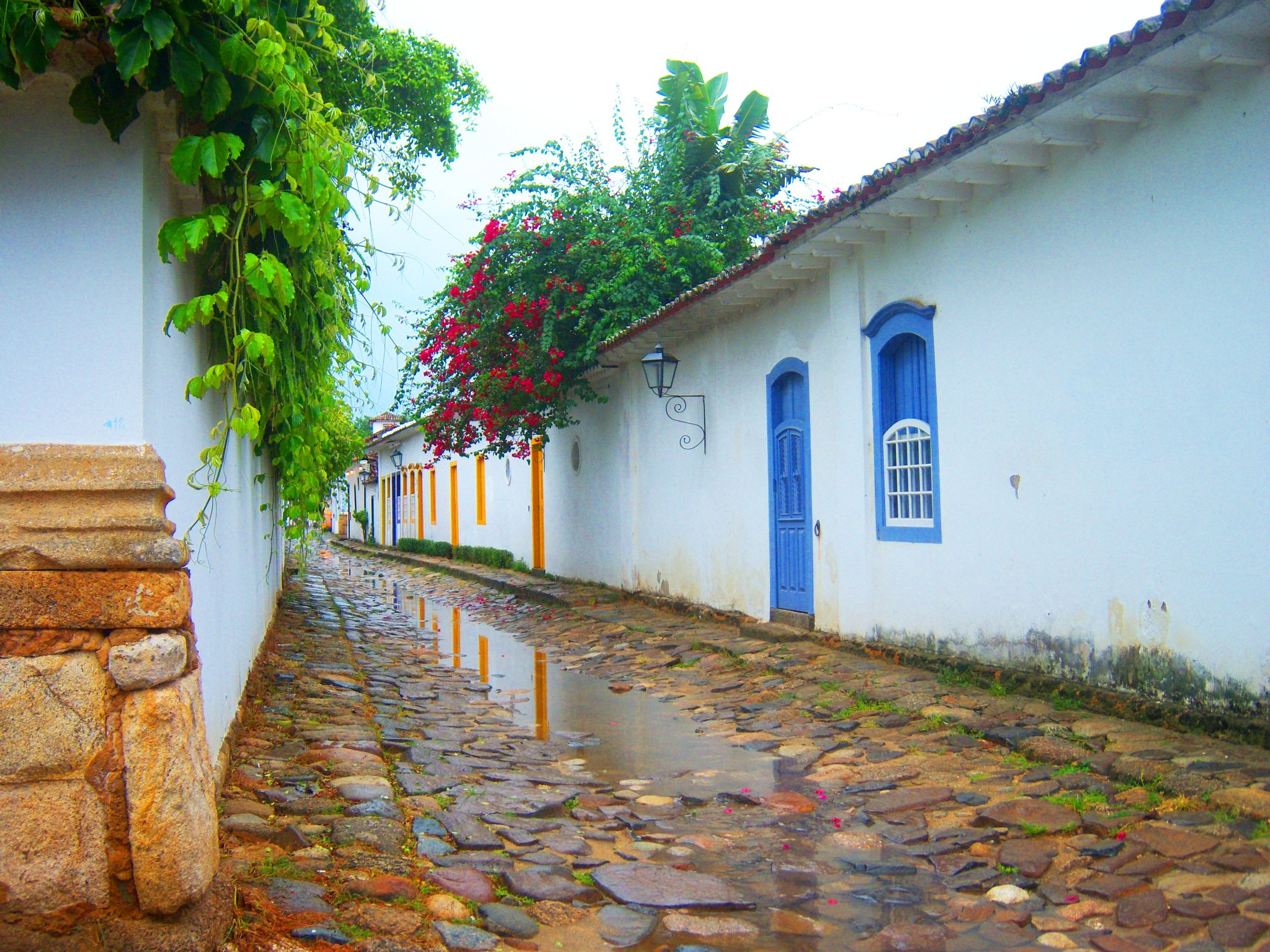
Here's the thing first-timers underestimate: once you arrive, you barely use a car at all. Paraty's historic center is closed to vehicles. The old town's streets are paved with the irregular, lumpy stones the locals call "pé de moleque," and they were never built for cars — they were laid so that high tides flow in through gaps in the seawall and rinse the low streets clean before draining back out. Charming, functional, and completely impractical for driving. So the center is, simply, a walking town.
What that means in practice:
- Park at the edge and walk in. If you've driven or been driven, the car stops at the periphery of the old town. From there you're on foot. Bring flat, sturdy shoes — the cobblestones are genuinely uneven, and wheeled luggage fights them the whole way. Soft bags or a backpack beat a hard roller case here.
- Taxis and ride-hail handle the trips the old town doesn't — to and from the bus terminal, out to the waterfall neighborhoods, to Trindade and other beaches down the coast. They can't take you into the historic center, but they'll get you to its edge.
- Jeep tours are the standard way to reach the inland attractions — the waterfalls and cachaça distilleries up the Paraty–Cunha road. They bundle transport and stops together, which saves you working out the back roads yourself. (For the full rundown, see our guide to Paraty's waterfalls.)
- Most of the real sightseeing is by boat. This is the big one. The bay holds something like 65 islands and around 300 beaches, and the great majority are reachable only by water. The classic schooner tours leave from the town pier; private speedboats (lanchas) do faster, custom trips. If you came to Paraty for the islands and beaches — and most people do — your "transport" once you're here is mostly a boat. Our boat guide covers how that works.
So the mild irony of getting to Paraty is that you spend a long day arranging cars and roads to reach a place where you then put the car keys away and travel on foot and by boat. Plan for that. You need a way to Paraty; you mostly don't need one within it.

When traffic and roads are worst
Paraty is small, and the Rio–Santos is two lanes. Put a national holiday's worth of cars on it and things slow down. If you can choose your dates, knowing the busy windows helps you either avoid them or plan around them. There are a handful of predictable crunch periods.
The Brazilian summer holidays (roughly mid-December through February) are the big one. School's out, the coast fills up, and the same heavy summer rains that swell the crowds also raise the landslide risk on the highway. Travel times stretch, the bus sells out, and the town is at its busiest. It's a wonderful, lively time to be in Paraty — just go in with a transfer booked, a buffer in your schedule, and a backup plan if the forecast turns.
Carnival (the dates shift each year, falling in February or early March) is its own surge. Paraty has a spirited Carnival, and the roads, accommodation, and buses all feel it. Book everything well ahead.
FLIP week — the Festa Literária Internacional de Paraty, the international literary festival held in early-to-mid July — is the other reliable peak. It's one of Latin America's most famous literary events and it packs the town. In 2026 it runs late July. If you're coming for FLIP, brilliant; if you're not, and you want a quieter Paraty, steer around that week.
The flip side of all this is the genuinely best time to come for an easy arrival: the shoulder months of April–May and September–October. The weather is drier, the road is at its most reliable, the crowds thin out, prices ease, and your four-hour drive is just four pleasant hours rather than a holiday-traffic slog. If your schedule is flexible and arrival logistics matter to you, aim there.
Good to know
Peak weeks affect more than traffic — accommodation, transfers, bus seats, and boat tours all book up and price up together during summer holidays, Carnival, and FLIP. The single best move for a smooth arrival is simply to lock in your second-leg transport (transfer or bus) at the same time you book your flights, rather than leaving it to sort out on the ground.
A sample door-to-door journey
To make all of this concrete, here's how a typical arrival actually unfolds — the common case of an international traveler flying into Rio and taking a private transfer down to Paraty.
- Land at Rio Galeão (GIG). You clear immigration and customs at Rio's international gateway. Aim, if you can, for a flight that gets you on the ground by early afternoon — that gives the drive plenty of daylight at the far end.
- Meet your driver. Your pre-arranged transfer is waiting in arrivals, name on a sign. Luggage in the car, and you're moving within minutes of clearing the airport — no taxi queue, no figuring out the route.
- Out of the city. The first stretch gets you clear of Rio and onto the Rio–Santos. Once the highway opens up along the coast, the view turns to forest on one side and water on the other.
- A stop around the midpoint. Roughly halfway, near Angra dos Reis, is the natural place to pause — stretch your legs, grab a coffee or a snack, use a proper bathroom. Then back on the road.
- Arrive in Paraty. About three and a half to four hours after leaving the airport, you reach town. The car takes you as close to your door as the car-free old town allows — to the edge of the historic center, or straight to your villa if it's outside the pedestrian zone.
- Switch off. You're there by late afternoon or early evening, in daylight, with time to settle in. Total elapsed time from wheels-down to your room: comfortably under five hours, most of it spent watching one of Brazil's best coastlines slide past the window.
That's the easy version, and it's the one most guests experience. Swap the transfer for the bus and you add a city hop to the Novo Rio terminal and a taxi at the Paraty end. Swap it for the air taxi and you compress the middle into a short flight. The bones are the same: a flight to a major airport, a leg down the coast, and a town worth every minute of it at the end. If you'd like the whole second leg handled before you land, that's the sort of thing the villa team can set up — but however you do it, the route is straightforward once you've read it through once.

Common questions
Can I fly directly to Paraty?
No. There are no scheduled commercial flights to Paraty. The town's airport (JPY) handles general aviation only — private planes and air-taxi charters on a short runway suited to light aircraft. To reach Paraty you fly into a major airport in Rio or São Paulo and travel the rest of the way by road, or charter a light plane into JPY.
Which airport should I use?
If you're arriving from abroad, fly into Rio de Janeiro / Galeão (GIG) — it's the main international gateway and usually gives the shortest drive to Paraty, around three and a half hours. Rio's Santos Dumont (SDU) and São Paulo's Guarulhos (GRU) and Congonhas (CGH) all work too, but they typically involve a domestic connection or a longer drive. Use whichever your flights land at most cheaply and conveniently; don't reroute just to shave a few kilometers.
How long does the drive from Rio take?
Plan on roughly three and a half to four hours from the Rio airports in normal conditions — and treat that as a range, not a promise. Heavy traffic on holiday weekends, slow trucks on the mountain curves, or rain can push it past five hours. The intercity bus, which stops more, runs around four and a half hours.
Is it safe to drive the road myself?
Yes, for a confident driver in good conditions. The Rio–Santos (BR-101) is scenic but curvy and shared with trucks. The key cautions: don't drive it at night, slow down for fog and rain, keep your fuel topped up, and overtake only with clear sightlines. Many travelers prefer a private transfer precisely so they can enjoy the view instead of negotiating an unfamiliar mountain road after a long flight.
What happens in the rainy season — can the road close?
It can. Heavy rain, worst from December through March, can trigger landslides that close or slow the Rio–Santos. It doesn't happen on every trip, but it's a real, recurring risk. If you're traveling in summer on a tight schedule, build in buffer time and keep the air-taxi option in mind — a light plane into JPY simply flies over a blocked road, weather permitting.
Do I need a car once I'm in Paraty?
Mostly no. The historic center is closed to cars — you park at the edge and walk its cobblestone streets, so bring flat, sturdy shoes. Taxis and jeep tours cover the inland waterfalls and nearby beaches, and most of the real sightseeing happens by boat out among the bay's islands. You need solid transport to Paraty; you rarely need your own wheels in it.
Sources & further reading
- UNESCO World Heritage List — Paraty and Ilha Grande: Culture and Biodiversity (No. 1308)
- ICMBio — Brazilian protected areas, including Parque Nacional da Serra da Bocaina
- INPI — Brazil's National Institute of Industrial Property (cachaça Geographic Indication)
- CDC Travelers' Health — Brazil (check current vaccination and mosquito-precaution advice before you go)
More from the Journal
The Complete Guide to Paraty, Brazil
Everything you need for the Costa Verde's most beautiful town: the UNESCO old town, the waterfalls and trails, the islands and beaches, the cachaça, where to eat and stay, when to come — and exactly how to get here.

The Waterfalls of Paraty: A Complete Guide
From the natural rock-slide of the Tobogã to the jungle pools of the Pedra Branca valley — where to find Paraty's waterfalls, how to reach them, how to stay safe, and the cachaça distilleries hidden among them.

Hiking & Nature in Paraty: Trails, Parks & the Atlantic Forest
The colonial Gold Trail, the Serra da Bocaina National Park, the wild Juatinga reserve and the climb to the Sugarloaf of the Mamanguá — a complete guide to walking one of the planet's richest forests.

Stay at Amorielli.
A villa with an infinity pool, a private waterfall, and the kind of view people travel a long way to find. Join the waitlist to book the first season.