At a glance
- Base
- Base in the old walled Medina, the modern city (Gueliz/Hivernage), or the palm groves (Palmeraie).
- When
- Spring and fall (March-May, Sept-Nov) for warm days; summer is hot; winter (Dec-Feb) has mild days, cold nights.
- Getting there
- Fly into Marrakech Menara Airport (RAK); prearranged transfer, petit taxi, or airport bus (Line 19).
- Getting around
- Medina is walkable; taxis for Gueliz/Hivernage/Palmeraie; motorbikes in alleys; hired driver for mountains.
- Book ahead
- Timed ticket for Jardin Majorelle; prearranged airport transfer, confirm riad meeting point.
- The price
- Spring and fall are busier, pricier months.
Marrakech rewards a decision most visitors make by accident: where to sleep. The city is really several places at once. There is the walled old town where a car cannot reach your door. There is a grid of modern avenues the French laid out a century ago. And there is a belt of palm groves north of the center where villas sit behind long walls. Where you base yourself shapes the trip more than any single monument will.
This guide is about making that choice well, then using the city once you are in it. What a riad actually is and how to read past the listing photos. When to come and how to handle the heat. How to get in from the airport. What to do in town, how to spend a day in the mountains, where to eat, and the small things that trip people up: dress, cash, and the men who will offer to guide you whether you asked or not.
In this guide
Where to base yourself
The choice usually comes down to three areas, and they feel nothing alike.
- The medina is the old walled city, a UNESCO-listed warren of lanes around the main square, Jemaa el-Fnaa. Staying here almost always means a riad, a courtyard house down an alley. You wake to the call to prayer and fall asleep to motorbikes. You are steps from the souks. And no car will reach your door.
- Gueliz and Hivernage are the modern city, just west of the walls. Gueliz is the new town the French built: wide avenues, sidewalk cafes, galleries, shops with fixed prices. Hivernage, next door, holds many of the larger hotels on quiet, tree-lined streets. Here you get an elevator, a real pool, dependable Wi-Fi, and a short taxi ride to the old city.
- The Palmeraie is a palm grove several miles north of the center, where resort hotels and rental villas sit behind walls with their own gardens and pools. It is calm and green and good for families or a slower pace. The trade-off is simple: you will drive or taxi for everything.
There is no wrong answer here, only a fit. First-time visitors who want the city in their bones tend to choose a riad and accept the noise. Travelers who want space, quiet, and a pool long enough to swim in choose Gueliz, Hivernage, or the Palmeraie and accept the taxis.
Where you sleep in Marrakech decides what the city becomes. A riad drops you inside the old town's rhythm and its clamor. A hotel in Gueliz gives you distance, quiet, and a pool. Neither is the mistake. Choosing without knowing the difference is.
| Area | Feels like | Best for | Trade-off |
|---|---|---|---|
| Medina (riads) | Old walled city, lanes, courtyards | Atmosphere, walking to the souks and square | Noise; cars can't reach the door |
| Gueliz / Hivernage | Modern avenues and hotels | Comfort, pools, Wi-Fi, nightlife, easy arrivals | A taxi ride from the old city |
| Palmeraie | Walled villas in a palm grove | Families, quiet, resort days | You drive for everything |
What a riad is, and how to pick one
A riad is a traditional Moroccan house built around an interior courtyard. The word comes from the Arabic for garden, and the garden is the point. Instead of facing the street, the house turns inward: rooms wrap around a central patio open to the sky, usually with a fountain, some citrus trees, and often a small plunge pool. In the close heat of the medina, that inward design was a way to hold on to privacy and cool air. From the lane outside, a riad can look like a plain wall and a single door. Inside, it opens up.
Most riads are small, a handful of rooms, though some owners have knocked several houses together into larger boutique hotels. That intimacy is the appeal and the catch: service is personal, but there is no lobby, no gym, and often no elevator. A few things separate a good riad stay from a frustrating one.
- Distance from Jemaa el-Fnaa. A riad five minutes' walk from the square is a different animal from one twenty-five minutes deep in the lanes, however similar the photos look. Check the walking time, not just the neighborhood.
- The rooftop terrace. In the medina, the roof is where the best hours happen: breakfast as the city wakes, mint tea at dusk, dinner under the sky. Compare terraces closely.
- What "pool" means. A riad pool is almost always a small courtyard plunge pool for cooling off, not for laps. If you want a real pool, look to Hivernage or the Palmeraie.
- Wi-Fi. Thick old walls block signals, and connections in the medina can be patchy. If you need to work, ask before booking.
- The arrival. Since cars can't reach most riad doors, good ones send someone to meet you at the nearest lane a vehicle can reach. Confirm this in advance.
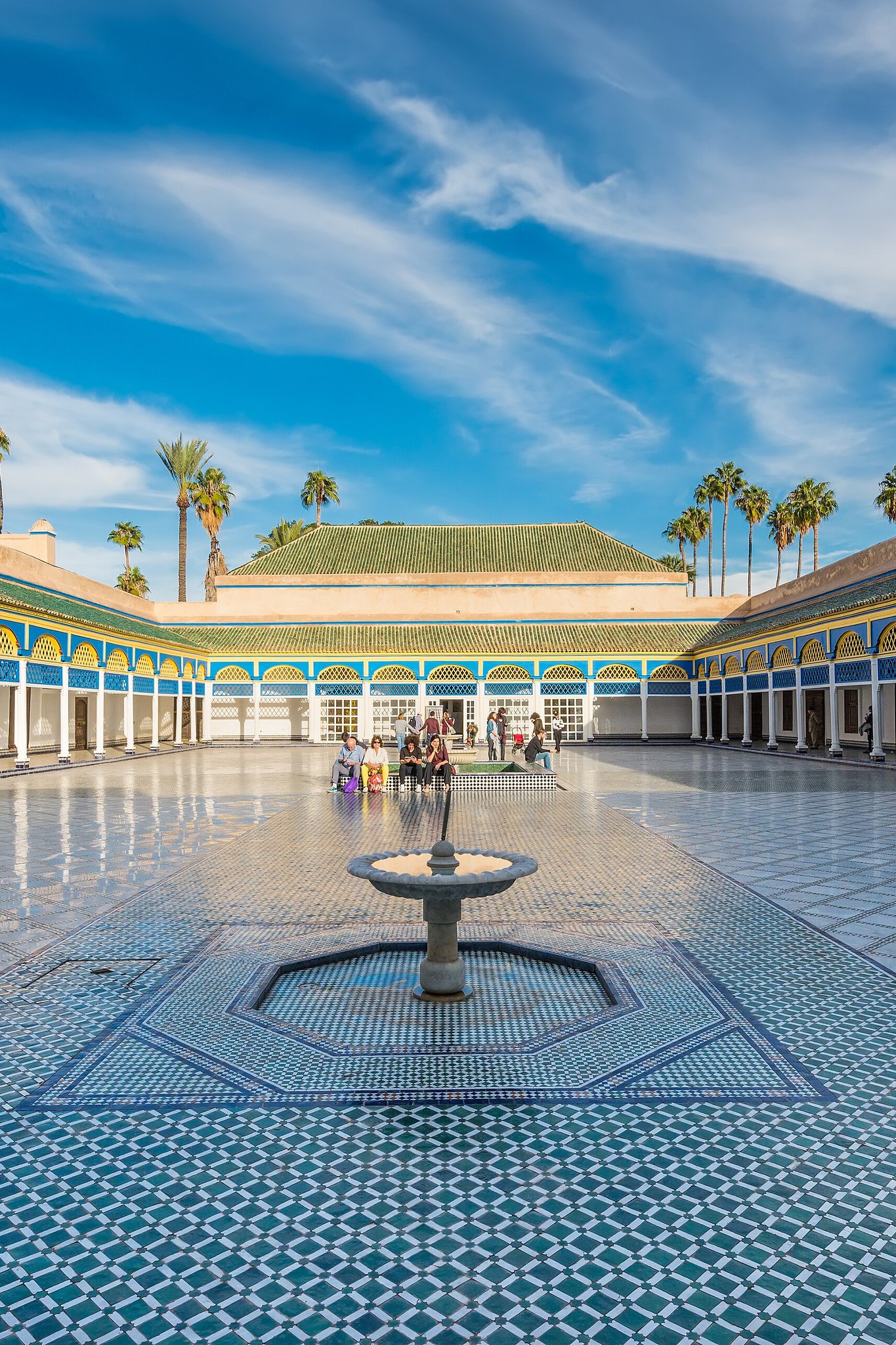
Bahia Palace large court · Val Traveler · CC BY-SA 4.0 · cropped
When to go, and the heat
Spring and fall are the clear best windows. March through May and September through November bring warm days and cool evenings, the kind of weather that makes the medina and the mountains both comfortable. These are also the busier, pricier months, for exactly that reason.
Summer is the thing to understand before you book. July and August are genuinely hot. Afternoons regularly climb past 100°F (about 38°C) and can go higher. You can travel then, but you will plan around the heat: sights in the early morning, a long midday pause, life returning after dark. Winter flips it. December through February brings mild, pleasant days and cold nights, some rain, and snow on the High Atlas peaks you can see from town. Pack a warm layer for winter evenings, because riad courtyards hold the chill.
One more thing to check: the dates of Ramadan, which shift about eleven days earlier each year. During the fasting month the city runs on a different clock. Some restaurants close during daylight, days are quiet, and evenings come alive after the fast breaks. It can be a rewarding time to visit if you arrive knowing the rhythm.
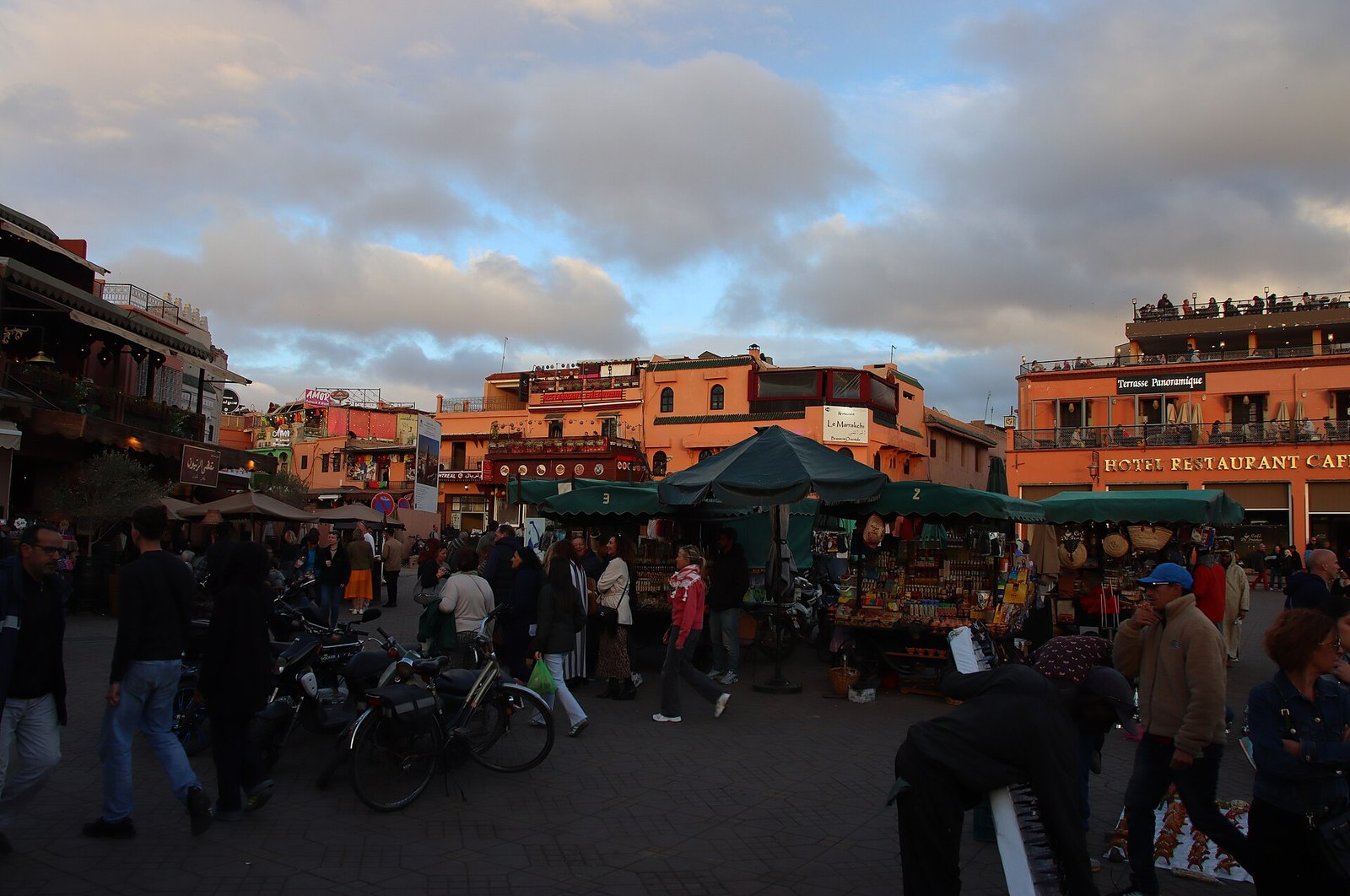
Džma el Fna, Marrákeš, 2025 (01) · Draceane · CC BY-SA 4.0 · cropped
Getting there and getting in
Almost everyone flies into Marrakech Menara Airport (airport code RAK), a short hop from the center: roughly four to five miles, usually 15 to 30 minutes by road depending on traffic and where you are staying. Getting from the terminal to your bed takes a little thought, mostly because of the medina's geography.
- A prearranged transfer through your riad or hotel is the easiest option, and for a medina riad it is close to essential. The driver knows the drop point, and staff meet you there to walk you in.
- Petit taxis wait outside the terminal. Agree on the fare before you get in rather than assuming a meter, and know that late-night rides carry a surcharge.
- The airport bus (Line 19 at the time of writing) runs between the airport and stops including Jemaa el-Fnaa, an inexpensive option if you are traveling light.
Here is the part that surprises first-timers: your riad's street address is often useless to a driver, because cars physically cannot enter the lanes. You are dropped at the nearest vehicle point and either met by staff or walked in by a porter with a cart for your bags. This is normal. Arrange it ahead of time and the whole thing is smooth.
Good to know
Before you arrive, ask your riad exactly where the car drops you and whether someone will meet you there. Cars can't reach most medina doors, and the last few hundred yards run through unmarked lanes. A porter with a cart will usually carry your bags in for a small tip. Have some dirham in cash on hand for that first walk-in. You won't want to be hunting for an ATM with your luggage.
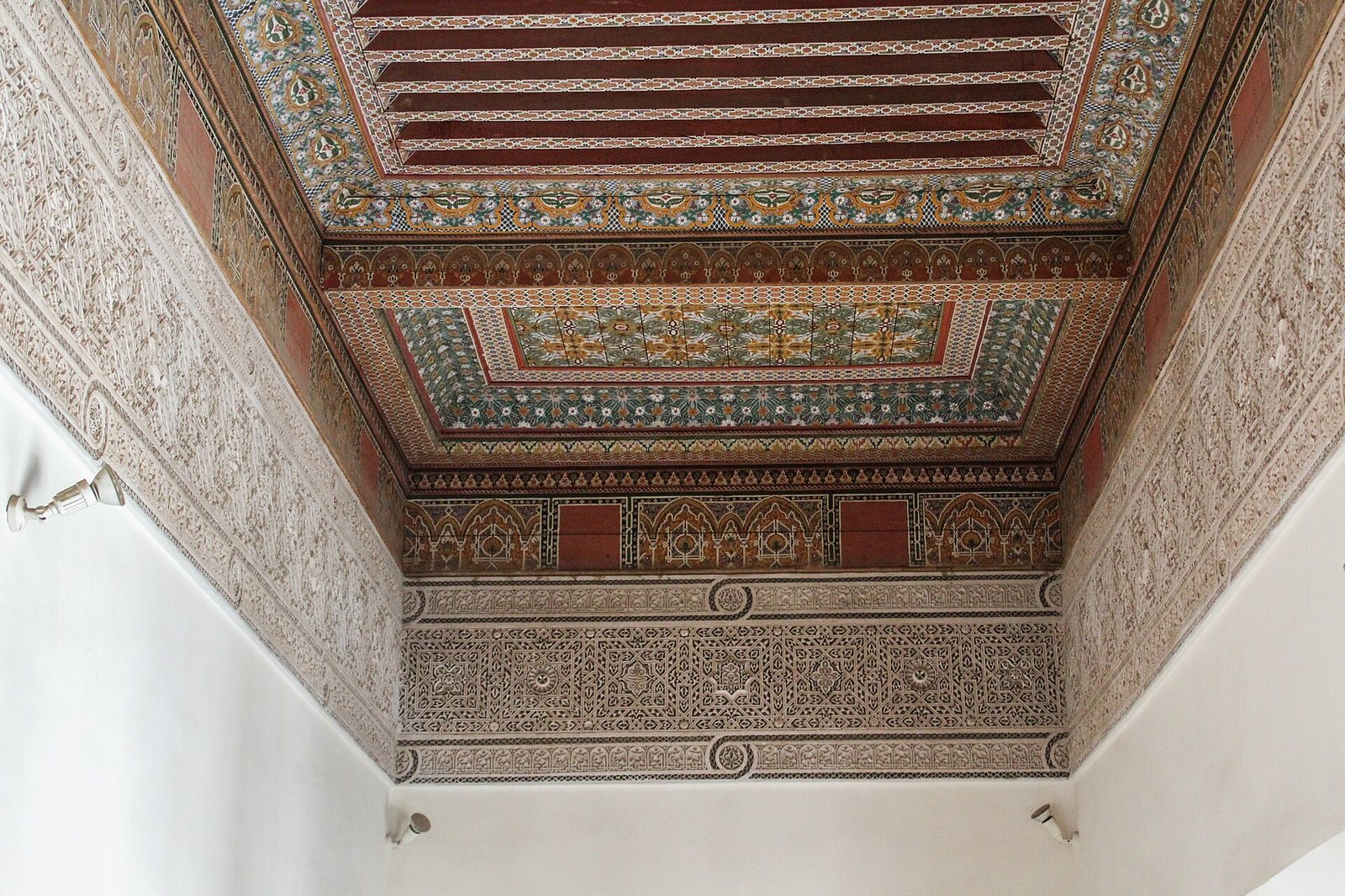
Bahia Palace 12 · Stolbovsky · CC BY-SA 4.0 · cropped
What to do in the city
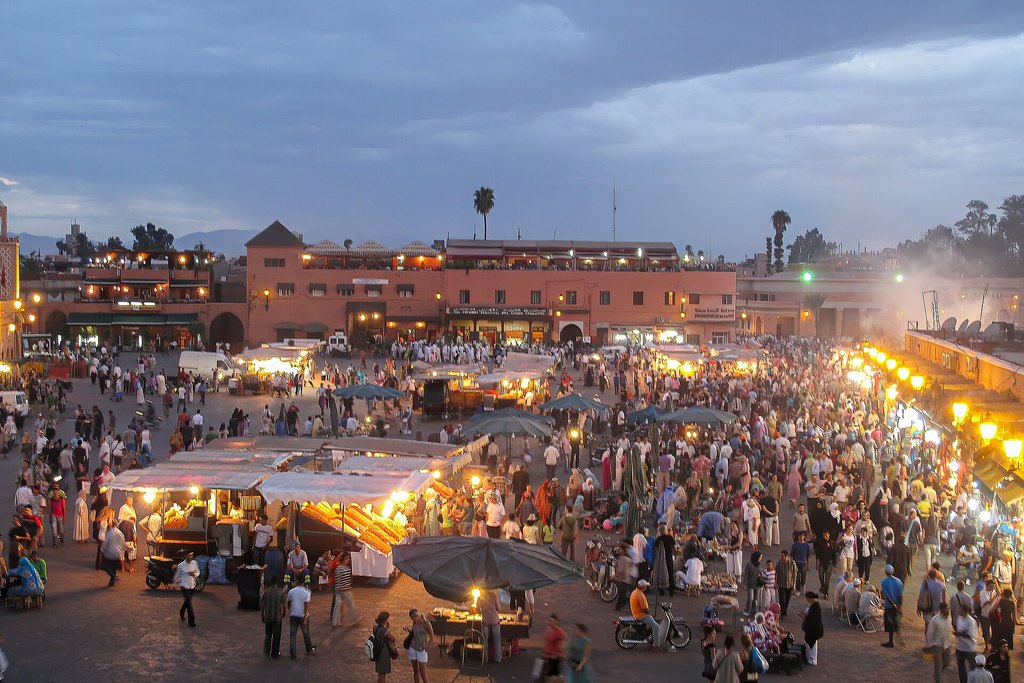
The center of gravity is Jemaa el-Fnaa, the great square at the edge of the souks. By day it is orange-juice carts, henna artists, and snake charmers working the crowd. After sunset it fills with food stalls and rings of people around musicians and storytellers. The tradition here is old enough that UNESCO recognizes it. Treat the daytime performers as paid acts: if you photograph a snake charmer or a monkey handler, expect to be asked for money, and if that bothers you, keep your camera down.
From the square, the souks spread north in a tangle of covered lanes, loosely sorted by trade: leather here, lamps and metalwork there, then carpets, slippers, spices, and dyed wool. Prices are not fixed. Bargaining is expected and, done with good humor, part of the fun. Walk in without a fixed agenda and let yourself get a little lost. You can always aim back toward the Koutoubia Mosque, whose minaret is the tallest thing around and a reliable compass. Non-Muslims cannot enter the mosque, but it anchors the skyline.
For quieter hours, the monuments deliver.
- Bahia Palace, a late-19th-century palace of painted cedar ceilings and tiled courtyards.
- Ben Youssef Madrasa, a former Islamic college with some of the finest carved and tiled work in the city, reopened after a long restoration.
- The Saadian Tombs, a 16th-century royal burial ground sealed for centuries and rediscovered in the 20th.
- Le Jardin Secret, a restored garden and riad complex in the heart of the medina, good for a pause off the lanes.
Just outside the walls toward Gueliz is the Jardin Majorelle, the cobalt-blue garden the French painter Jacques Majorelle built in the 1920s and 1930s, later bought and restored by Yves Saint Laurent and Pierre Berge. It is small and extremely popular, so book a timed ticket and go early. The same grounds hold a museum of Amazigh (Berber) culture, and the Musee Yves Saint Laurent Marrakech stands next door.
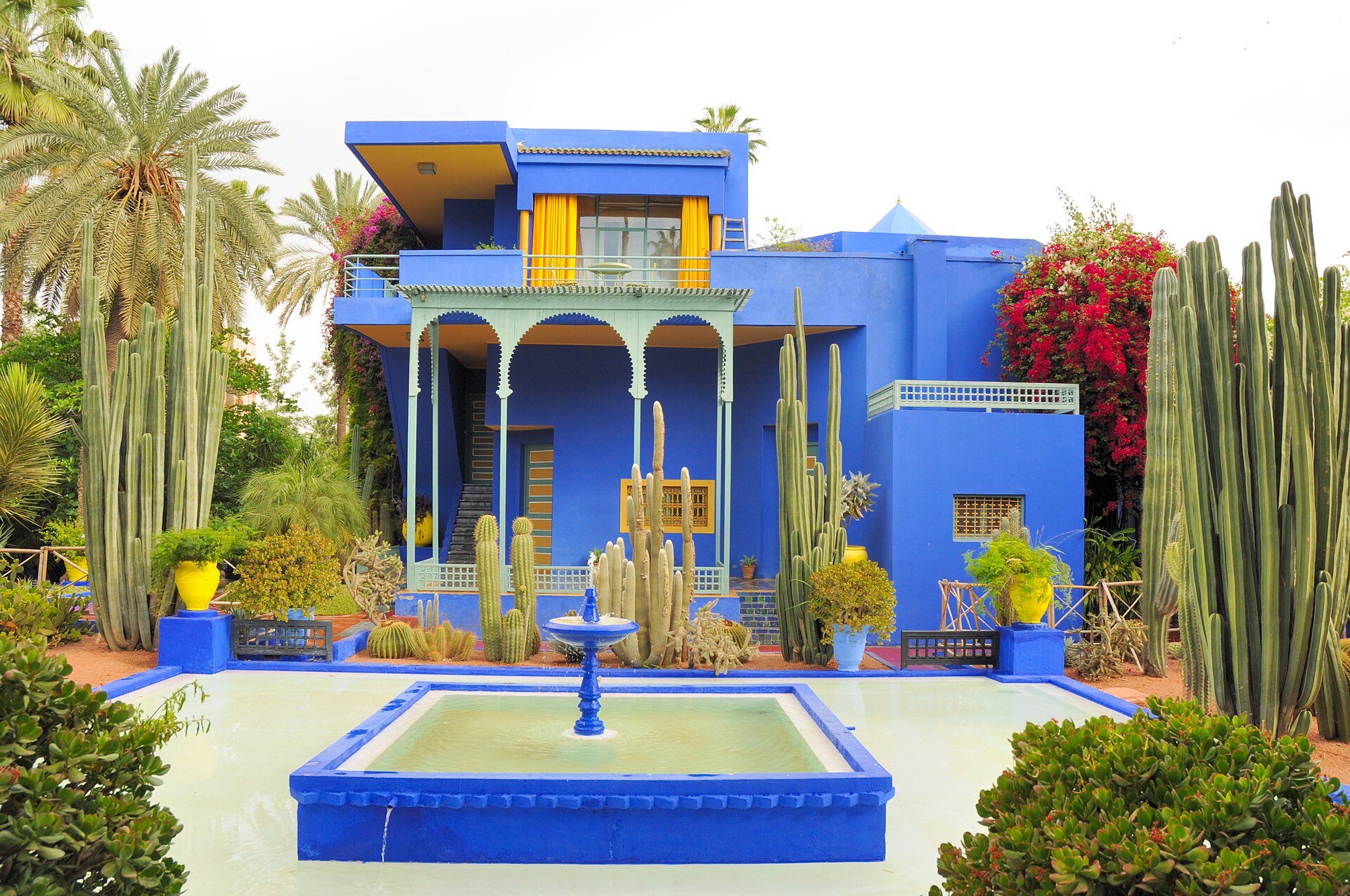
Le jardin des majorelle l5 · Viault · CC BY-SA 4.0 · cropped
A day in the mountains
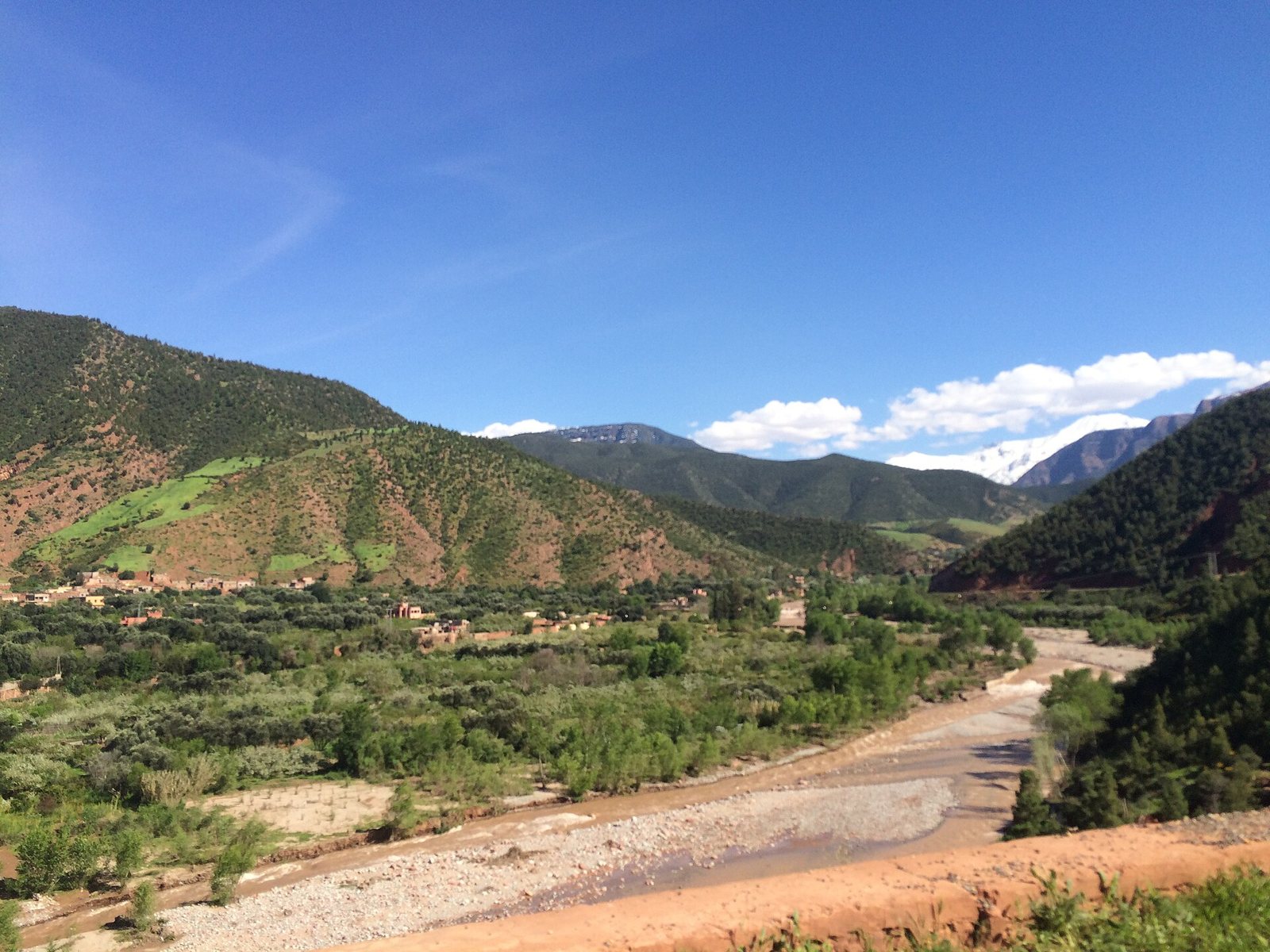
Marrakech sits on a plain with the High Atlas mountains rising to the south, close enough that a day trip is easy and worth building into any stay longer than a couple of days. The nearest and simplest is the Ourika Valley, a river valley of Amazigh villages and terraced fields about an hour or so out of town, with a walk up to the Setti Fatma waterfalls at the end of the road. It is green, cooler than the city, and a fast reset.
For real mountains, Imlil is the gateway village to Mount Toubkal, the highest peak in North Africa. You can drive up for lunch and a short walk, or use it as a trailhead for something longer. Closer to town, the Agafay desert is a stretch of rocky, treeless hills, not sand dunes, popular for sunset dinners and camel or quad rides within an easy drive. Farther afield, the Ouzoud waterfalls make a long but rewarding full day. A hired driver or a small-group tour handles the logistics. Roads are winding, so budget more time than the distance suggests.
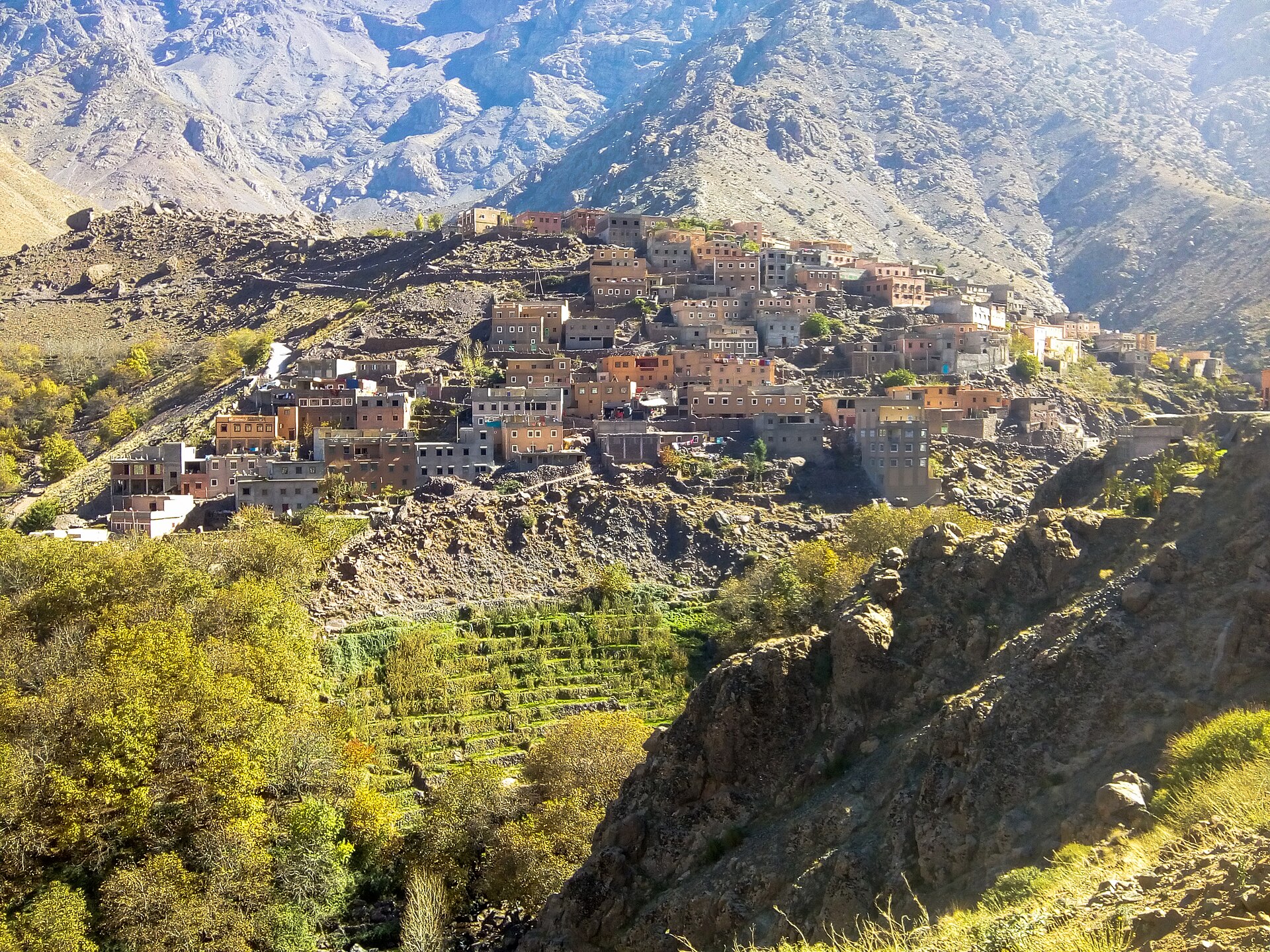
Imlil village, High Atlas Mountains · Mounir Neddi · CC BY-SA 4.0 · cropped
Where to eat
The dish you will meet most is the tagine, a slow-cooked stew (lamb with prunes, chicken with preserved lemon and olives, vegetables with warm spice) named for the conical clay pot it cooks in. Marrakech has a specialty of its own worth seeking out: tanjia, beef or lamb sealed in an urn-shaped pot with garlic, cumin, and preserved lemon and cooked for hours in the embers of a bathhouse furnace. It is traditionally a men's dish, slow and rich. Look also for mechoui, whole lamb roasted until it falls apart, sold by weight near the square, and for couscous, which many families eat on Fridays.
Eating well here spans a wide range. The food stalls that fill Jemaa el-Fnaa at night are an experience in themselves, all grilled meats, soups, and skewers at communal benches, though pick a busy stall with high turnover. Rooftop restaurants around the medina trade a view for a calmer meal. And Gueliz is where you find modern Moroccan cooking, international food, and licensed restaurants if you want wine or a cocktail, which are scarce inside the old town. Wherever you land, the meal tends to end the same way: sweet mint tea, poured from a height.
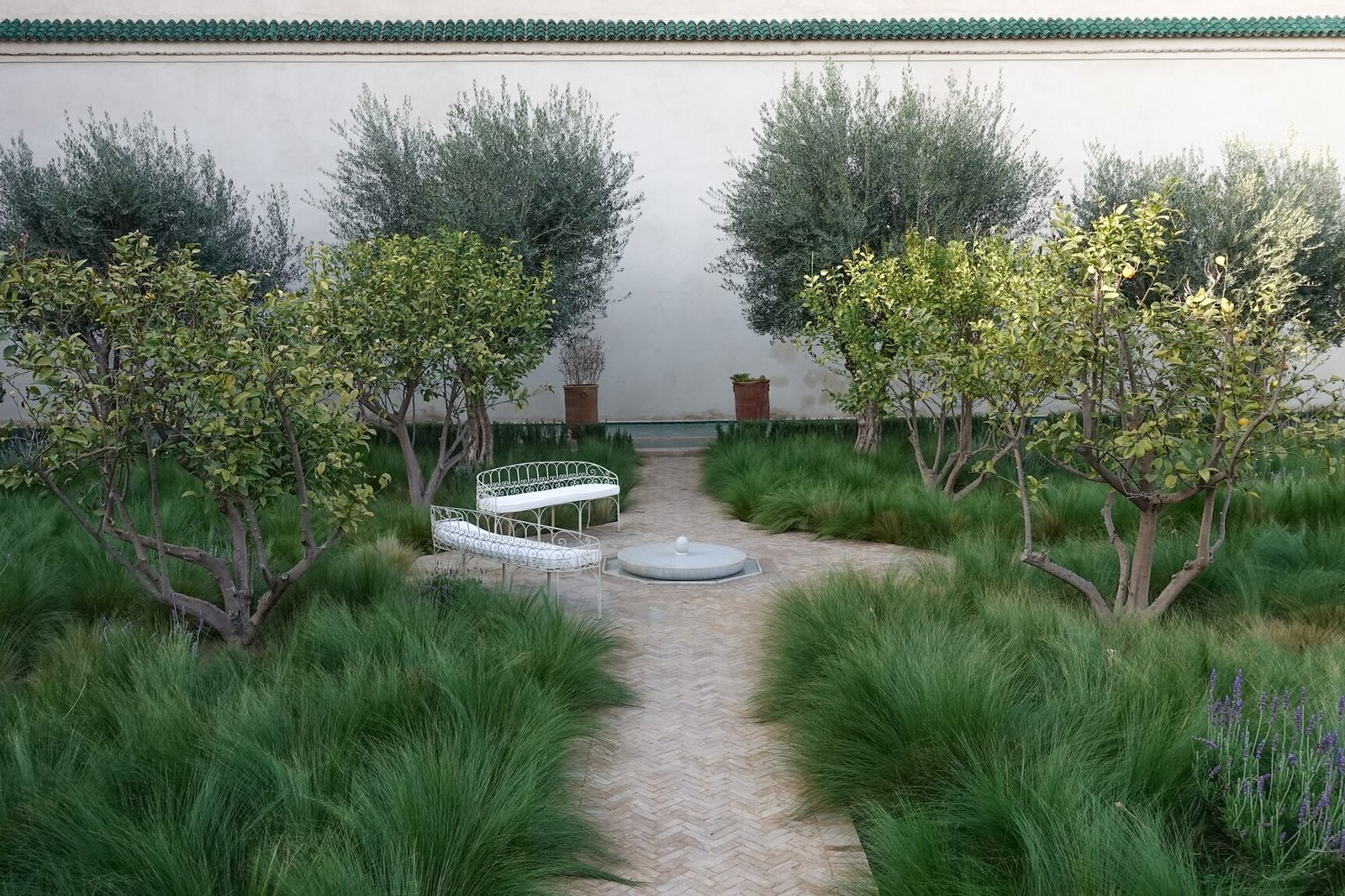
Le Jardin Secret Marrakech Morocco · Bernhard Holub · CC BY-SA 4.0 · cropped
Dress, cash, and faux guides
Morocco is a Muslim country, and a little modesty goes a long way, especially in the medina and at religious sites. For women that generally means covering the shoulders and knees. There is no need to cover your hair. Men are fine in long pants and sleeved shirts. Nobody expects visitors to dress traditionally. Just lean toward covered rather than bare, and you will feel more comfortable for it.
The other thing to prepare for is the faux guide: an unofficial guide, often a young man, who attaches himself to you with an offer to show the way, then either steers you to shops that pay him a commission or tells you a site is "closed" to redirect you. It is a persistent hustle, not usually a dangerous one. A firm, friendly "no thank you" and no eye contact is the standard response. Keep walking. If you want a guide, a licensed one arranged through your riad is worth it and removes the problem entirely.
- Cash. The currency is the dirham (MAD), and it is hard to get outside Morocco, so plan to withdraw from ATMs once you arrive. Many riads, stalls, and small restaurants take cash only, and small tips are part of daily life. Carry small bills.
- Getting lost. The medina is walkable, but the lanes twist and phone maps only half-work among the walls. Note a landmark near your riad, save its location offline, and don't be shy about doubling back. Watch constantly for motorbikes, which own the alleys.
- Water and pace. Stick to bottled water, and in warm months copy the locals: move in the morning and evening, rest through the worst of the afternoon.
- Rhythms. Friday is the main prayer day and runs a little slower. During Ramadan, daytime is quiet and the city comes alive at night.
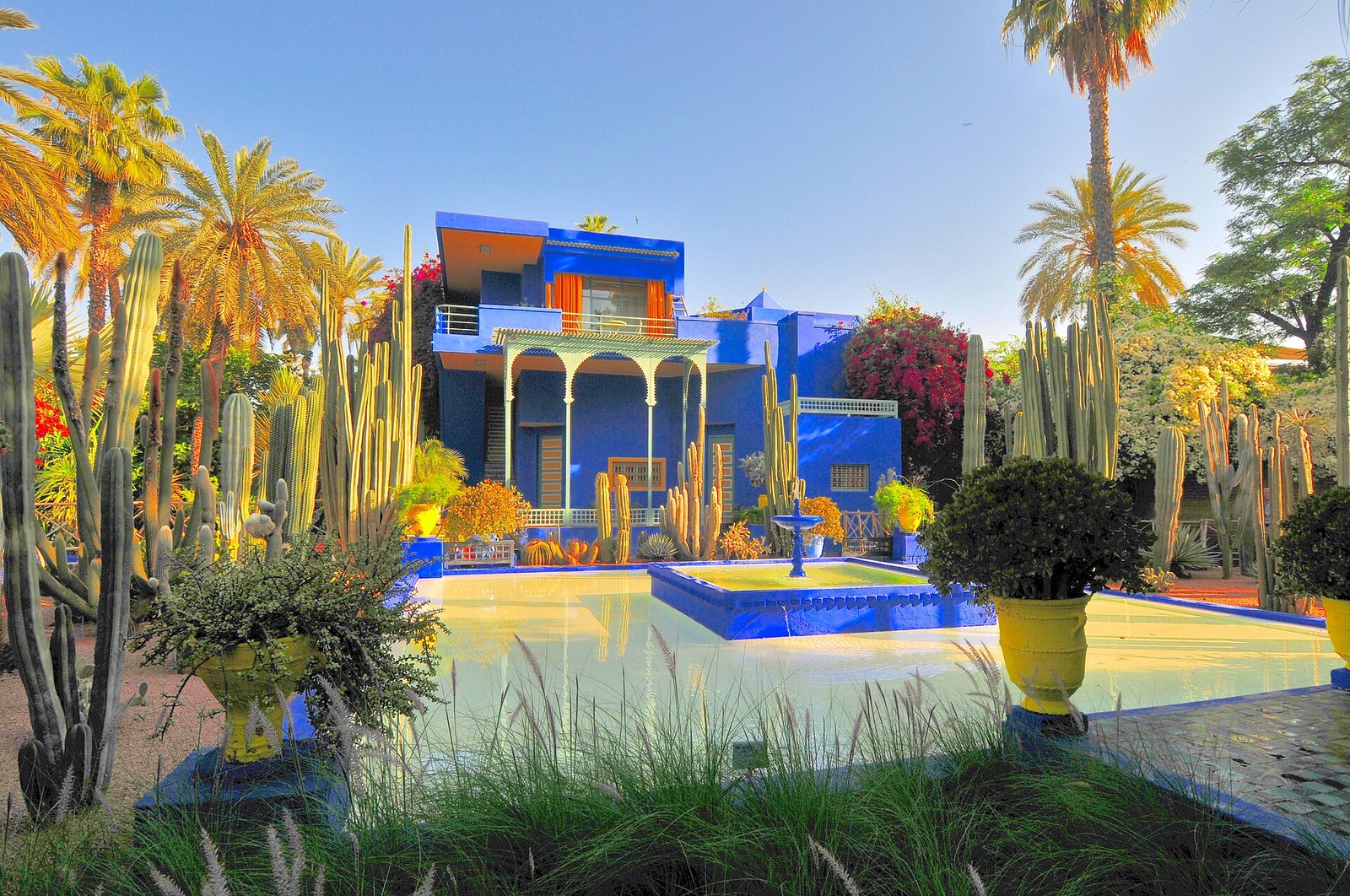
Le jardin des majorelle 21 · Viault · CC BY-SA 3.0 · cropped
By the numbers
Road to Ourika · Wimmiden · CC BY-SA 3.0 · cropped
Common questions
How many days do I need in Marrakech?
Three to four nights is a comfortable amount for a first visit, enough for the medina and its monuments, the Jardin Majorelle, a proper meal or two, and one full day in the Ourika Valley or the High Atlas. Add nights if you want a slower pace or a longer mountain or desert trip.
Is the medina safe to walk at night?
The main areas around Jemaa el-Fnaa and the busier lanes are generally lively and fine after dark, and plenty of people walk them. Use ordinary city sense: stick to streets with people and light, keep your bag close, and if the lanes near your riad are deserted and unlit, take a taxi to the nearest car point and have staff walk you in.
Do women need to cover their hair?
No. Covering your hair is not expected of visitors. Modest dress that covers the shoulders and knees is respectful and will make you more comfortable, particularly in the medina, but a headscarf is not required, except when entering an active mosque, which non-Muslims generally cannot do anyway.
Should I stay in a riad or a modern hotel?
If you want atmosphere and to walk into the souks from your door, choose a riad in the medina and accept the noise and the walk-in. If you want a real pool, an elevator, reliable Wi-Fi, and easy arrivals, choose Gueliz, Hivernage, or the Palmeraie and accept the taxi rides. Many people split the difference: a couple of nights in a riad, then a resort or villa to unwind.
Can I drink the tap water?
Most visitors stick to bottled water to be safe, and it is cheap and everywhere. Bring a filter bottle if you would rather cut down on plastic.