At a glance
- Base
- Caldera villages (Fira, Oia, Imerovigli, Firostefani) for views; inland villages or beach towns for value.
- When
- Late April into June and September into October for warm weather, swimmable sea, fewer crowds, lower prices.
- Getting there
- Fly to Santorini (Thira) Airport (JTR) from Athens or Europe; ferry from Piraeus (Athens) to Athinios port.
- Getting around
- Buses (hub in Fira), rental car (flexible for flat side), ATV, taxis (book ahead), cable car, Fira-Oia cliff walk.
- Book ahead
- Ferries and caldera-view rooms, especially cave suites, book months ahead for summer and peak season.
- The price
- Caldera views, private plunge pools, and Oia addresses drive up prices; July/August is the most expensive.
Santorini is really two places that happen to share a name. There is the caldera — the great curved cliff where the white villages spill down toward the water, where the sunset photos come from, and where most of the money goes. And there is the back of the island: flatter, planted with vines, edged with black-sand beaches, and much quieter. Where you sleep decides which of the two you mostly experience.
This guide is for the reader trying to choose well rather than just book the first cave suite that shows up. We go through the villages one at a time, explain what you are actually paying for with a caldera-view room, sort out when to come so you are not sharing the cliff with four cruise ships, cover how to arrive by plane or ferry, and lay out what is worth your hours once you are on the ground.
In this guide
Two islands in one
Santorini is what is left after a volcano blew its top. A large eruption in the Late Bronze Age, roughly 3,600 years ago, collapsed the center of a round island and let the sea pour in. What remains is a crescent of land wrapped around a flooded crater — the caldera — with a couple of small, still-active volcanic islets, Nea Kameni and Palea Kameni, sitting in the middle of the water.
That history is the whole logic of the place. The western edge is a sheer cliff. The famous villages — Fira, Firostefani, Imerovigli, and Oia — line the top of it, looking down several hundred feet to the water and across to the volcano. The eastern and southern side is the outside of the old cone, so it slopes gently to sea level. That is where the vineyards grow, where the older inland villages sit, and where the black-sand beaches are. Ferries dock at Athinios on the west coast. The airport is over on the flat east side, near Kamari. Once you picture the crescent, the map makes sense.
Where to base: the caldera villages
For a first visit, most people want to wake up over the caldera, and that means one of four villages strung along the cliff. They sit close together — you can walk the whole rim from Fira to Oia — but they feel different.
- Fira is the capital and the hub. The island's buses radiate from here, and it has the most hotels, restaurants, bars, and shops. If it is your first time and you would rather not rent a car, Fira is the practical choice. The trade-off is that it is the busiest of the four and can feel crowded and commercial in high season.
- Firostefani is a ten-to-fifteen-minute walk north along the rim from Fira. Same caldera view, calmer streets, and you can still stroll into Fira for dinner. It is a sensible middle ground and often a little cheaper than the bigger names.
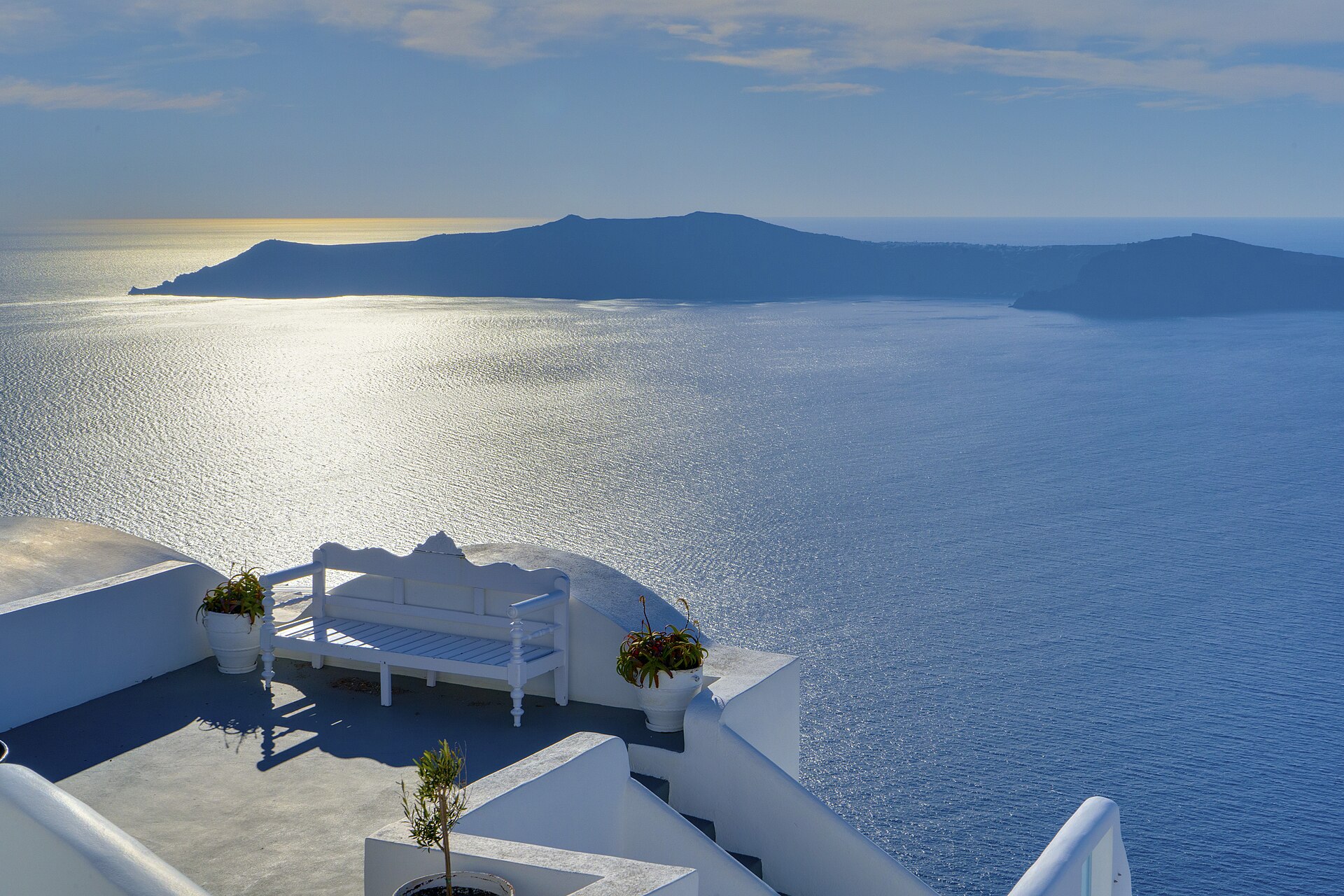
- Imerovigli sits at the highest point of the cliff and is the quietest of the four. It has the widest views, faces west, and many people think its sunset beats Oia's without the mob. Skaros Rock, a rocky headland that once held a fort, juts out below it. There are fewer restaurants, so plan to walk to Fira or drive.
- Oia is the postcard: the tumble of white houses, the blue domes, the sunset that ends up on every cover. It is also the most expensive and the most crowded, especially in the couple of hours around sunset. It is genuinely beautiful early in the morning, before the day-trippers arrive.
One thing to know: none of these four cliff villages has a beach. They are all clifftop. Swimming means a bus or a drive to the other side of the island, or a boat down at Ammoudi below Oia.
| Village | Feel | Views | Walk to Fira | Crowds | Best for |
|---|---|---|---|---|---|
| Fira | Busy, central | Caldera + volcano | — | Highest | First-timers, no car, nightlife |
| Firostefani | Calm, walkable | Caldera + volcano | 10–15 min | Moderate | Views with better value |
| Imerovigli | Quietest, upscale | Widest, strong sunset | 25–30 min | Lower | Couples, quiet, sunset |
| Oia | Iconic, priciest | Classic caldera + sunset | Bus or hike | Highest at sunset | The postcard, if budget allows |
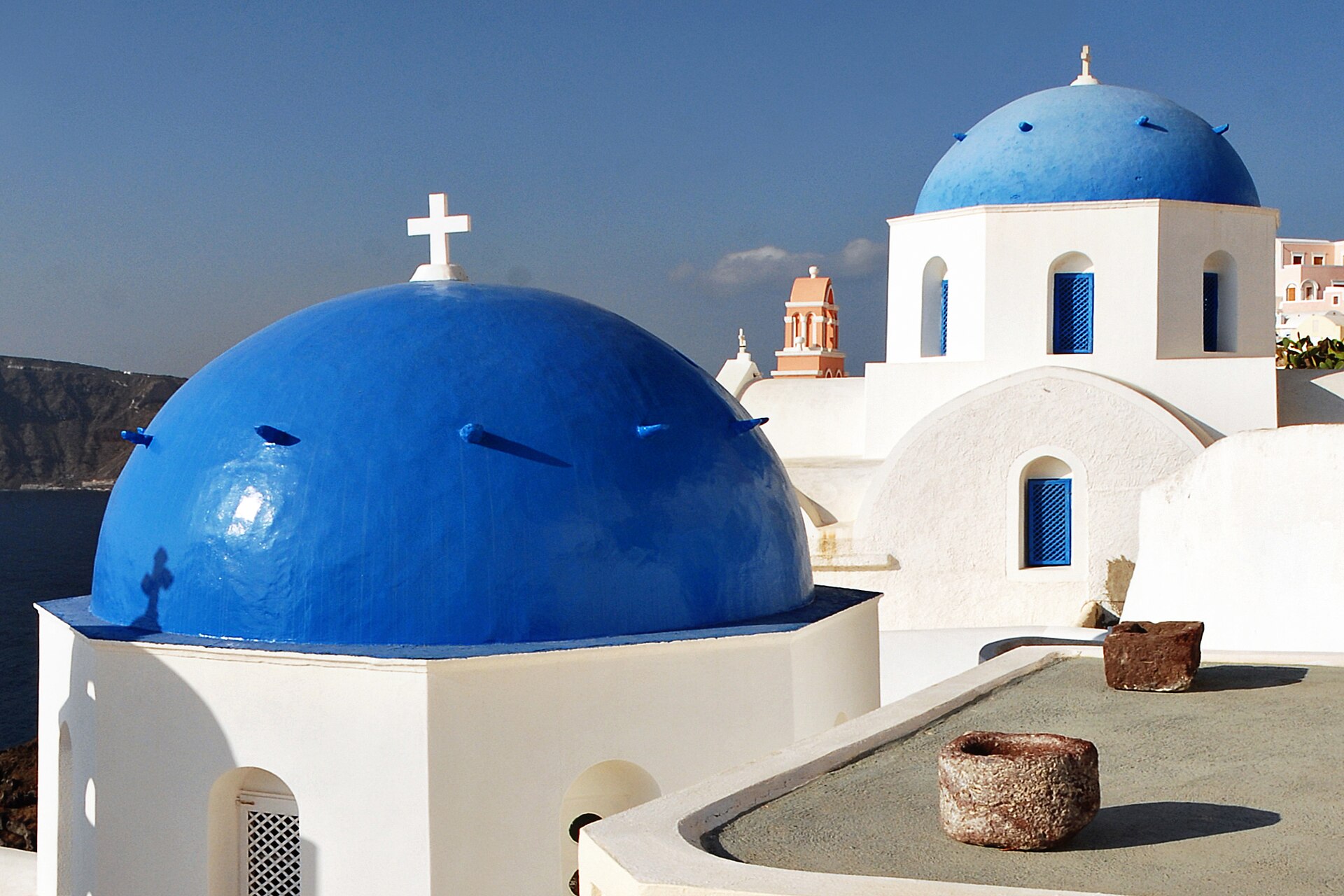
Reknown blue domes of the Church dedicated to St. Spirou in F… · Mstyslav Chernov · CC BY-SA 3.0 · cropped
The quieter side: Pyrgos, Megalochori, and the beaches
The caldera is not the only place to stay, and for some travelers it is not even the best one. The inland villages and the beach towns cost less, give you more room, and put you closer to the wineries and the sand. The price you pay is the view: you give up the caldera, and you will want a car, an ATV, or a bus habit.
- Pyrgos climbs a hill near the middle of the island around a Venetian-era fortress, the Kasteli. It is one of the highest points on Santorini, so the views run in every direction, and the lanes stay quiet even when Oia is packed. Climb to the top for a sunset with a fraction of the crowd.
- Megalochori is a small village with a square that still feels lived in, cave houses along narrow lanes, family wineries, and an old arched bell tower you can walk under. It made its money on Vinsanto, the sweet wine, and the wine culture is still close by.
- Emporio, the largest of the traditional villages, has a medieval Kasteli of tight, maze-like alleys built to slow down pirates. It sees few tourists relative to the caldera.
The beaches are on the southeast and south coasts, and the sand is black or dark red volcanic grit, not soft pale stuff. Kamari is the organized one — a long promenade of tavernas and cafes, water sports, sun beds, and a Blue Flag rating. Perissa, on the other side of the Mesa Vouno headland, is more low-key and popular with a younger crowd. Perivolos runs south from Perissa and is where the beach clubs and loungers are. Red Beach, near Akrotiri, is the dramatic one, backed by rust-red iron cliffs; it is small, it gets busy, and there have been rockfall warnings on the approach, so check current conditions before you scramble in.
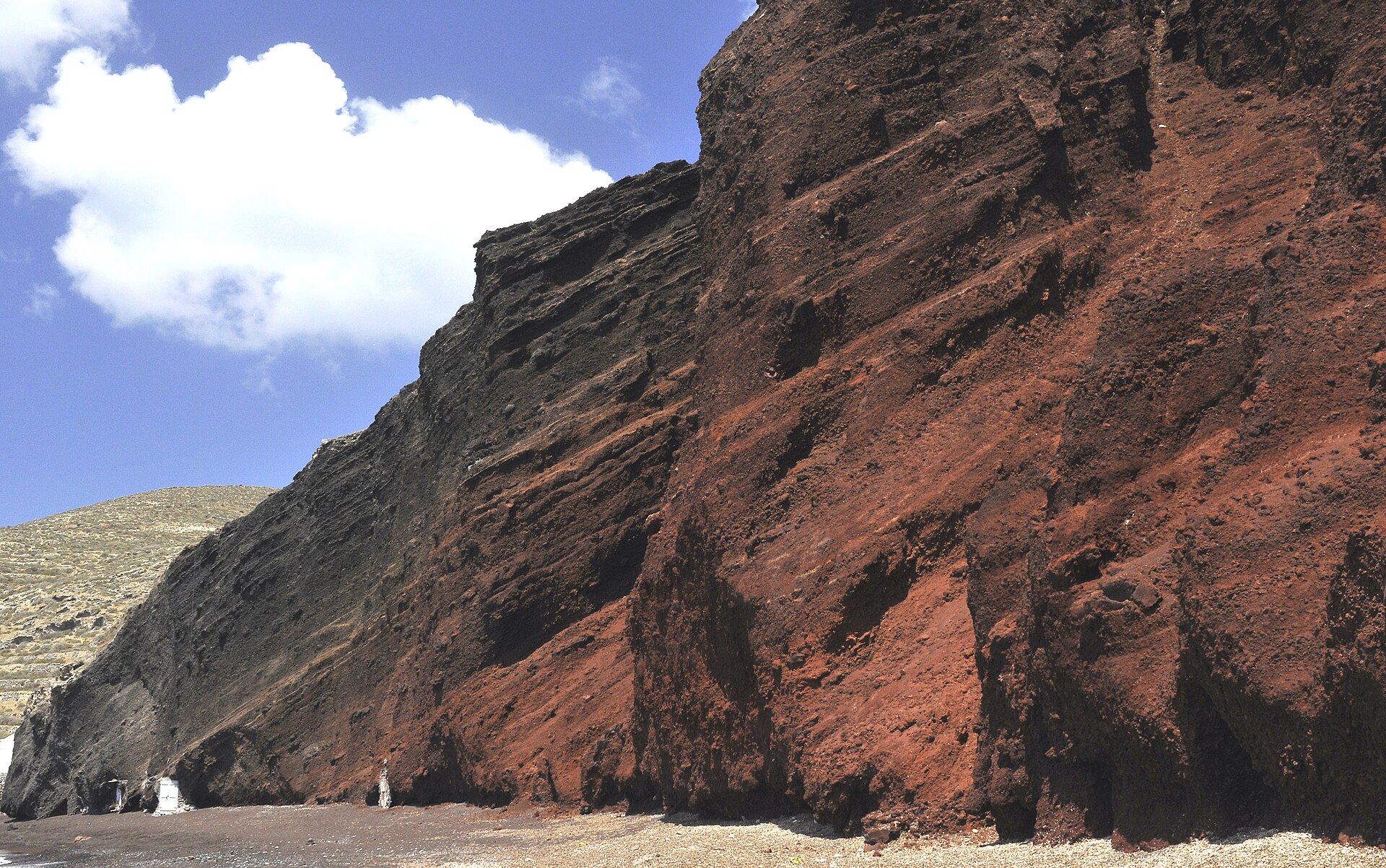
Santorini 91 · LBM1948 · CC BY-SA 4.0 · cropped
Cave houses and caldera-view stays
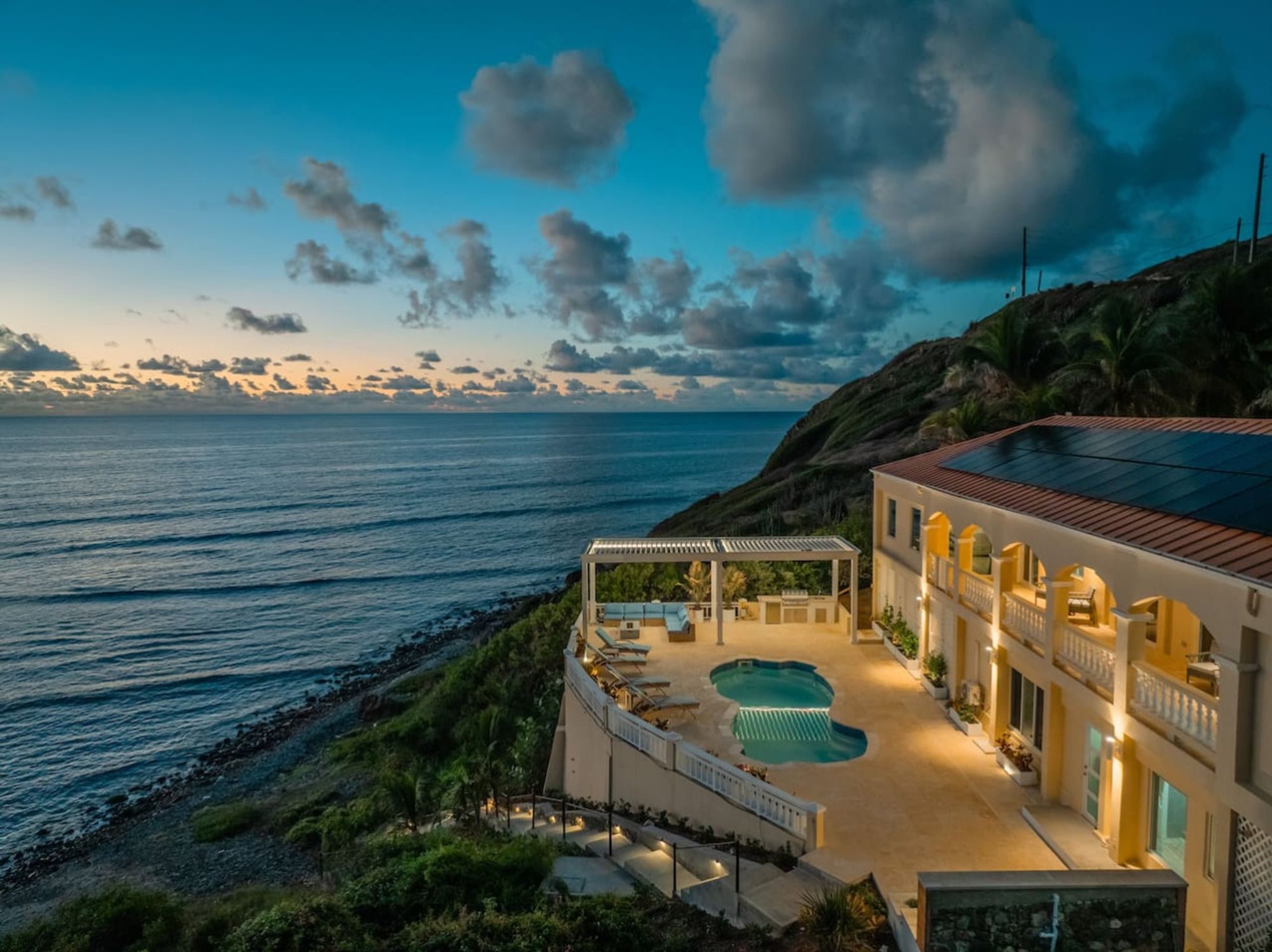
The stay Santorini is known for is the cave house. Locals carved homes and wine cellars straight into the soft volcanic rock of the cliff — barrel-vaulted rooms that stay cool in summer, called yposkafa. Many have been turned into hotels and suites. The look is now standard on the caldera: a whitewashed cave room dug into the cliff, a small private terrace, and often a plunge pool set right at the edge of the drop.
What you pay for comes down to a few things. A caldera view costs far more than a room facing the village or the flat side. A private plunge pool costs more than a shared one. An Oia address costs more than the same room in Firostefani or Imerovigli. So the range runs wide: simple guesthouses and no-view rooms on the flat side and in the beach towns at the low end; comfortable caldera-view studios in Fira and Firostefani in the middle; and the famous cliff-hanging cave suites with private pools in Oia and Imerovigli at the top, which book out months ahead for summer.
The most expensive word in a Santorini room listing is not 'pool' or 'cave.' It is 'caldera' — and plenty of rooms that hint at the view do not actually face the sunset, so read the compass, not the adjectives.
Two practical warnings before you book. First, a caldera view and a sunset view are not the same thing; some of the best cliff hotels look straight at the volcano but not at the point where the sun goes down, so confirm the orientation if the sunset matters to you. Second, cliffside means stairs — which brings us to the thing nobody mentions until they are dragging a suitcase down a hundred steps.
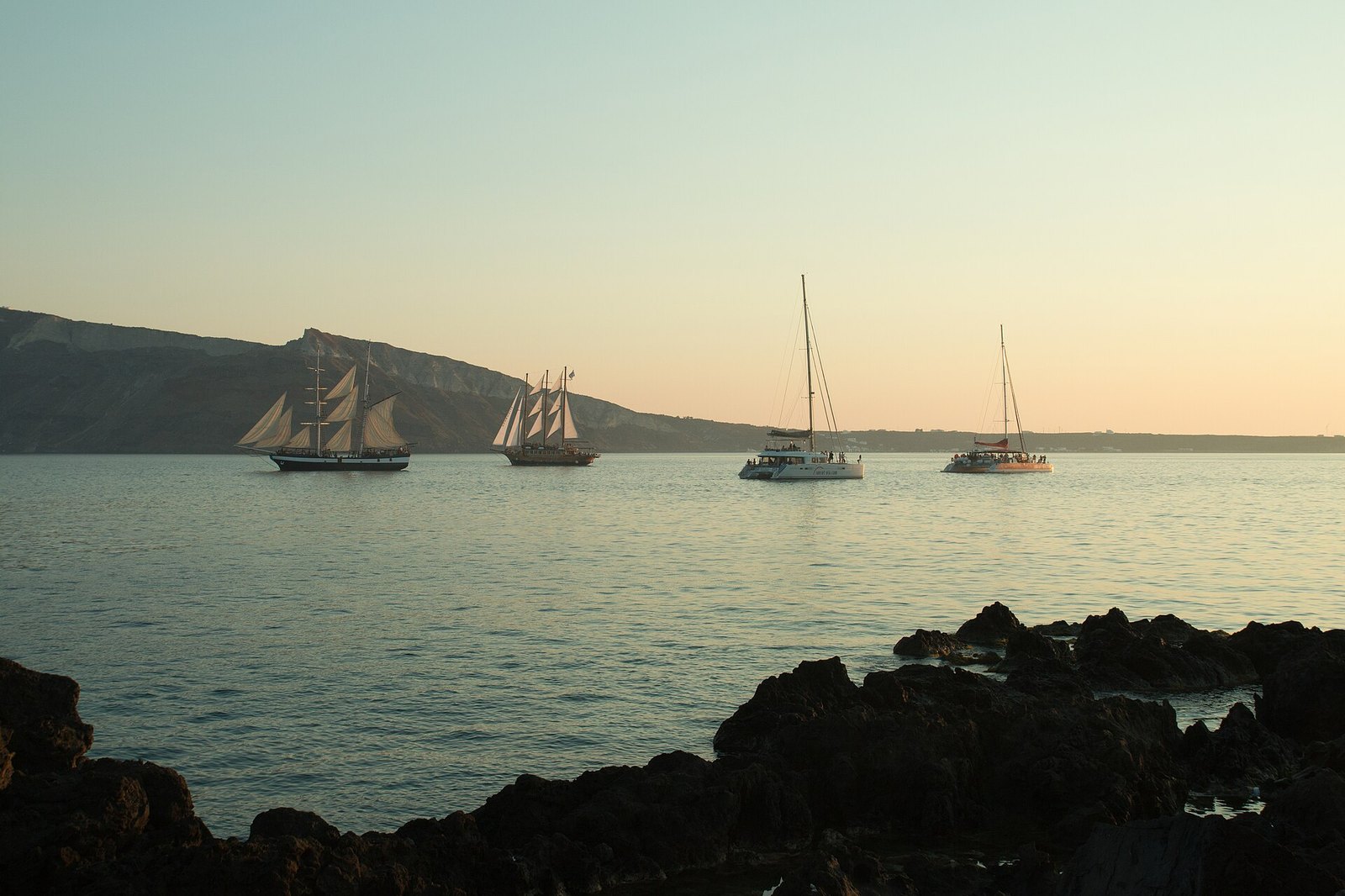
Ships in sunset, Ammoudi, Santorini, 176700 · Zde · CC BY-SA 4.0 · cropped
When to go, and how to dodge the crowds
Santorini has a short, intense season. The best windows are late April into June and again from September into October. In those months the weather is warm, the sea is swimmable by late spring and still warm in fall, almost everything is open, and the crowds and prices sit below peak. July and August are the hottest, busiest, and most expensive stretch, and August is the crunch. In winter the island is quiet and moody, but many caldera hotels and restaurants close, and boat schedules thin out.
The crowds are not spread evenly through the day, and understanding that is the single most useful trick on the island. On heavy days, several large cruise ships anchor in the caldera and send thousands of passengers up to Fira and over to Oia. From roughly mid-morning to late afternoon, the two star villages clog. So flip your schedule: see the caldera villages and walk the cliff early in the morning and again in the evening, and use the middle of the day for the beaches, Akrotiri, the wineries, or a boat trip, when those places are pleasant and the cliff towns are a scrum. You can look up cruise arrivals in advance to see which days will be worst.
The Oia sunset deserves its own note, because it is the single most crowded moment on the island. If you want the classic Oia spot, arrive well over an hour early to stake it out. If you would rather not, the sunset is just as good — some say better — from higher up in Imerovigli, from the top of Pyrgos, from a winery terrace like Santo Wines, or from Ammoudi Bay at the foot of Oia's cliff, where you can have dinner by the water while everyone else fights for a wall to stand on.
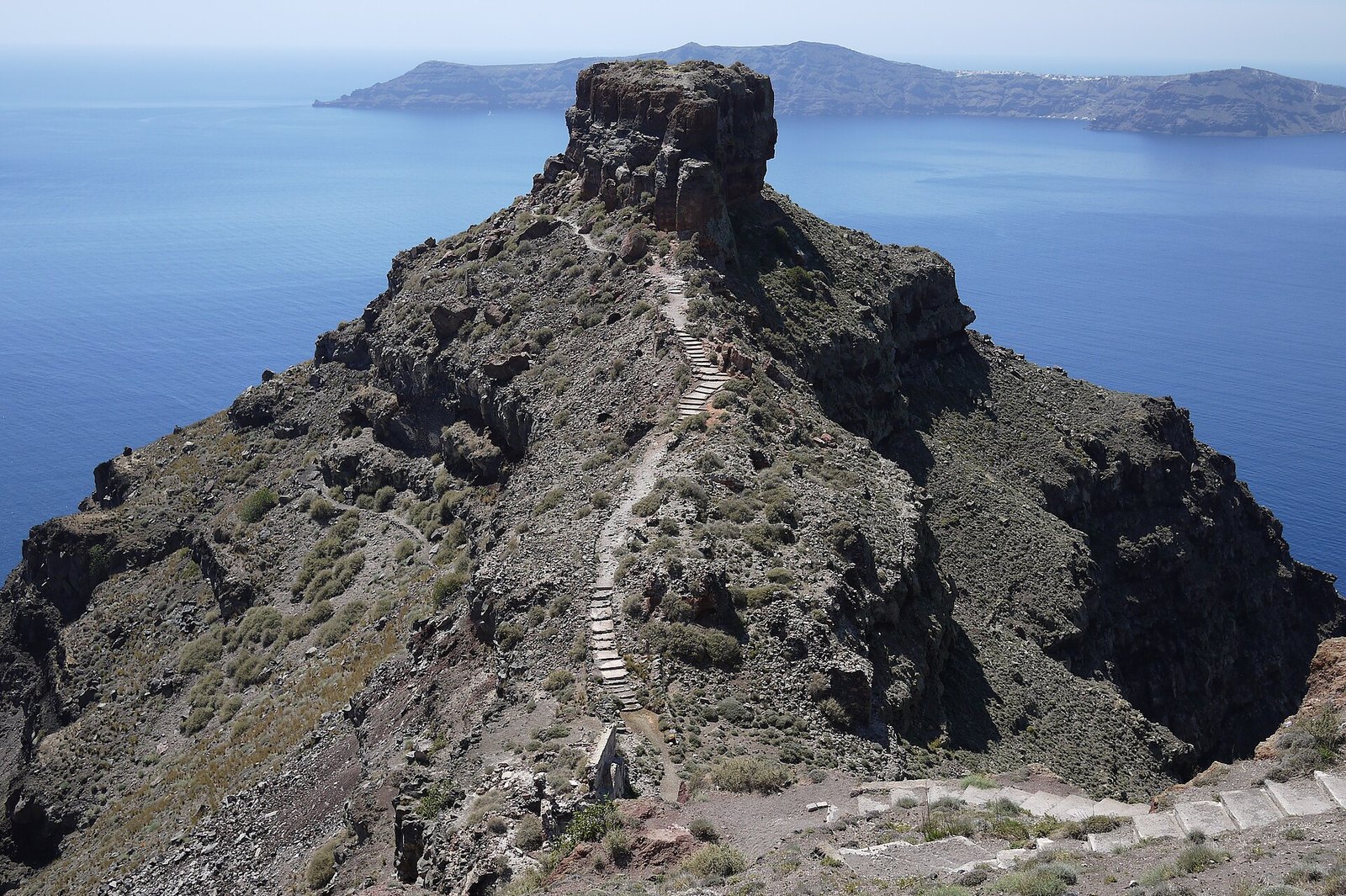
Skaros Rock · Christopher Down · CC BY 4.0 · cropped
Getting there and getting around
You arrive by air or by sea. Flying is fastest: Santorini (Thira) Airport, code JTR, sits on the flat east side of the island near Kamari, and the hop from Athens takes under an hour on carriers such as Aegean, Olympic Air, and Sky Express. In summer there are also seasonal direct flights from a number of European cities. It is a small airport and it gets congested at peak, so leave margin.
The ferry from Athens leaves from Piraeus, the city's main port, reachable by metro or taxi. High-speed catamarans — SeaJets and others — make the run in roughly five hours, while the slower conventional car ferries, including Blue Star, take longer but ride steadier in wind and usually cost less. Boats land at Athinios port on the west coast, at the bottom of a switchback road up the cliff, where buses, taxis, and hotel transfers meet arrivals. Book ahead in summer. The fast boats sell out, and they are the first to be canceled when the meltemi wind blows hard, so a conventional ferry can be the more reliable choice on a windy day.
On the island, your options are:
- Buses. The KTEL network hubs in Fira and connects Oia, Kamari, Perissa, the airport, and Athinios port. Fares are only a few euros, and service is frequent in summer, thinner in shoulder season. It is the cheapest way around if you are based in Fira.
- Rental car. The most flexible choice for the flat side — the beaches, wineries, and inland villages — but parking in Fira and Oia is tight, and you cannot drive up to most cliff hotels.
- ATV or quad. Cheap, everywhere, and fun, but the roads are narrow, steep, and busy in summer, and there are serious accidents every season. Bring the right license, wear the helmet, and go slow.
- Taxis. Santorini has a famously small taxi fleet, so they are hard to grab on the spot in peak season. Pre-book transfers for the airport and port.
- Cable car. A short car connects the Old Port, where cruise tenders land, up to Fira. It is quick, but the line can be very long when ships are in. The old stone stairs are the alternative; the donkey rides up them are best skipped on animal-welfare grounds.
And the best thing to do on foot: the Fira-to-Oia cliff walk, a path of roughly 10.5 kilometers (about 6.5 miles) along the rim through Firostefani and Imerovigli that takes most people three to five hours with stops. It is free, the views run the whole way, and it gets you away from the cruise crowds.
Good to know
Most cliffside hotels in Oia, Imerovigli, and Firostefani sit on pedestrian paths that cars cannot reach. You get dropped at a road or a square and walk down stairs — sometimes well over a hundred of them — to your door, then back up with your bags when you leave. Better properties will send a porter if you arrange it in advance. Pack light, wear real shoes, and think hard about a top-tier cave suite on the cliff if stairs, heat, or heavy luggage are a problem for anyone in your group.
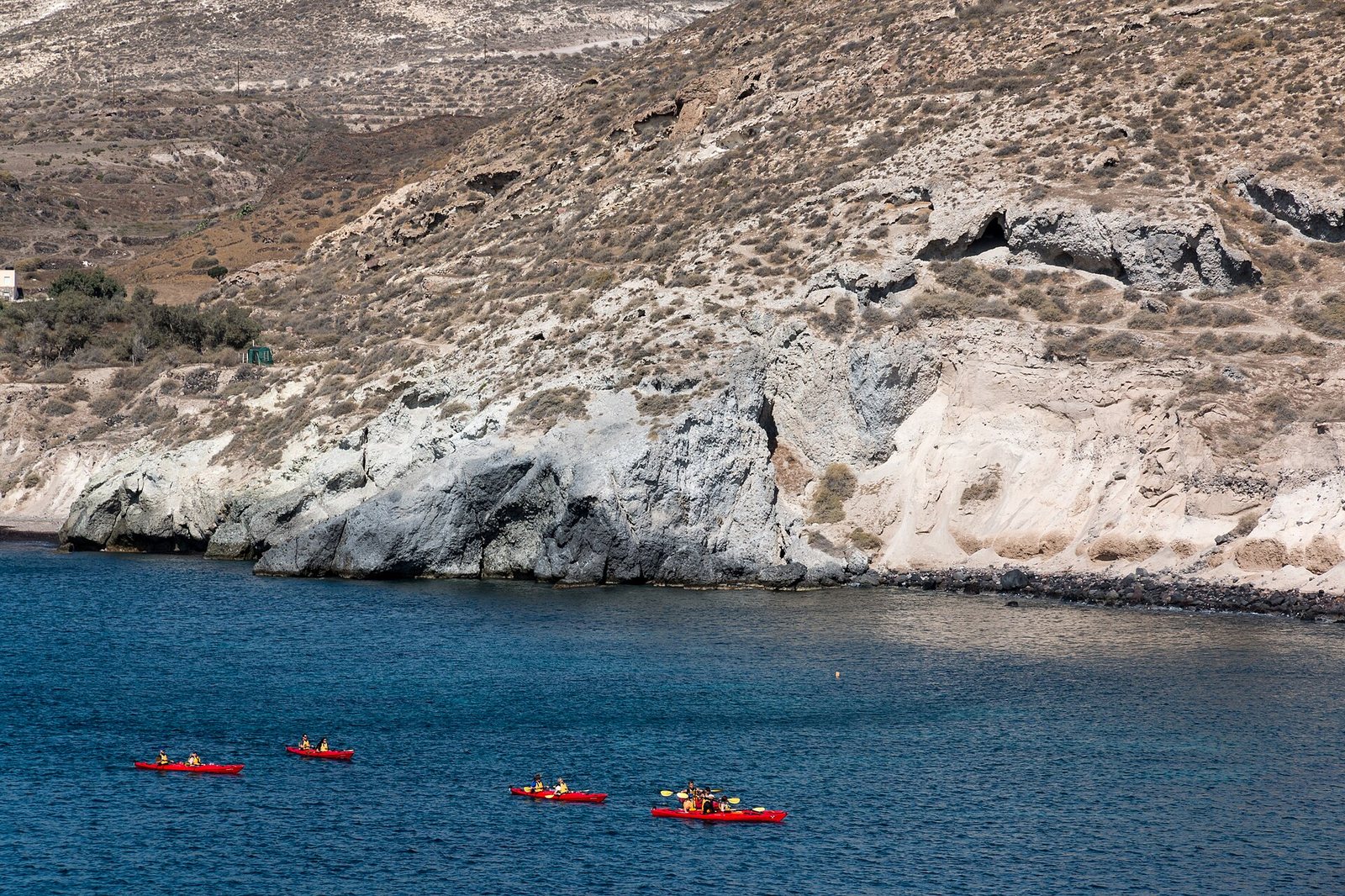
Santorin (GR), Akrotiri, Bucht -- 2017 -- 2498 · Dietmar Rabich · CC BY-SA 4.0 · cropped
What to actually do
Beyond the villages and the sunset, a few things earn your time.
- Akrotiri. The Bronze Age town that the eruption buried in ash, now excavated and under a modern roof. You walk streets of multi-story buildings with their drainage and pottery still in place — one of the best-preserved prehistoric towns anywhere. Most of the famous frescoes are in museums now, including the Museum of Prehistoric Thera in Fira and museums in Athens. Because it is shaded and mostly indoors, Akrotiri is a smart midday move when the caldera is mobbed.
- Wine tasting. Santorini's wine is genuinely distinctive and worth a half-day. The grape is Assyrtiko, grown in volcanic soil with almost no rain, on ungrafted vines that growers train into low basket shapes, called kouloura, to trap moisture and hide from the wind. The dry white is crisp and mineral; the sweet Vinsanto is made from sun-dried grapes. Names to know include Santo Wines, the island cooperative with a large terrace over the caldera; Venetsanos, built into the cliff above Athinios port; Estate Argyros, known for old vines and a long pedigree; and Domaine Sigalas near Oia, a benchmark for Assyrtiko.
- The volcano and hot springs. Boat trips cross the caldera to Nea Kameni, where you hike up to the crater and its sulfur vents, then swim in the warm, iron-tinted springs off neighboring Palea Kameni. Many trips add the island of Thirasia and loop back for the Oia sunset from the water.
- The beaches. Kamari and Perissa for a real swim day on black sand, Perivolos for the beach clubs, Red Beach for the look.
- The slow villages. Pyrgos, Megalochori, and Emporio reward an aimless hour of walking, and they stay cool and quiet when the cliff is not.
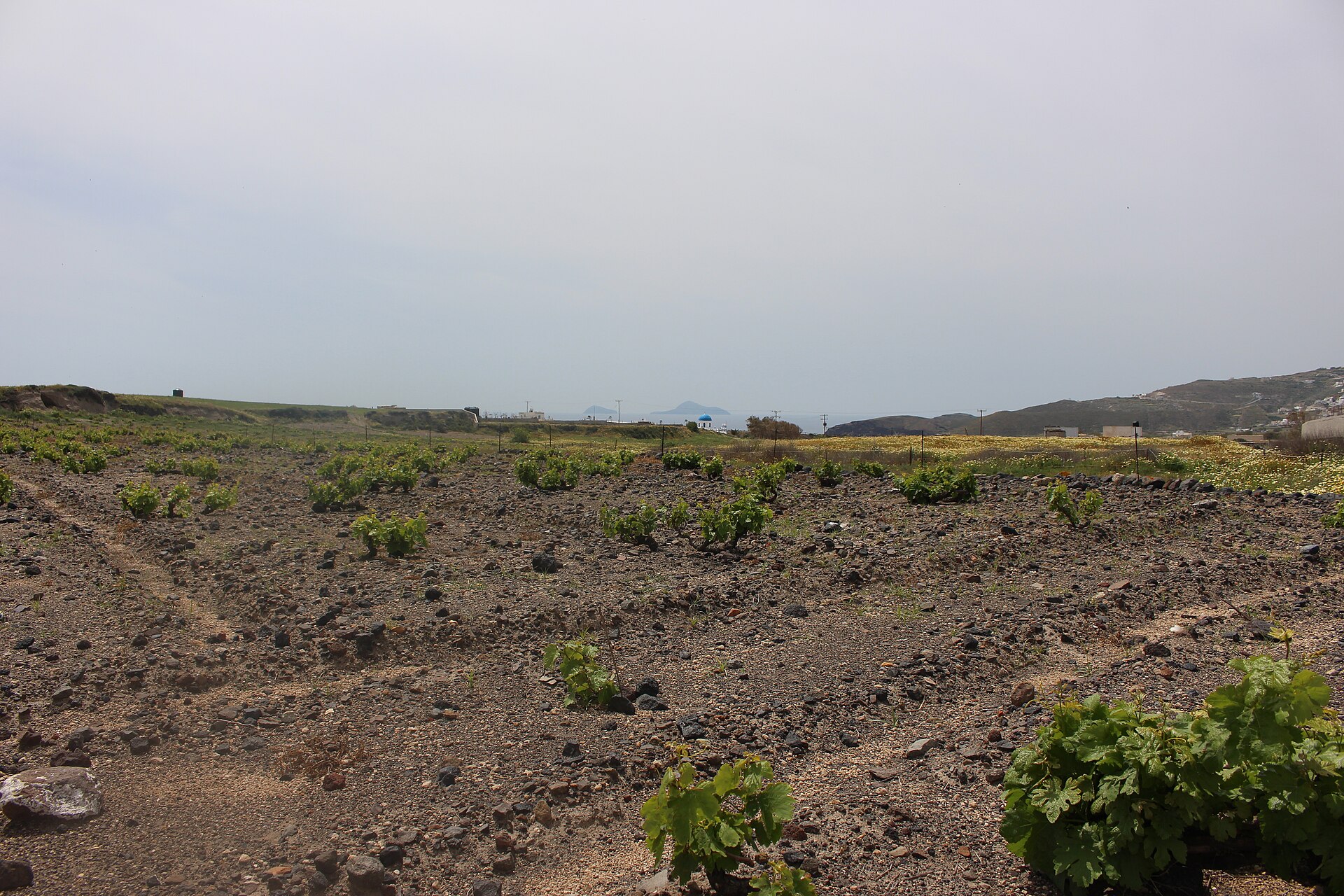
Vineyard in Santorini 2 · ArticCynda · CC BY-SA 4.0 · cropped
Where to eat and drink
The dry volcanic soil gives Santorini a real local table, and it is worth ordering around it. Look for the island's small, intense cherry tomatoes, often fried into tomatokeftedes (tomato fritters); fava, a smooth yellow split-pea puree with its own protected status; white eggplant; capers and caper leaves; and whatever fish came in that day. Wash it down with Assyrtiko, and ask for it by producer.
On where to sit, a few honest rules. The caldera-view restaurants in Oia, Imerovigli, and Fira charge for the terrace as much as the plate; some are very good, but you are paying for the drop. Ammoudi Bay, the little fishing harbor at the bottom of the cliff below Oia, has fish tavernas right at the water and a sunset that rivals the one up top, though it fills up, so book. And the better value, and often the better cooking, is inland and at the beach — the tavernas in Pyrgos, Megalochori, Emporio, and Exo Gonia, and the seafront places at Kamari and Perissa, where locals actually eat.
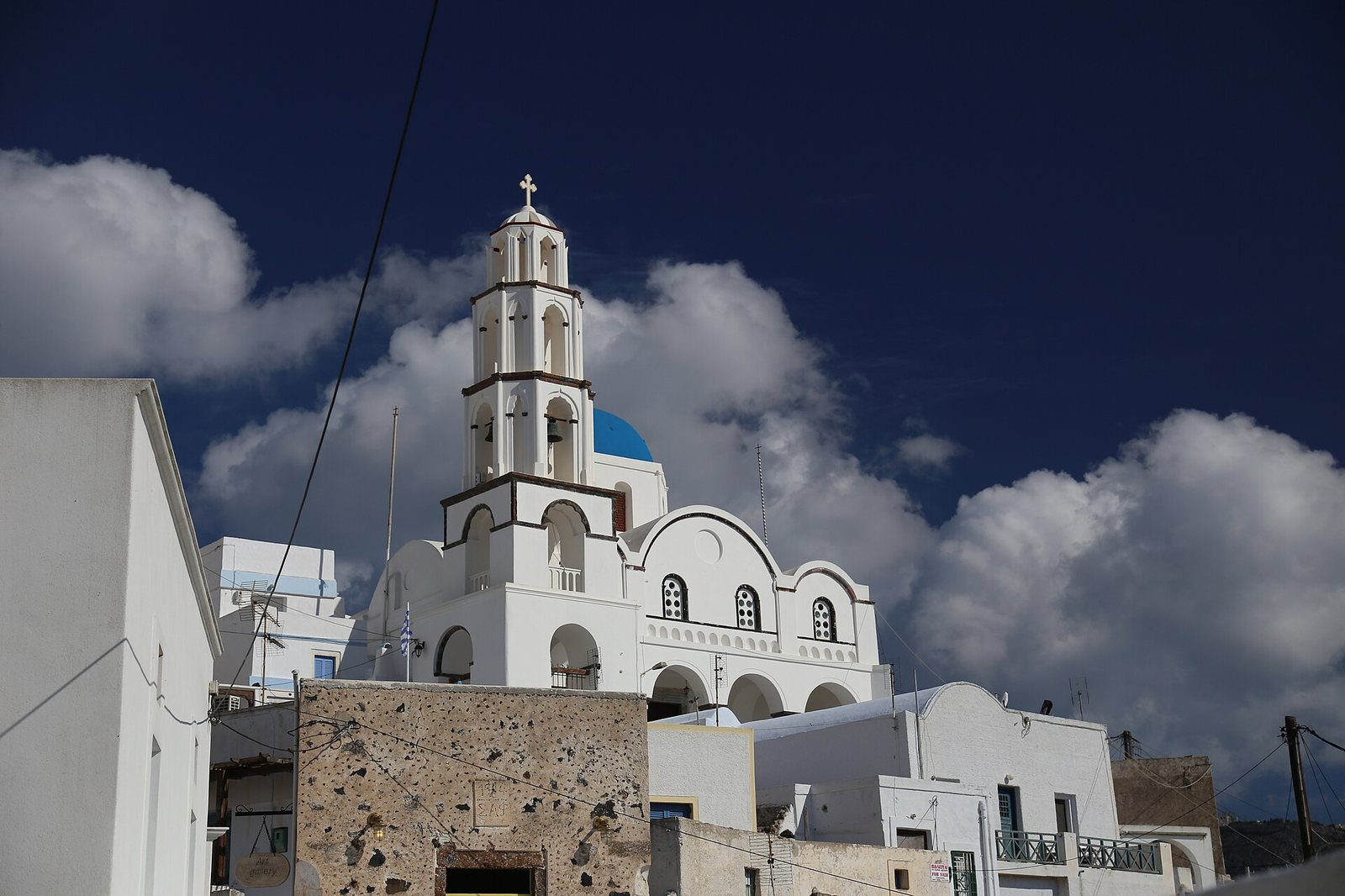
Pyrgos Kallistis 847 00, Greece - panoramio (17) · logopop · CC BY-SA 3.0 · cropped
Money and practical notes
Santorini is one of the pricier Greek islands, and the caldera in July and August is the top of the market. You do not have to pay that, though. Here is how the money and the logistics tend to shake out.
- Where the savings are. Come in shoulder season, base off the caldera — the beach towns and inland villages cost much less — and bus or drive in. Watch the sunset from a free spot or a winery rather than a view-priced dinner table. Take buses over taxis. Walk the Fira-Oia path instead of paying for a tour.
- Book early. For July and August, and for any caldera-view room in any month, reserve well ahead. The best cave suites go months out.
- Cash and cards. Cards are widely accepted, but carry some cash for small tavernas, buses, and the villages.
- Water. The island runs largely on desalinated water, and tap water is generally not recommended for drinking, so most people buy bottled or use a filter.
- Stairs and sun. The caldera is all steps, and the summer sun is strong with little shade. Bring water, wear real shoes, and pace the midday heat.
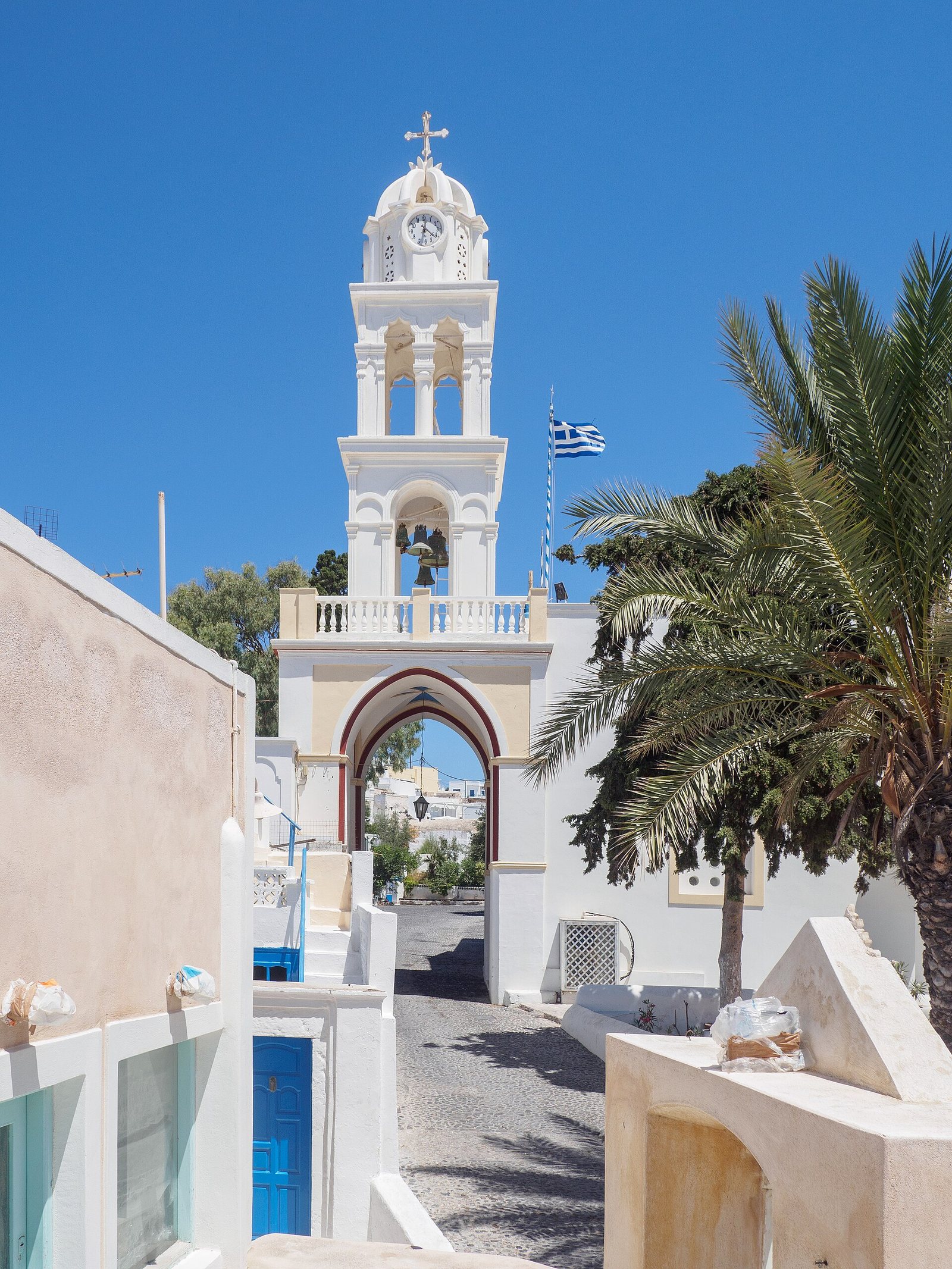
Κοίμηση Θεοτόκου, Μεγαλοχώρι 9740 · C messier · CC BY-SA 4.0 · cropped
By the numbers
Common questions
Oia or Fira — which should I pick?
It depends on what you want. Choose Oia for the looks and the sunset if the budget allows and you will get out early to beat the crowds. Choose Fira for logistics: it is the bus hub, has the most restaurants and nightlife, and costs less. Firostefani and Imerovigli split the difference, with caldera views and far more quiet.
How many days do I need?
Three to four nights is a solid first visit — enough for the villages, a sunset or two, Akrotiri, and a bit of wine or beach. Add a night if you want real beach days and a proper winery afternoon without rushing.
Do I need to rent a car?
Not if you stay in Fira and use the buses, which reach the main sights and beaches. Yes, more or less, if you want the beaches, wineries, and inland villages on your own schedule. ATVs are a cheaper option but carry real risk on these roads.
Is the Oia sunset worth the crowds?
The view is real, and so is the crush. If you go, arrive well over an hour early. If you would rather not, watch from Imerovigli, the top of Pyrgos, a winery terrace, or Ammoudi Bay, all of which are quieter and just as good.
When is it cheapest and least crowded?
The shoulder months: late April through May, and mid-September into October. Skip August for both price and crowds. Winter is cheapest and calmest, but much of the caldera shuts down.
Sources & further reading
- Discover Greece (GNTO) — Best beaches in Santorini
- Discover Greece (GNTO) — The villages of Santorini
- Wines of Greece — PDO Santorini (Assyrtiko & Vinsanto)
- Domaine Sigalas — winery, Oia
- Santo Wines — Santorini's cooperative winery
- National Geographic — Vinsanto, Santorini's dessert wine
- Ferryhopper — Athens (Piraeus) to Santorini ferries