At a glance
- Base
- St. Moritz Dorf for shops and crowds, St. Moritz Bad for lake and quiet, or quieter Engadin villages.
- When
- Mid-December to spring for reliable snow; mid-January or spring for quiet. Summer for lakes/walking. Avoid Nov, late April-May.
- Getting there
- Fly to Zurich, then train (via Chur) or drive (Julier Pass) for 2.5-3.5 hours. Samedan airport for private aircraft.
- Getting around
- Walkable town, good local buses (often covered by guest card). Car optional, but parking limited in Dorf.
- Book ahead
- Book early for peak weeks (Christmas, New Year, mid-Feb). Confirm dates, many hotels close between seasons.
- The price
- Peak weeks (Christmas, New Year, mid-Feb) are priciest. Half-board common in winter. Bad and other villages often cheaper.
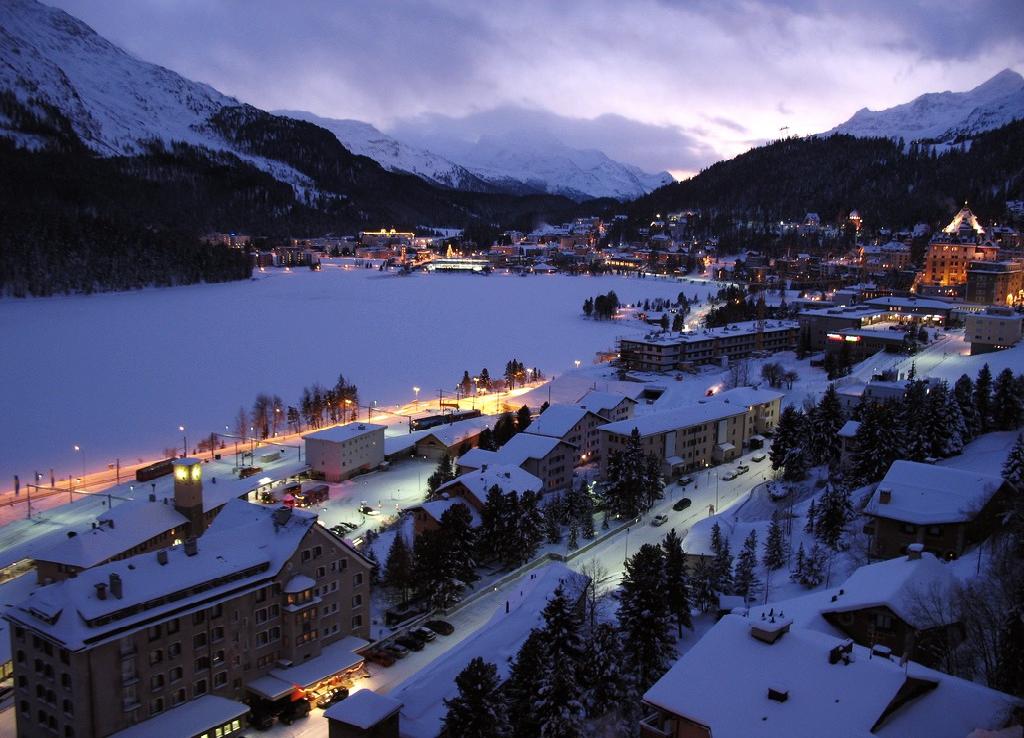
St. Moritz is really two places that share a name. The Dorf sits on a shelf above the lake, a compact grid of boutiques, funicular stations and the older grand hotels. The Bad lies a few minutes downhill by the water, flatter and plainer, closer to the cross-country tracks and the mineral springs the town was named for. Before you look at a single hotel, the useful question is which half you want to wake up in, and whether you want to be in St. Moritz at all rather than one of the quieter Engadin villages a short train ride away.
The second decision is how you arrive. There is a small airport at Samedan for private aircraft, but most people fly into Zurich and cover the last stretch by road or rail. The train from Chur climbs the Albula line into the valley, which is a reason in itself to take it rather than drive. What follows is how the ground actually lies, which villages suit which kind of trip, where the well-known hotels sit within that, and when the snow and the crowds line up.
In this guide
The lay of the land: Dorf and Bad
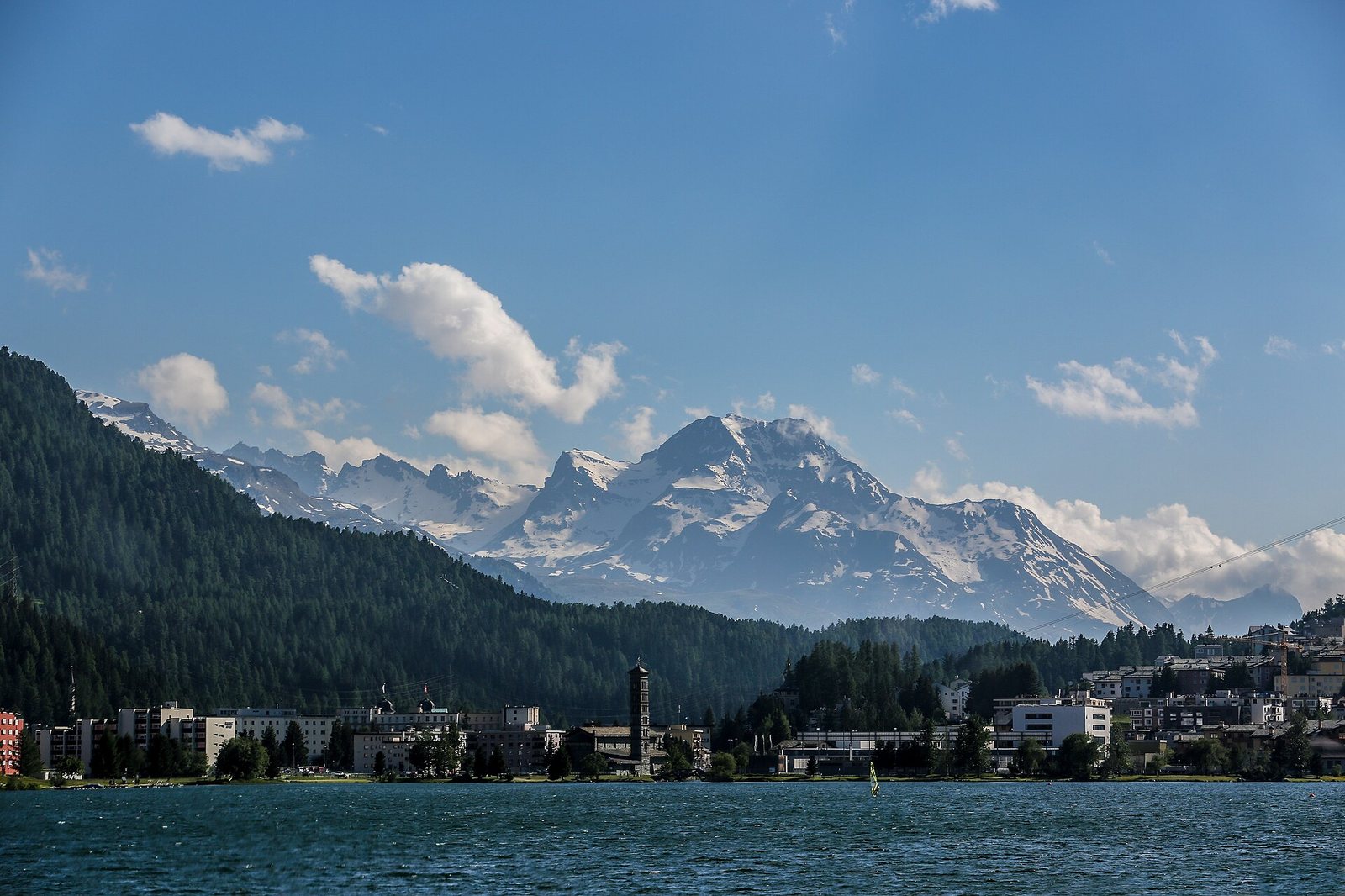
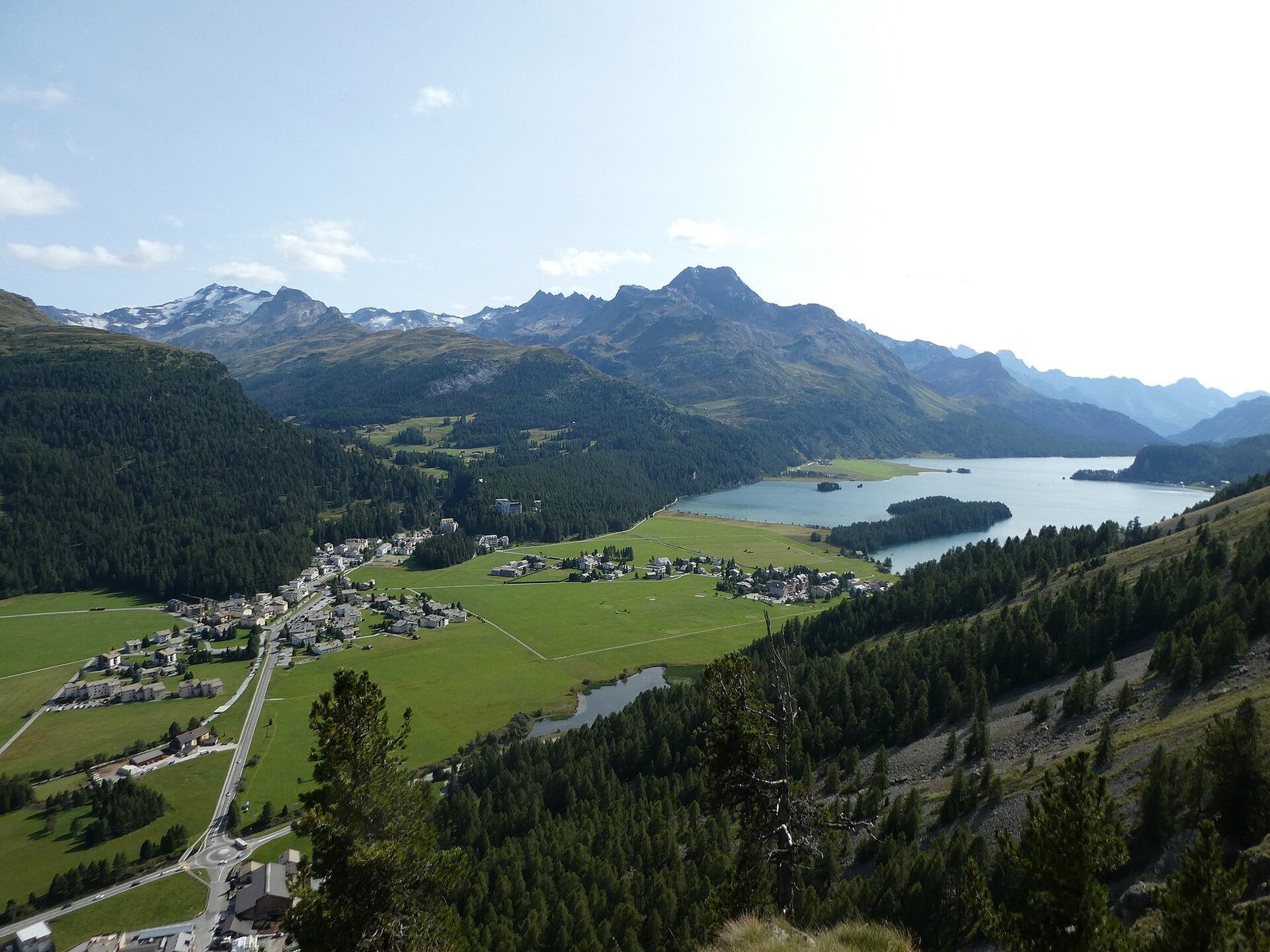
St. Moritz sits roughly in the middle of the Upper Engadin, a high valley in the south-east of Switzerland that runs for around 55 kilometres and strings together a line of lakes and about a dozen villages. The valley floor is high, close to 1,800 metres, and the climate that comes with that altitude is the reason people first came: cold, dry and unusually sunny, with snow that tends to stay. The town looks down on its own lake, which in deep winter freezes hard enough to carry horses, polo ponies and a small city of tents.
The town itself splits in two. St. Moritz Dorf, at around 1,856 metres, is the historic centre on the hillside. This is where the shop windows are, along the Via Serlas and the streets around it, and where most of the grand hotels stand with their terraces facing the lake. It is also where the evening crowd gathers and where the funicular up to the Corviglia slopes begins. St. Moritz Bad, a little lower at around 1,774 metres, sits down by the lake. It grew up around the mineral springs, it holds the cross-country trails and a cable car of its own onto the mountain, and it is generally quieter, more spread out and less expensive than the Dorf.
The real choice in St. Moritz is not which hotel to book but which half of town to wake up in: the Dorf, in the middle of the shops and the evening crowd, or the Bad, a quiet quarter-hour below it by the water.
The two halves are close. It is a downhill walk of fifteen to twenty minutes from the Dorf to the Bad, or a short ride on the local bus that connects them. If you want to step out of your hotel into the shops and the noise, base in the Dorf. If you would rather have the lake, the tracks and a calmer street at the cost of a walk or a bus to the centre, the Bad does that, often for less.
The Engadin villages worth basing in
St. Moritz is the name everyone knows, but it is one stop on a valley served by frequent trains and buses. Several neighbouring villages put you on the same mountains and the same lakes, usually with more quiet and lower room rates. If you have a car, or you are happy on the train, they are worth a look.
Celerina
Just east of St. Moritz and a few minutes down the valley, Celerina sits at the foot of the Corviglia slopes and links up to them through the Marguns area. It is a real village rather than a resort strip, it gets a lot of sun, and it is where the Cresta Run and the bob run finish. Train connections are good in both directions. For skiers who want quick access to Corviglia without the Dorf prices, it is one of the sensible choices.
Pontresina
South of St. Moritz, on the road toward the Bernina Pass, Pontresina stands among larch woods at the foot of the Bernina massif. It leans more toward walkers, cross-country skiers, climbers and families than toward nightlife, and it is the natural base for the mountains on that side of the valley, including Diavolezza, Muottas Muragl and Alp Languard. It is calmer than St. Moritz and keeps its own character.
Silvaplana
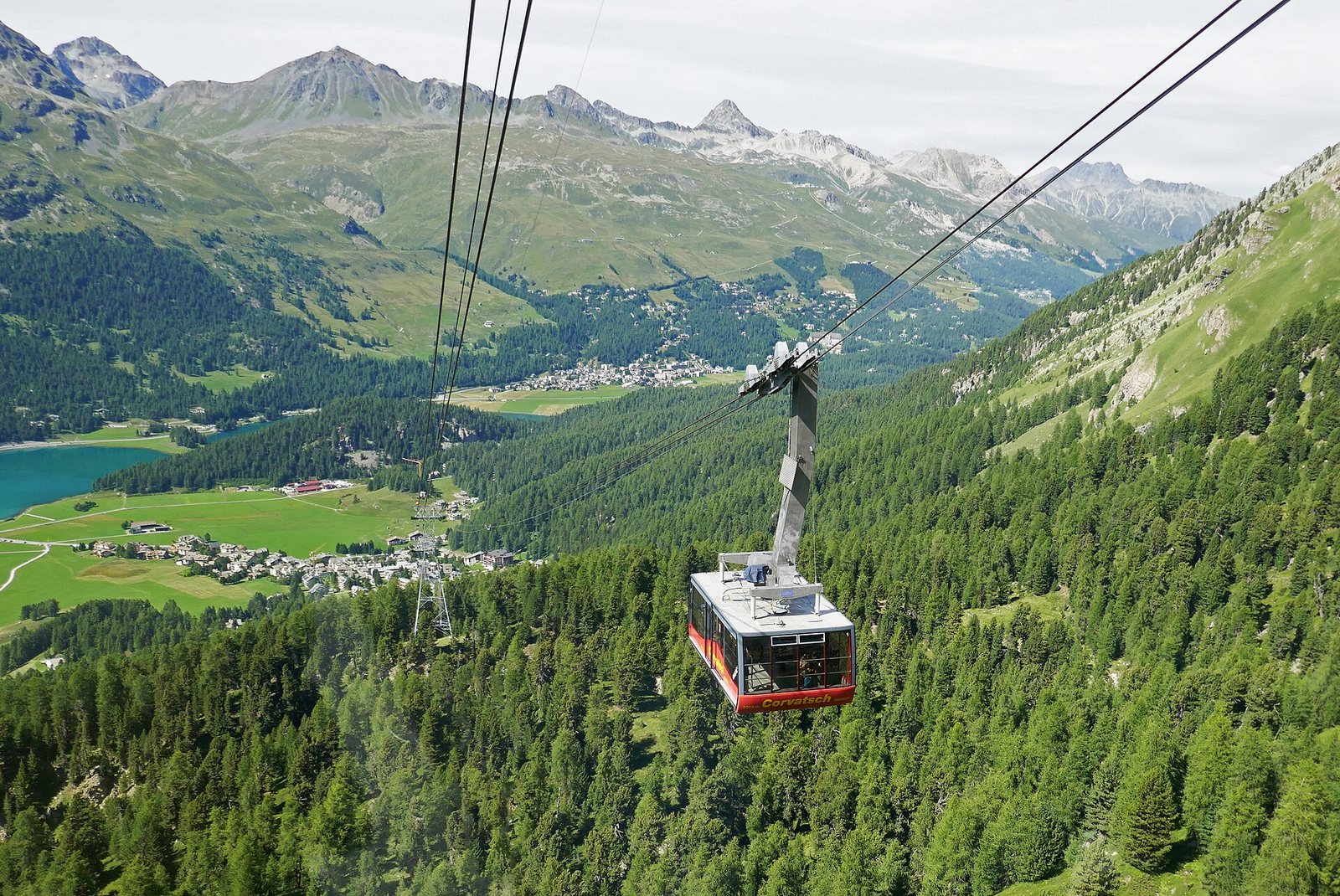
A short way up the valley on the lake of the same name, Silvaplana is the base for the Corvatsch cable car and its long runs. It is a quieter, more village-like place than St. Moritz, and in summer it is well known for its wind, which draws windsurfers and kitesurfers to the lake. In winter it is a straightforward, well-placed spot for the Corvatsch side of the region.
Sils Maria
At the far, quiet end of the lakes sits Sils, whose main hamlet is Sils Maria. This is the calmest of the bases covered here, a place of low houses by Lake Sils with horse-drawn sleighs running into the side valleys. Nietzsche spent seven summers here in the 1880s, and the house he stayed in is kept as a small museum. Choose Sils if what you want from the Engadin is stillness and walking rather than shops and crowds.
Samedan
Samedan is the working capital of the Upper Engadin, a proper town of painted Engadine houses rather than a resort. It holds the region's airport and is a junction of the Rhaetian Railway, which makes it a practical, central base for reaching the whole valley by train, and it has public mineral baths of its own. It is less glamorous than St. Moritz and the better for it if you want somewhere lived-in.
Lej da San Murezzan · Janoschobfelden · CC BY-SA 4.0 · cropped
Where to stay: the hotels
The famous St. Moritz hotels fall, roughly, into two groups: the grand old houses in and around the Dorf that are tied up with the town's history, and the ones set a little apart, quieter or more self-contained. None of the rates below are quoted here because they move with the season and the room, and the grand houses in particular tend to run on half-board arrangements in winter. Book early for the peak weeks; several of these hotels close entirely outside the winter and summer seasons.
The grand old houses
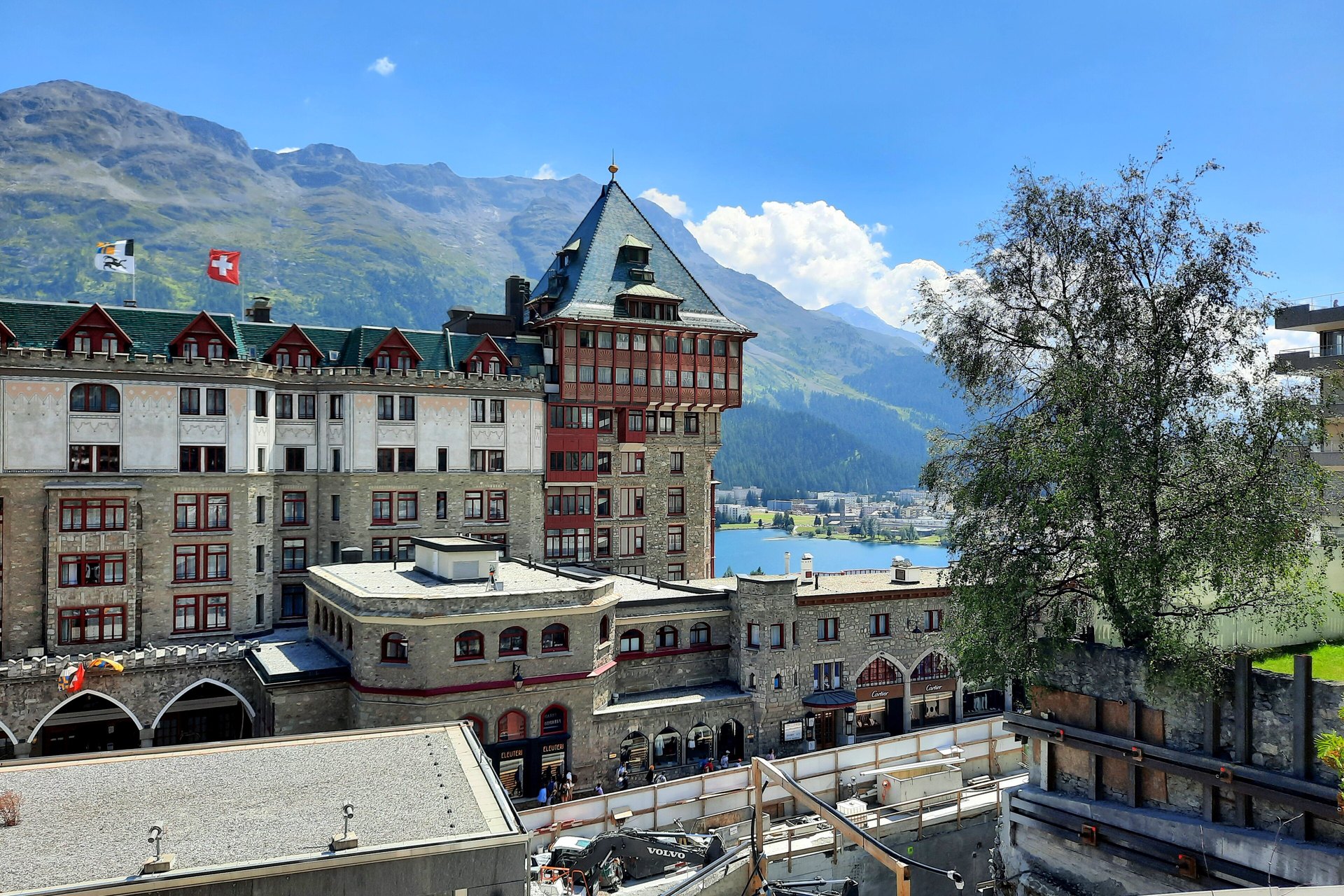
Badrutt's Palace Hotel is the one most tied to the image of St. Moritz. It opened in 1896, it stands at the top of the Via Serlas in the Dorf with its tower over the lake, and its restaurants, among them the old farmhouse Chesa Veglia, are part of the town's furniture. It is the grand hotel at its most visible and most central.
Kulm Hotel St. Moritz traces its origins to 1856, when Johannes Badrutt took on a guesthouse here; the family's wager that winter in the Engadin could be a pleasure rather than an ordeal is often told as the start of Alpine winter tourism. The Kulm sits above the lake in its own park in the Dorf, with its own ice rink, and its grounds are bound up with the town's turns as an Olympic host in 1928 and 1948.
Carlton Hotel St. Moritz stands on the hillside above the lake, close to the Chantarella funicular, and is more contemporary in feel than its neighbours. Its rooms are arranged to face the water and the mountains across it. It is a quieter alternative to the two landmarks above while still being firmly in the Dorf.
St. Moritz 20220724 – 1 · VynedJ · CC BY 4.0 · cropped
Set a little apart
Suvretta House sits on its own, above the valley on the edge of St. Moritz, with its own ski lift onto the Corviglia slopes and a self-contained, resort-like feel. It has long been a family-oriented choice, away from the centre and its traffic, for people who want the mountain at the door and the town at arm's length.
Grand Hotel des Bains Kempinski is the large house down in St. Moritz Bad, built by the springs the district takes its name from. It has direct access to the cross-country tracks and sits opposite the cable car up to Corviglia, with a big spa fed by the local spring water. If you want the wellness side of St. Moritz and a base by the lake rather than in the shopping streets, this is the grand hotel that fits.
Good to know
- The grand hotels commonly run on half-board in winter, so dinner may be built into the rate; check before you book if you would rather eat out.
- Many hotels and some lifts close in the between-seasons months of spring and late autumn, so confirm dates rather than assume year-round opening.
- A guest card, given by most hotels, usually covers the local buses that link the Dorf, the Bad and the neighbouring villages, which makes going without a car easy.
- Parking is limited in the Dorf; if you drive, ask your hotel about parking before you arrive.
The skiing and the mountains
The Engadin does not offer one giant linked circuit. Instead it has several separate mountains, each reached on its own, and a regional pass that covers them all. The three main ski areas are Corviglia above St. Moritz, Corvatsch above Silvaplana, and Diavolezza toward the Bernina Pass, and between them they add up to a few hundred kilometres of piste. You move between them by bus or train rather than by skiing across.
Corviglia is the home mountain for St. Moritz. A funicular climbs from the Dorf up through Chantarella to Corviglia, and a cable car carries on to the top at Piz Nair, at around 3,057 metres; from the Bad side, the Signal cable car is the other way up. The terrain is broad, sunny and mostly cruising, with the town and its lake in view for much of the day, and it links round to Marguns above Celerina.
St Moritz Muottas · Murdockcrc · CC BY 3.0 · cropped
Corvatsch, above Silvaplana and Sils, tops out at around 3,303 metres, which makes it one of the higher mountain stations in the region and a good bet for snow. Its long descents are the draw, and on Friday nights part of the mountain is lit for night skiing. It is a separate mountain from Corviglia but sits on the same regional pass.
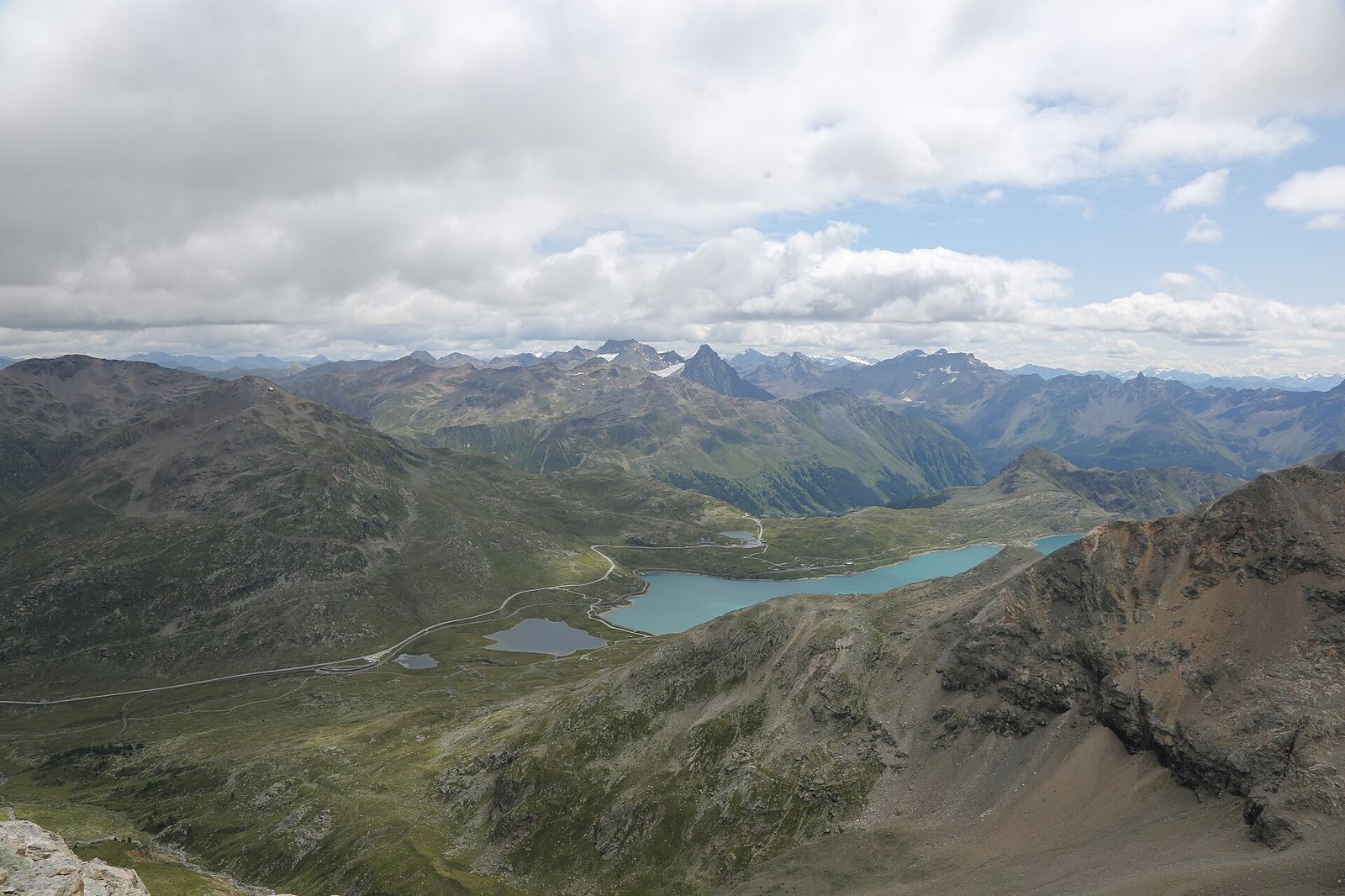
Diavolezza, on the road up toward the Bernina Pass beyond Pontresina, is the high, glacier-touched area, reaching around 2,973 metres, with big views across to Piz Palü and Piz Bernina and down onto the Morteratsch Glacier. Its best-known run is the long guided descent over the glacier, taken with a mountain guide; across the road, Lagalb gives steeper, quieter pistes. It holds snow well and is a good choice into the spring.
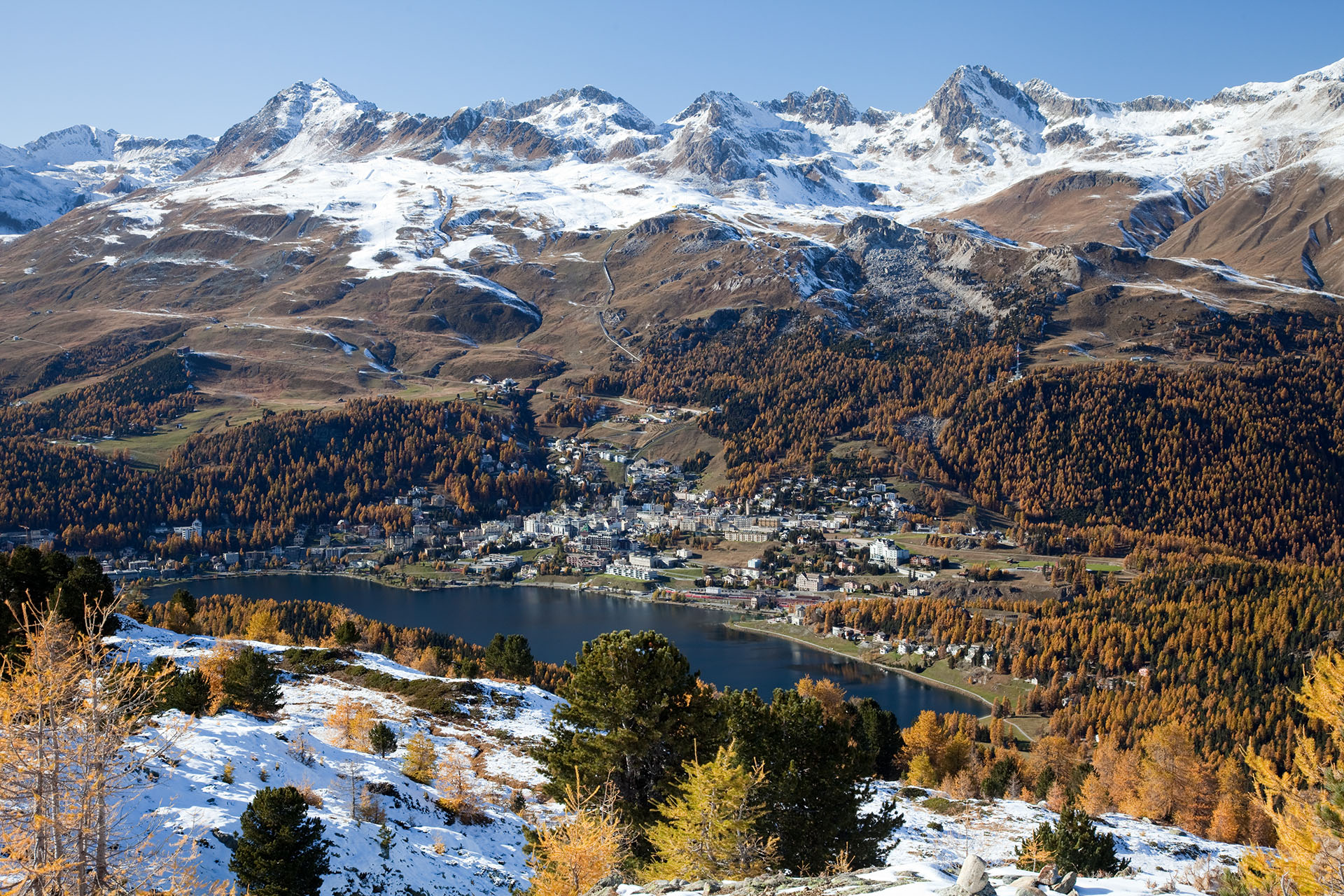
Muottas Muragl is not really a ski area at all. A funicular, the oldest in the Engadin and running since around 1907, climbs from Punt Muragl, between Pontresina and Samedan, to a viewpoint over the whole line of lakes. There is a mountain hotel at the top, a marked panorama walk, and a long winter toboggan run back down, and it is one of the better places in the valley to be at sunrise or sunset.
When to go
The Engadin winter is long, cold and bright, and the altitude keeps the snow reliable from about the middle of December into spring. The busiest and most expensive weeks are Christmas and New Year and the middle of February, the latter pushed up by the events out on the lake. If you want the same snow and sun without the crush, the weeks in the middle of January are quieter, and the spring, when the higher areas keep their cover and the days lengthen, is quieter still. Summer is a second, gentler season built around the lakes and the walking; the months on either side of the seasons are when much of the valley shuts.
| Season | Months | What it is like | Good for |
|---|---|---|---|
| Deep winter, high season | Late December to February | Cold, dry and bright, with the most reliable snow; Christmas, New Year and February are the busiest and priciest weeks. | The resort in full swing, the lake events, seeing St. Moritz at its liveliest. |
| The off-weeks | Mid-January | The same snow and sun as the peak, but between the holiday and the February events, so calmer and often cheaper. | Skiers who want the mountains without the crowds. |
| Spring skiing | March to early April | Longer, warmer days and softer snow; the higher and glacier areas hold up best; noticeably quieter. | Value, sunshine and relaxed skiing. |
| Summer | Late June to September | A green valley of lakes and trails, with hiking, cycling and wind sports; a slower, second season. | Walkers, cyclists and warm-weather days by the water. |
| Between seasons | November, late April to May | Many hotels and lifts close and the valley goes quiet; not much is running. | Plan around it rather than for it. |
RhB Ge 4-4 II 614 Glacier Express on Landwasser Viaduct · Kabelleger / David Gubler · CC BY-SA 4.0 · cropped
How to get there
For nearly everyone the gateway is Zurich, and the last stretch into the Engadin takes around three to three and a half hours by road or rail. There is an airport at Samedan, around ten minutes from St. Moritz and one of the highest in Europe, but it handles private and charter aircraft rather than scheduled airlines, so most visitors reach the valley by train or car.
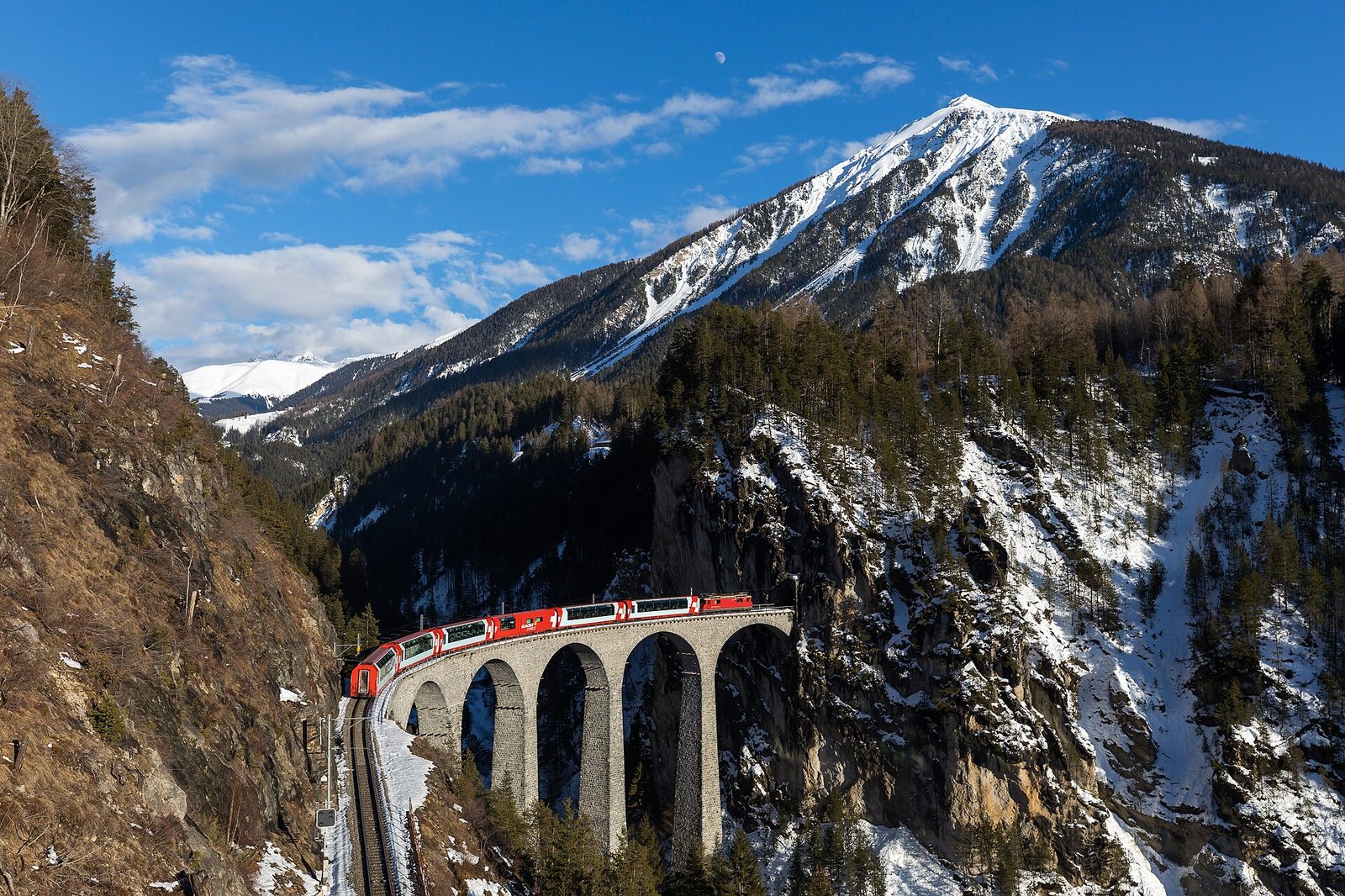
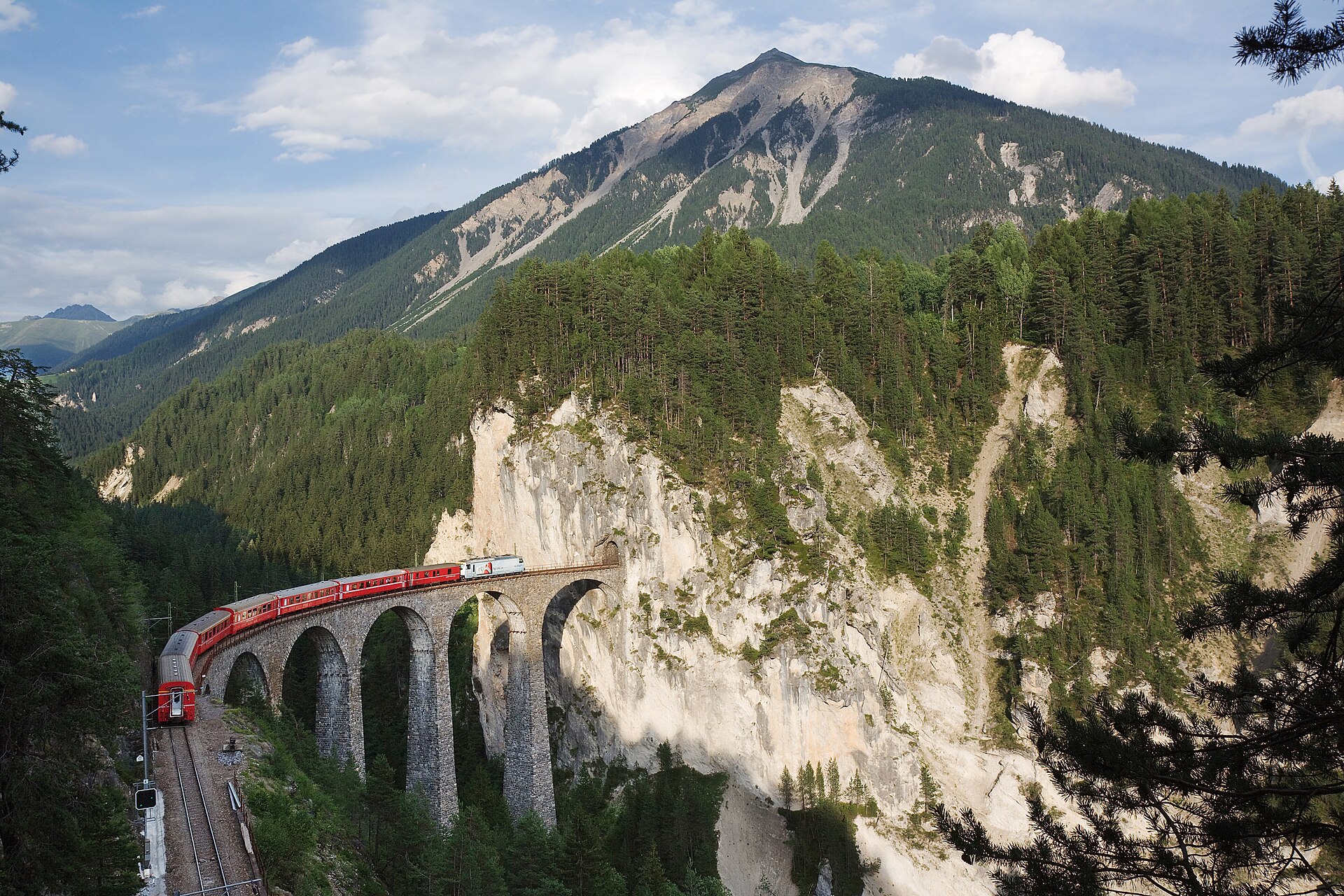
By train. There is no direct service from Zurich; you change at Chur, or sometimes Landquart, onto the Rhaetian Railway. The leg from Chur up to St. Moritz takes a little under two hours on the Albula line, which is part of the UNESCO-listed route, so the journey is a large part of the point. Total time from Zurich is usually around three and a quarter to three and a half hours, and you step off in the middle of town.
Landwasserviadukt · Ikiwaner · CC BY-SA 3.0 · cropped
By car. St. Moritz is around 200 kilometres from Zurich, roughly two and a half to three hours, with the final climb into the valley over the Julier Pass, which is kept open through the winter; carry the usual winter equipment. Once you are there a car is optional, since the town is walkable and the buses are good, and parking in the Dorf is limited.
The scenic trains. Two well-known panoramic services run through here, and both are experiences rather than the quick way in. The Glacier Express links St. Moritz with Zermatt in around eight hours and is billed as the slowest express train, crossing the middle of the country at walking-tour pace. The Bernina Express climbs over the Bernina Pass and down to Tirano, in Italy. The Albula and Bernina lines they run on have together been a UNESCO World Heritage site since 2008, for the viaducts, spirals and tunnels that carry the track over the mountains.
Beyond the slopes: the lake, the spa, the tables
A good deal of what makes a St. Moritz winter happens off the pistes, and much of it happens on the frozen lake. In deep winter the ice is thick enough to hold events that exist almost nowhere else.
The events on the ice
- White Turf. Horse racing on the frozen lake, held across three Sundays in February and running in some form since 1907. Alongside flat racing and trotting it includes skikjoring, in which skiers are towed at speed behind riderless horses, a discipline particular to this meeting.
- Snow Polo World Cup St. Moritz. A high-goal polo tournament played on the snow-covered lake over three days, usually in late January, and staged here since 1985.
- The Cresta Run. A natural ice track for head-first skeleton tobogganing, built in 1884 near the hamlet of Cresta in Celerina and run to this day by the St. Moritz Tobogganing Club, founded in 1887. Riders start from either the Top or the lower Junction and reach serious speed. It was for most of its history a men-only club; women were barred in 1929 and voted back as active members in 2018. Visitors can arrange to ride during the winter season, weather and the club permitting.
Spas, sleighs and slower days
The wellness side of St. Moritz is concentrated in the Bad, where the mineral springs gave the district its name, and in the large hotel spas; Samedan has its own public mineral baths as well. Beyond that, the slow pleasures are simple: the walk or bus between the Dorf and the Bad, horse-drawn sleighs into the side valleys around Pontresina and Sils, and, in the coldest weeks, the frozen lake itself, which you can walk out onto between the events.
Where to eat
Eating runs from the mountain huts on Corviglia, where lunch on a sunny terrace is half the day, to the old town restaurants, of which Chesa Veglia at Badrutt's Palace is the best known. The grand hotels carry much of the serious cooking, and the valley has held Michelin stars across several of them, though which kitchens hold what changes from year to year, so check the current listings rather than an old recommendation.
Panoramic view over Lago Bianco and mountain ranges from Diav… · Paradise Chronicle · CC BY-SA 4.0 · cropped
By the numbers
Silsersee, Sils-Segl Maria and Sils-Segl Baselgia · Capricorn4049 · CC BY-SA 4.0 · cropped
Corvatsch cable car 3 · Tiia Monto · CC BY-SA 4.0 · cropped
Common questions
Dorf or Bad, which should I book?
Base in the Dorf if you want to step out into the shops, the grand hotels and the evening crowd, and start the funicular up to Corviglia from the door. Base in the Bad if you want the lake, the cross-country tracks, a quieter street and, usually, a lower rate, and you do not mind a fifteen to twenty minute walk or a short bus to the centre.
Do I need a car?
No. The train brings you to the middle of St. Moritz, the local buses link the town with the surrounding villages, and most hotels give a guest card that covers them. A car is only really worth it if you want to roam widely on your own schedule, and parking in the Dorf is tight.
Which village should I choose if I want it quiet?
Sils Maria is the calmest of the bases here, at the far end of the lakes. Pontresina is quiet and good for walkers and cross-country skiers, and Celerina is an easygoing village with fast access to the Corviglia slopes. Any of the three is calmer than central St. Moritz.
Is St. Moritz only worth it in winter?
No. Summer is a genuine second season, greener and quieter, built around the lakes, the hiking and the cycling, with wind sports on the lake at Silvaplana. The times to avoid are the between-seasons months, roughly November and the stretch from late April into May, when many hotels and lifts are closed.
Can I watch White Turf and the Snow Polo without a ticket?
The events on the lake are open to spectators, with paid grandstand and hospitality options on top. White Turf runs across three Sundays in February and the Snow Polo over three days in late January, so if you want to see them, plan your dates around those weekends.
How do I get there from Zurich?
Fly into Zurich, then take the train, changing at Chur onto the Rhaetian Railway, in around three and a quarter to three and a half hours, or drive a similar time over the Julier Pass. The airport at Samedan is close to St. Moritz but serves private and charter aircraft rather than scheduled flights.
Sources & further reading
- Engadin Tourism — the regional tourist board for the valley
- St. Moritz Tourist Information — the town official site
- Rhaetian Railway — the Albula and Bernina lines, Bernina Express and Glacier Express
- Switzerland Tourism — the Engadin destination overview
- Badrutt's Palace Hotel — the landmark grand hotel in the Dorf
- White Turf St. Moritz — horse racing on the frozen lake
- UNESCO World Heritage — Rhaetian Railway in the Albula / Bernina Landscapes