At a glance
- Base
- Inside the old city on the east bank, on or across the water, or in the village of Delwara in the hills.
- When
- October to March, with November to February most comfortable; March is a good shoulder alternative.
- Getting there
- Maharana Pratap Airport (UDR) or Udaipur City station; prearranged hotel car is the smoothest.
- Getting around
- Old city on foot; auto-rickshaws and taxis for further; boats on Lake Pichola.
- Book ahead
- Book early for cool months; popular lake hotels book months ahead for winter; sunset boat departures sell out.
- The price
- Season, whether the room faces the lake, and whether you are on the water at all.
Udaipur is a city arranged around water, and the first choice you make here is where to sleep beside it. Lake Pichola sits at the centre. The old city crowds the eastern shore in a slope of whitewashed houses and temple spires, while the grander hotels stand on the far bank, on islands in the lake, or out in the hills. You can wake on the water in a palace reached only by boat, in a haveli a short walk from the ghats, or in a resort with room to breathe. Almost everything else about the trip follows from that decision.
This guide is about making that call well and then using the city once you have arrived: where the lakes and neighbourhoods sit and which base suits you, the palaces and havelis you can actually sleep in and what drives the rate, the City Palace and the old-city sights on foot, when to come — the season matters more here than the map, and March, the tail of the cool months, is one of the better windows — how to arrive, the day out to Kumbhalgarh and Ranakpur, and the practical notes: food, temples, and the heat.
In this guide
The lakes, and how the city sits
Udaipur is the old capital of Mewar, in the green, hilly south of Rajasthan, and it was built around water on purpose. Lake Pichola lies at the centre, enlarged in the sixteenth century when Maharana Udai Singh II moved his capital here. The old city climbs the eastern shore — close-packed houses, temple spires, and the long waterfront wall of the City Palace. Two islands sit out on the water: Jag Niwas, now the Taj Lake Palace hotel, and Jag Mandir, an older island palace you can visit by boat.
A second lake, Fateh Sagar, lies just to the north, joined to Pichola by a canal and ringed by a road locals walk in the evenings. Behind it all rise the Aravalli hills. The water is why the city looks the way it does, and why the season matters so much: in a dry year the lakes drop, and after a good monsoon they fill to the steps of the ghats. This is a living city of several hundred thousand people, not a stage set — pilgrims climb to the Jagdish Temple through the same lanes as the tour groups. Where you stay comes down to one question you can settle before any other:
- Lake Pichola is the heart of it, with the old city on its east bank and most of the famous hotels on or around it.
- Fateh Sagar is quieter and more residential, good for a walk or a lakeside evening away from the crowds.
- The ghats — the stone steps down to the water — are where the old city meets the lake. Gangaur Ghat and Lal Ghat are the busiest and most walkable.
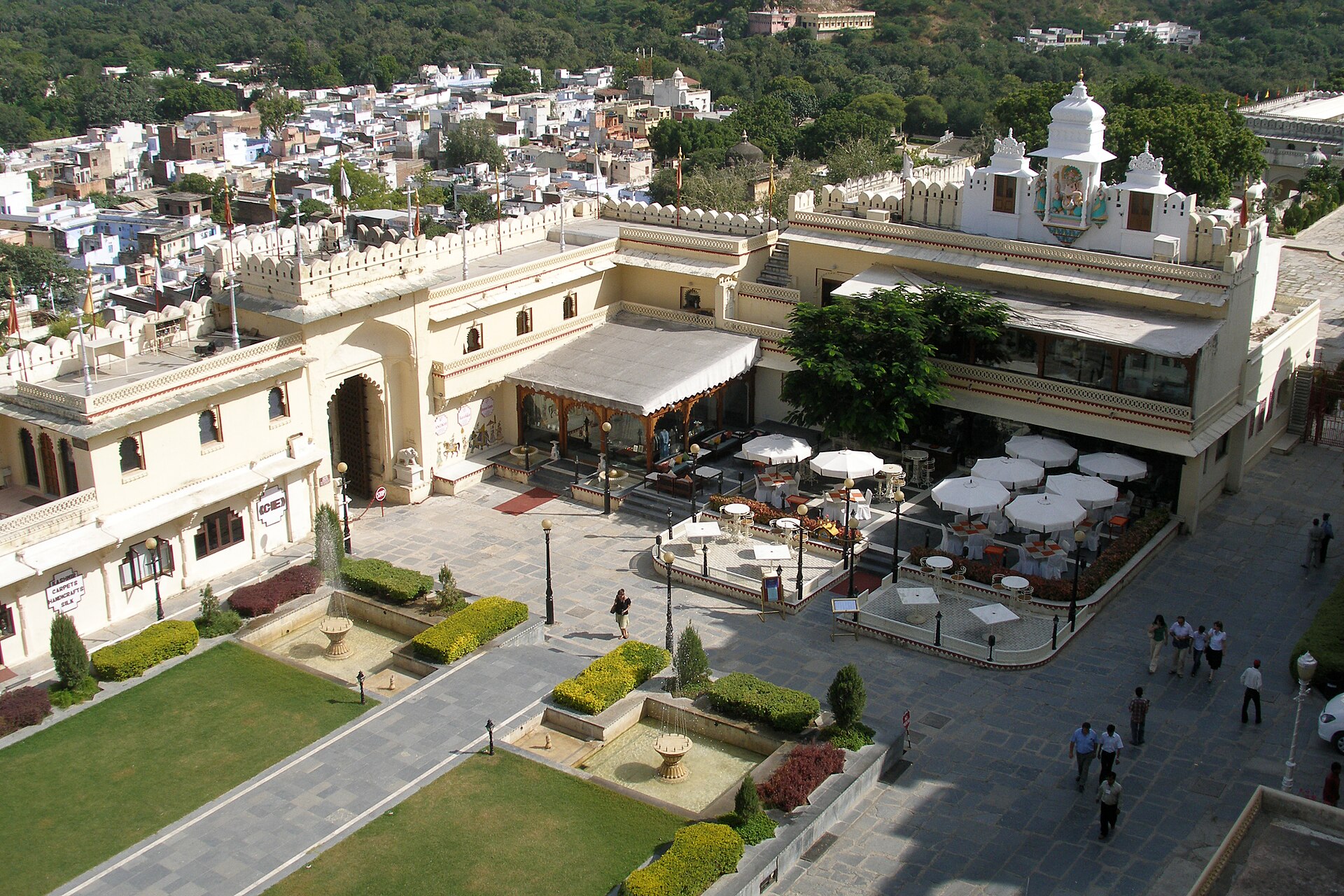
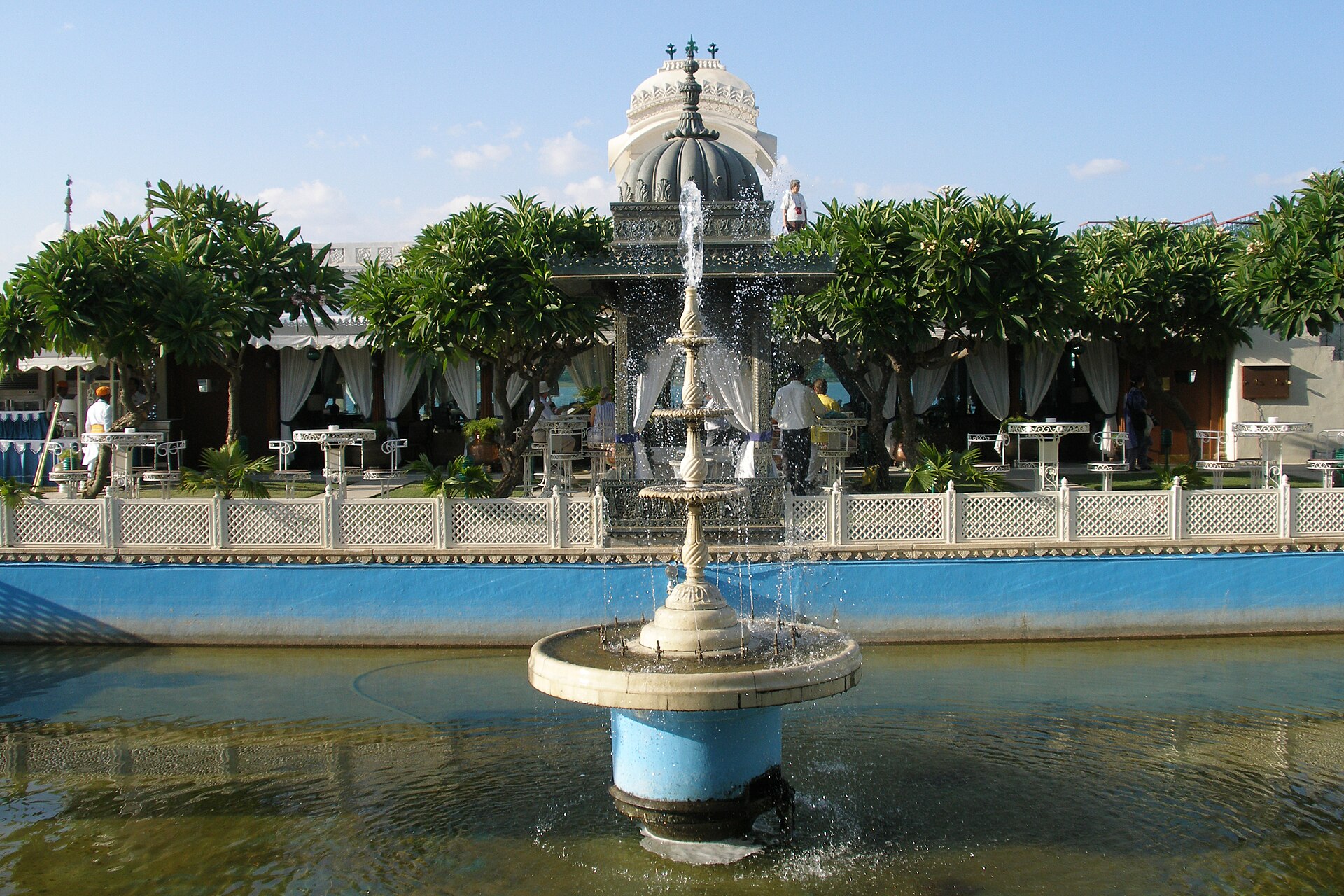
Udaipur, India, Jag Mandir Palace, Fountains · Vyacheslav Argenberg · CC BY 4.0 · cropped
Where to base yourself
There is really one big decision, and everything else follows from it: base inside the old city on the east bank, or on and across the water where the resorts and palaces sit. They are close on the map and completely different to wake up in.
The old city: Lal Ghat, Gangaur Ghat, and Jagdish Chowk
This is the walkable heart of Udaipur, the tangle of lanes above the eastern ghats. Staying here usually means a haveli, a traditional townhouse turned into a small hotel, often with a rooftop restaurant looking across the lake to the City Palace and the Lake Palace. You can walk to the temple, the ghats, the bazaars, and the boat jetty. The trade-offs are the ones any old city carries: narrow lanes, some noise, steep stairs instead of lifts, and streets a car cannot always reach. For most first-time visitors the atmosphere is worth it.
On and across the lake
The other choice is the water or the far bank, where the large hotels have room for gardens, pools, and quiet, and the island palaces are reached in some cases only by the hotel boat. You trade the street life and the short walk to the sights for calm, space, and service.
Out in the hills
A third option is to leave the city for the countryside — most often the village of Delwara, about forty minutes out, where a restored palace looks over the Aravalli hills. This suits travellers who want deep quiet and do not mind a drive into town to sightsee.
Stay in the old city and Udaipur comes with temple bells, motorbikes, and lanes too narrow for a car. Stay on the water and you trade that for calm and a pool. The lake looks much the same from both shores; what you hear from the window does not.
| Base | Feels like | Best for | Trade-off |
|---|---|---|---|
| Island or lake palace | On or over the water, reached by boat | The view, calm, a proper pool | A boat or car from the street life |
| Inside the City Palace | Grand rooms within the palace walls | History, a short walk to the lake | Formal, among the busiest sights |
| Old-city haveli | Lanes, ghats, rooftops over the lake | Atmosphere, walking everywhere | Noise, stairs, cars can't reach the door |
| Out in the hills | A quiet countryside palace | Deep calm, space, slow days | You drive into town for everything |
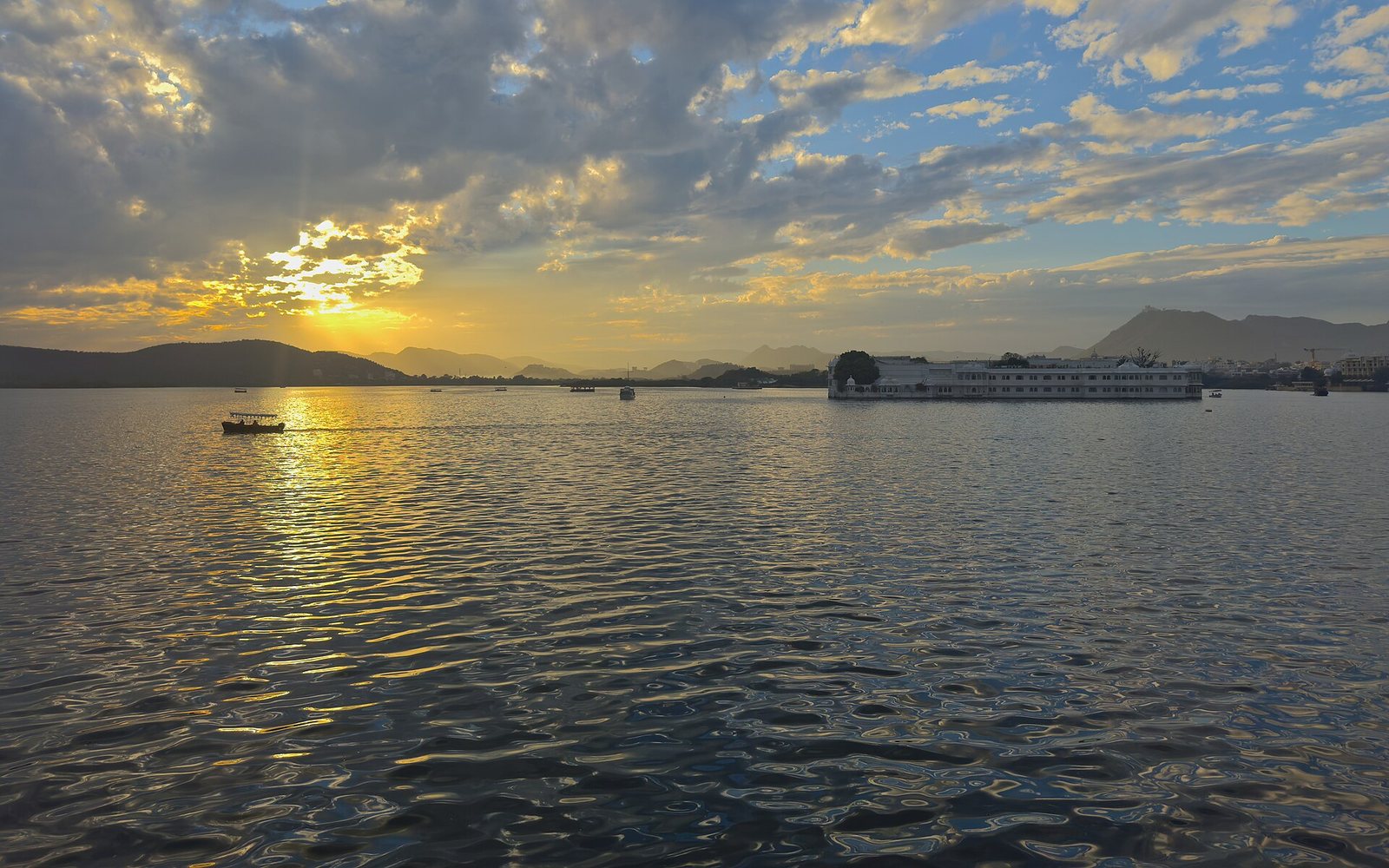
Lake Pichola at sunset, Udaipur, Rajasthan, India · UnpetitproleX · CC BY-SA 4.0 · cropped
The palaces you can sleep in
These are established, verifiable places to stay, grouped by character rather than price. Rates in Udaipur swing hard with the season, so book early for the cool months and confirm directly with each hotel.
On the water: the island and lakeside palaces
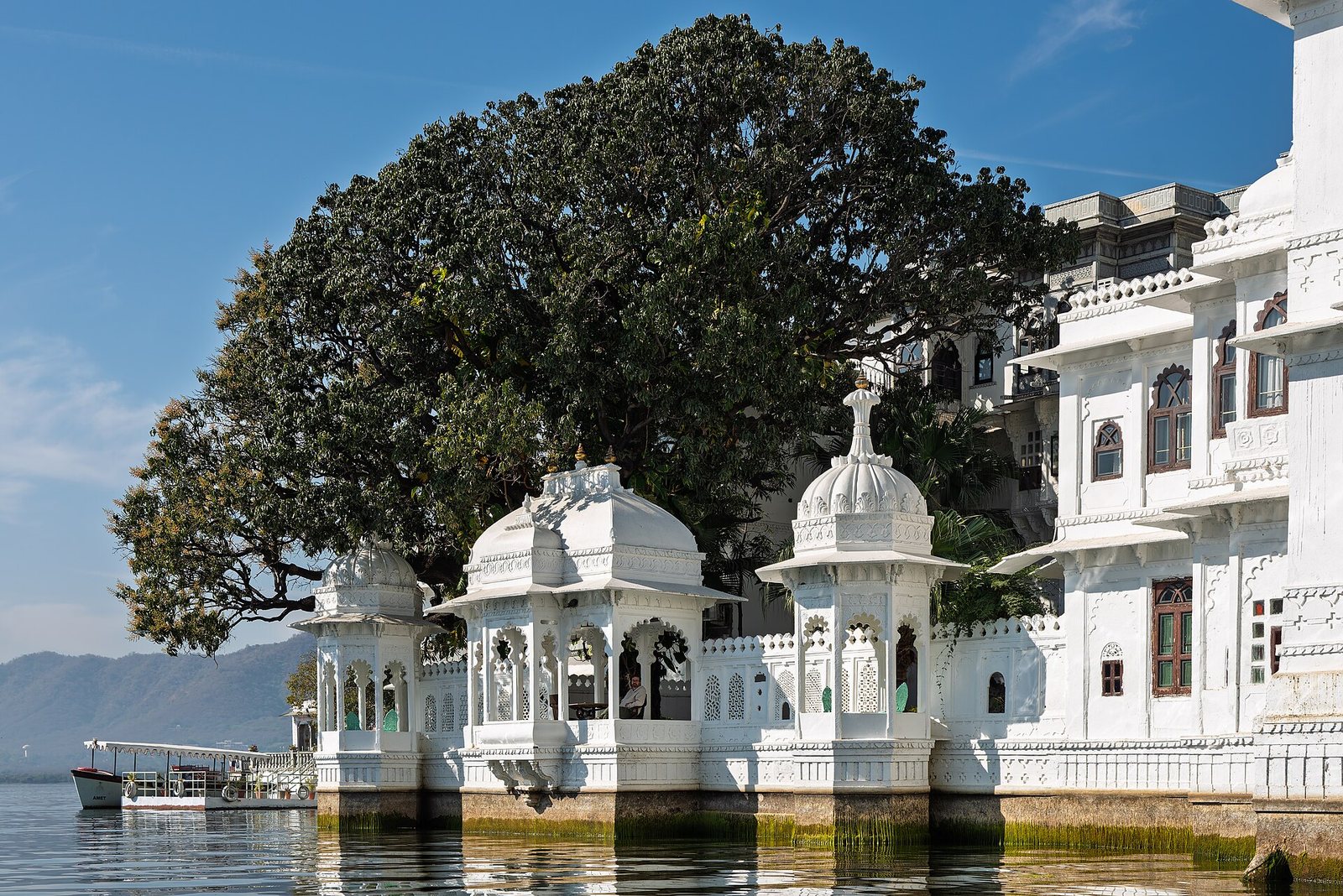
Taj Lake Palace is the white marble palace that appears to float on Lake Pichola. It was built as a royal summer residence on the island of Jag Niwas in the 1740s, in the reign of Maharana Jagat Singh II, opened as a hotel in the 1960s, and has been run by Taj Hotels since 1971. You reach it only by the hotel boat, and that is the point: a night here is a night on the lake, with the City Palace lit across the water. It is the picture most people carry of Udaipur.
The Oberoi Udaivilas is the more spacious alternative, and often the quieter one. It stands on the western bank of Lake Pichola on former royal hunting grounds, a modern hotel built in the older Mewar style, with some thirty acres of gardens, domes, and courtyards, a large pool, and long views back across the water to the city.
The Leela Palace Udaipur is the newest of the big lakeside hotels, on the same side of the water, with rooms facing the lake and the City Palace beyond. Its signature arrival is by the hotel's own electric boat across the lake, though a road entrance exists for guests who would rather drive in.
Inside the City Palace: the HRH hotels
Part of the vast City Palace complex is run as hotels by Historic Resort Hotels, the hospitality arm of the former Udaipur royal family. Staying here puts you inside the palace walls, a short walk from the museum and the lake.
- Shiv Niwas Palace is the crescent-shaped former royal guesthouse, built in the reign of Maharana Fateh Singh in the early twentieth century, with a courtyard pool and rooms from comfortable to grand.
- Fateh Prakash Palace stands next door in the same complex, a more formal palace hotel overlooking Lake Pichola.
Heritage havelis in the old city
For the old-city location without a palace budget, the havelis along the eastern ghats are the answer. Jagat Niwas Palace, a converted seventeenth-century haveli on Lal Ghat, is the best known, with lake-facing rooms and a well-regarded rooftop restaurant over the water. There are many smaller family-run havelis in the same lanes; what separates a good one is the walk to the ghats, whether the room actually faces the lake, and how high the rooftop sits.
Out in the hills
RAAS Devigarh is an eighteenth-century palace in the village of Delwara, about forty minutes from the city, restored over many years and reopened as an all-suite hotel around the turn of the 2000s. It looks over the Aravalli countryside rather than the lake, the pick for travellers who want hills and quiet over the bustle of town.
What drives the price
Three things move the rate most: the season, whether the room faces the lake, and whether you are on the water at all. A lake-view palace room in January sits at the top of the range; the same hotel in the monsoon, or a courtyard-facing room, costs far less. Book the popular lake hotels months ahead for the winter.
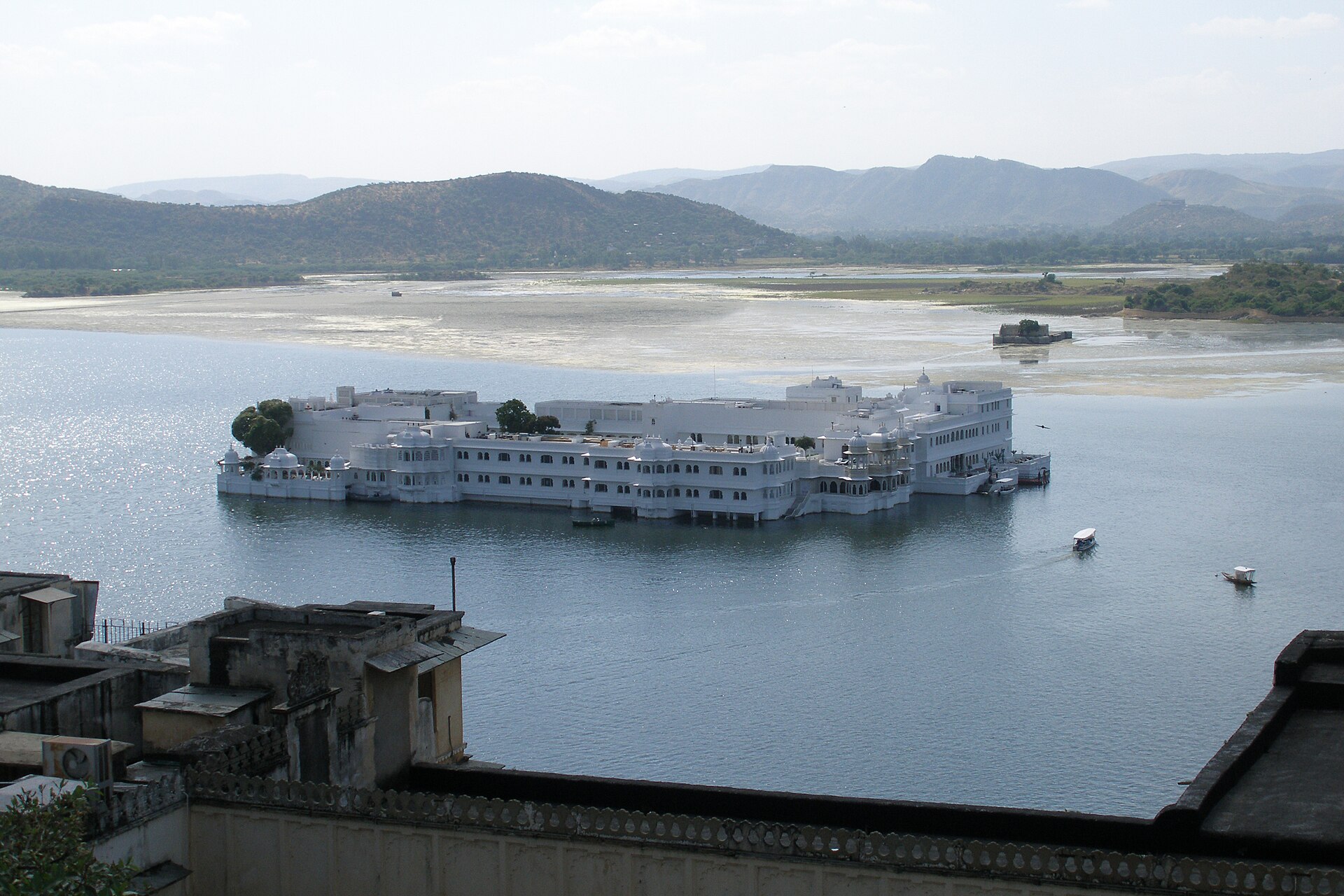
Udaipur, India, Lake Palace on Lake Pichola · Vyacheslav Argenberg · CC BY 4.0 · cropped
The City Palace and the old city
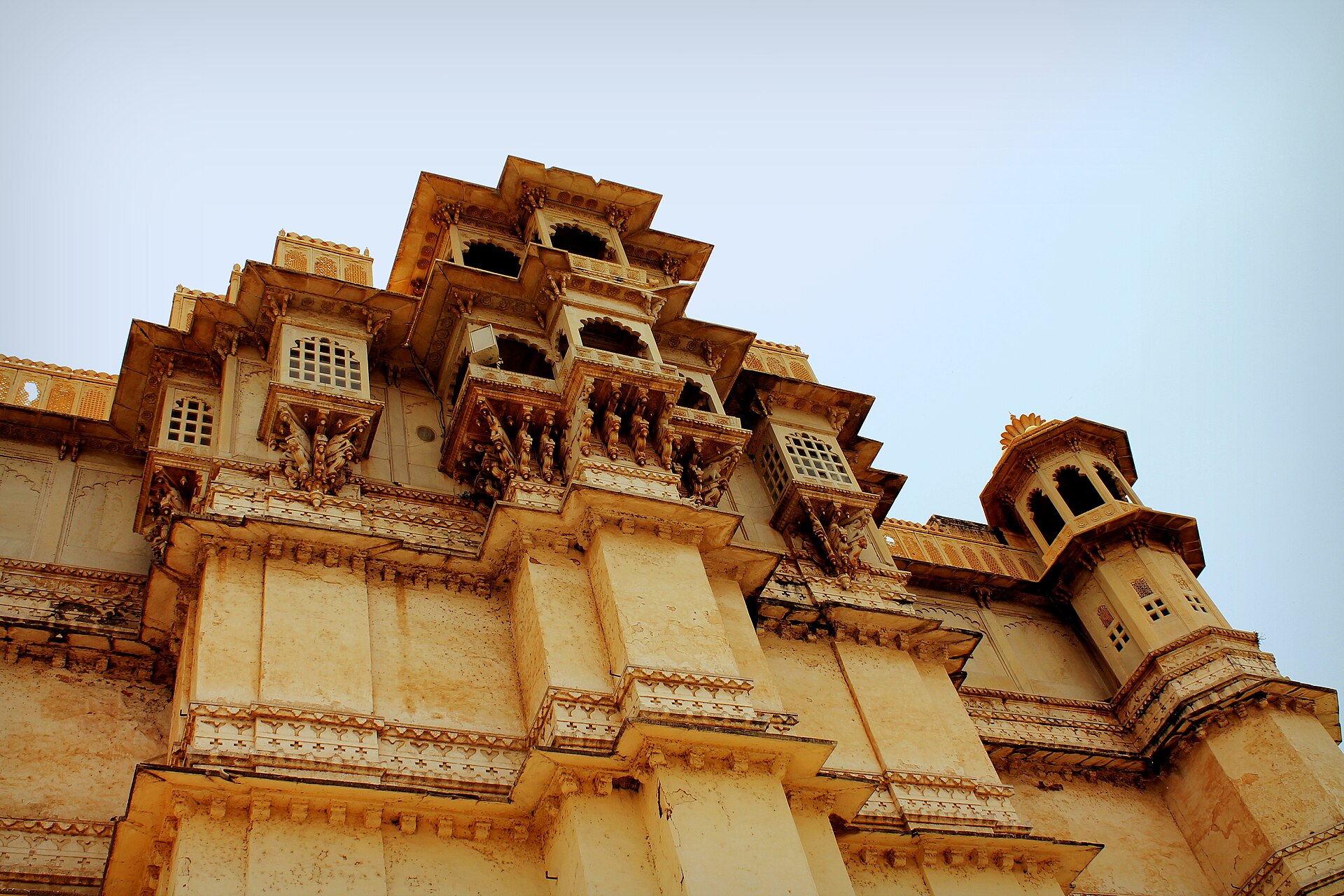
The City Palace of Udaipur is the obvious first stop, and the largest palace complex in Rajasthan. Begun by Maharana Udai Singh II and built up by his successors over roughly four hundred years, it reads as a run of connected palaces rather than a single building: courtyards inside courtyards, painted rooms, mirror and glass work, and balconies that lean out over Lake Pichola. Part is a museum open to visitors, part is still used by the former royal family, and part is the HRH hotels. Give it a couple of hours at least.
From there the rest of the old city is close, most of it on foot.
- Jagdish Temple, a short walk up from the palace, is a large working Hindu temple finished in 1651 and dedicated to Vishnu. It is active and busy, so leave your shoes at the door and dress modestly.
- Bagore ki Haveli, on Gangaur Ghat, is an eighteenth-century mansion built by a Mewar prime minister, now a museum. In the evenings its courtyard hosts the Dharohar show of Rajasthani folk dance and puppetry, one of the easier ways to see the region's dance.
- Saheliyon ki Bari, the Garden of the Maidens, is an eighteenth-century pleasure garden of fountains, pools, and marble pavilions laid out for the women of the court.
- The Monsoon Palace, or Sajjangarh, is an 1884 hilltop palace on a ridge west of the city, inside a wildlife sanctuary. People go up for the long view over the lakes at sunset rather than for the building itself.
The other thing to do is get out on the water. Boats run on Lake Pichola through the day, with a stop at the island of Jag Mandir, and the late-afternoon departures that catch the light on the City Palace are the ones people plan around. Come evening, the classic Udaipur dinner is on a rooftop above the ghats, with the palace lit up across the lake.
Good to know
The main Lake Pichola boat jetty sits inside the City Palace complex, so a lake cruise can mean buying a palace or boat ticket on top of the ride itself — check what your ticket covers before you queue. Sunset departures are the most popular and can sell out in the busy months, so buy ahead or take an earlier slot. Many indoor sights close in the late afternoon while the boats and the Monsoon Palace are best at dusk, so keep the museums for the middle of the day. The airport, code UDR, is about 22 km east, usually a 30 to 45 minute drive.
When to go
Season matters more than almost anything else in Udaipur. Come in the cool, dry months if you can, roughly October to March, with November to February the most comfortable stretch for walking the old city and sitting out on a rooftop at night. These are also the busiest and priciest months, and the lake hotels book out well ahead for the winter.
March, the tail of the cool season, is one of the better windows: warm, clear days, mild nights, and the deep-winter crowds beginning to thin, though it warms up noticeably by the end of the month. The hot season proper runs from about April to June, before the rains, when afternoons can climb past 40°C (about 104°F) and sightseeing becomes an early-morning-and-evening affair. The monsoon follows from roughly July to September — humid and green, with rain in bursts rather than all day. It is the quieter, cheaper season, and the lakes refill, at the cost of some grey, washed-out afternoons. Temperatures and rainfall vary from year to year, so treat these as broad patterns rather than a forecast.
Festivals are worth checking against your dates, since many follow the lunar calendar and move from year to year: the spring Mewar Festival, tied to the Gangaur celebrations, and the autumn lights of Diwali are the big ones, and both make the city busier than usual.
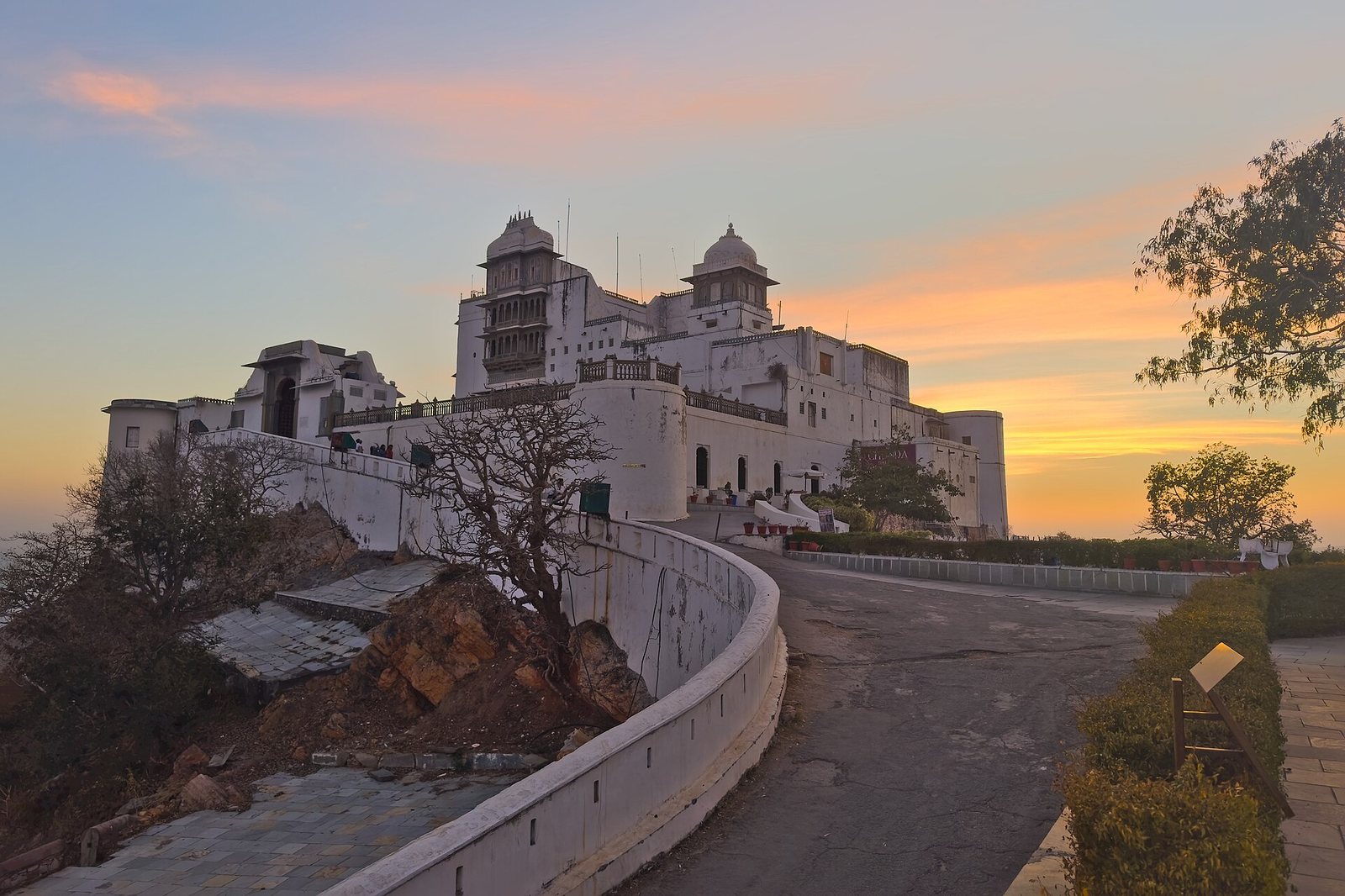
Sajjangarh Monsoon Palace at dusk, Udaipur, Rajasthan, India · UnpetitproleX · CC BY-SA 4.0 · cropped
Getting there and getting around
Getting in
Maharana Pratap Airport, code UDR, at Dabok about 22 km east of the city, is the usual way in, with domestic flights from Delhi, Mumbai, and other Indian cities. There is no significant international service, so most overseas visitors connect through Delhi or Mumbai. The other common arrival is by train, into Udaipur City station, on overnight and daytime services from Delhi, Jaipur, and beyond.
- From the airport or station, a prearranged hotel car is the smoothest option, and for the lake palaces it is close to essential, since the last stretch is by the hotel boat.
- By road, Udaipur connects to Jaipur and Jodhpur in a long half-day of driving each, which is why it often sits at the start or end of a Rajasthan road trip. Treat drive times as generous, since the roads wind through hills.
- In the old city, cars cannot reach some haveli doors. A good hotel will tell you the nearest point a vehicle can reach and, where needed, meet you there.
Getting around
Once you are settled, the old city is best on foot — it is compact, and much of it is closed to cars anyway. For anything further, auto-rickshaws and taxis are easy to find, and it is normal to agree the fare before you set off rather than expect a meter. On the lakes, the boats double as transport as much as sightseeing.
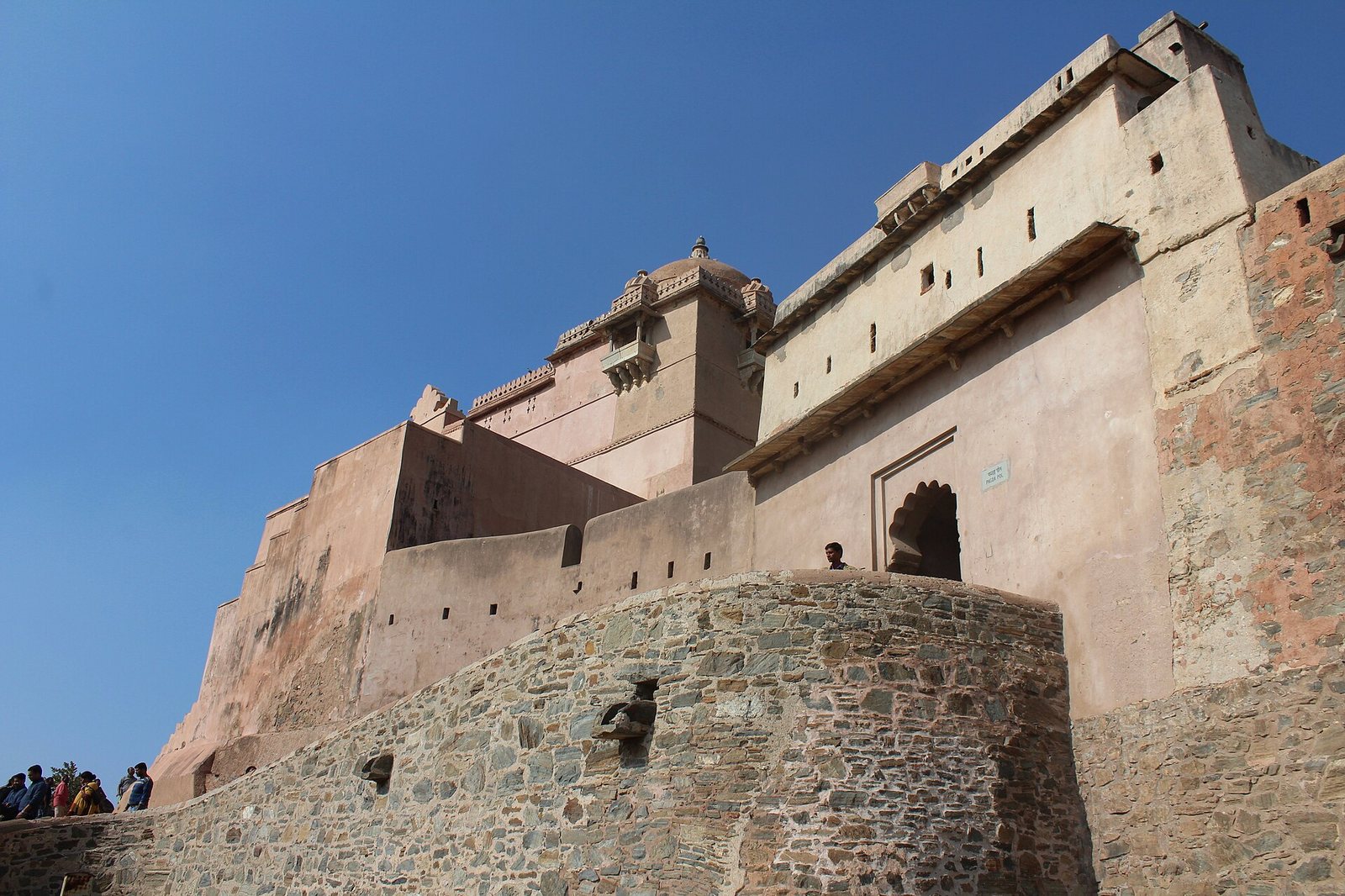
Kumbhalgarh Fort, Rajasthan 08 · Varada Phadkay · CC BY-SA 4.0 · cropped
Kumbhalgarh and Ranakpur
The countryside north of Udaipur holds two of the finest historic sites in Rajasthan, usually combined into one long day out.
- Kumbhalgarh is a fifteenth-century hill fort built by Rana Kumbha, wrapped in a perimeter wall often called the Great Wall of India — one of the longest continuous walls in the world, running for around 36 km along the ridges. It is a UNESCO World Heritage Site, listed among the Hill Forts of Rajasthan, about two hours from the city by road, and remembered as the birthplace of Maharana Pratap.
- Ranakpur, roughly 33 km on from Kumbhalgarh, is a fifteenth-century Jain temple of white marble dedicated to Adinath, known for its forest of carved columns — 1,444 of them, and no two said to be alike. It is an active place of worship, with set visiting hours for non-worshippers, rules on dress, and leather items usually restricted.
Doing both in a day means a fair amount of driving, but the pairing of the great wall and the carved temple is worth the early start. A hired car and driver, arranged through your hotel, handles the logistics; some travellers break the trip with a night near Kumbhalgarh rather than return the same evening.
Kumbhalgarh Fort, Rajasthan 02 · Varada Phadkay · CC BY-SA 4.0 · cropped
Food and practicalities
The regional cooking is Mewari, a branch of Rajasthani food shaped by a hot, dry land and a strong vegetarian tradition. The dish to know is dal baati churma: baked wheat balls broken into lentils, served with a sweet, crumbled churma. You will also see gatte ki sabzi, gram-flour dumplings in a yoghurt gravy, and ker sangri, a tangy dish of dried desert beans and berries. Meat-eaters should look for laal maas, a fiery red mutton curry, though many kitchens here, especially in the old city, are vegetarian by choice. A thali — the compartmented platter that lets you try several dishes at once — is the easy way in.
In the old city the rooftop is the classic place to eat, restaurants stacked above the ghats looking out at the City Palace and the Lake Palace on the water. The view is the draw and the food is usually solid rather than remarkable, though a few of the haveli hotels, Jagat Niwas among them, do it better than most. Alcohol is served in hotels and licensed restaurants but not everywhere, so do not assume a rooftop will have a bar.
- Temples and Jain sites. Remove your shoes, cover your shoulders and knees, and expect leather belts, bags, and straps to be restricted at Jain temples such as Ranakpur.
- Cash and cards. Cards and phone payments work in hotels and larger shops, but keep some cash for auto-rickshaws, small cafes, temple donations, and the bazaars, where bargaining is normal.
- Heat and sun. Even in the cool season the midday sun is strong: carry water, wear a hat, and in the hot months pace the sightseeing around the middle of the day.
- A local quirk. Parts of the 1983 James Bond film Octopussy were shot in Udaipur, and small cafes still screen it most evenings — harmless tradition more than a must-see.
By the numbers
Common questions
How many days do I need in Udaipur?
Two to three nights covers the city without rushing: the City Palace, the temple and the ghats, a boat on the lake, a garden or two, and time to just sit above the water. Add a night to fold in the Kumbhalgarh and Ranakpur day out, which is long, or simply to slow down.
Is it better to stay in a lake palace or in the old city?
It depends on what you want. A lake or island palace gives you calm, space, a pool, and the view everyone comes for, at the cost of being a boat or a car from the street life. A haveli in the old city puts you a short walk from the temple, the ghats, and the bazaars, with a rooftop over the water, at the cost of noise and stairs. Many people do a night or two of each.
Can I visit the Taj Lake Palace if I am not staying there?
The island is private to hotel guests, but non-guests can sometimes visit by booking a meal there, subject to availability and a minimum spend, with the hotel arranging the boat across. It is not a walk-up sight, so arrange it well in advance and expect it to depend on how full the hotel is.
What should I wear at the temples?
Dress modestly: cover your shoulders and knees, and take your shoes off before going in. At Jain temples, including Ranakpur, leather items are often not allowed inside, so plan to leave belts and leather bags behind or in the car.
Is Udaipur a good place for families?
Yes. The boat rides, the gardens, the palace with its courtyards and museum, and the folk-dance evening at Bagore ki Haveli all work well with children, and the parts of the city where you will spend most time are walkable. The main things to manage are the midday heat in the warmer months and the busy lanes and ghats.
When is the best time to go?
For most people, November to February: warm days, cool evenings, and the lakes at their fullest after the monsoon. March is a fine shoulder alternative with thinner crowds. It is the busiest and priciest window for exactly that reason, so book the popular hotels well ahead.
Sources & further reading
- Rajasthan Tourism — Lake Pichola and Udaipur, the official state guide
- The City Palace Museum, Udaipur — the official museum site
- Taj Hotels — the Lake Palace on the island of Jag Niwas
- The Oberoi Udaivilas — the lakeside resort on the western bank
- Incredible India — Kumbhalgarh Fort and its perimeter wall
- Wikipedia — Ranakpur Jain temple and its 1,444 marble pillars