Valle de Guadalupe: Colours of a Dry Valley
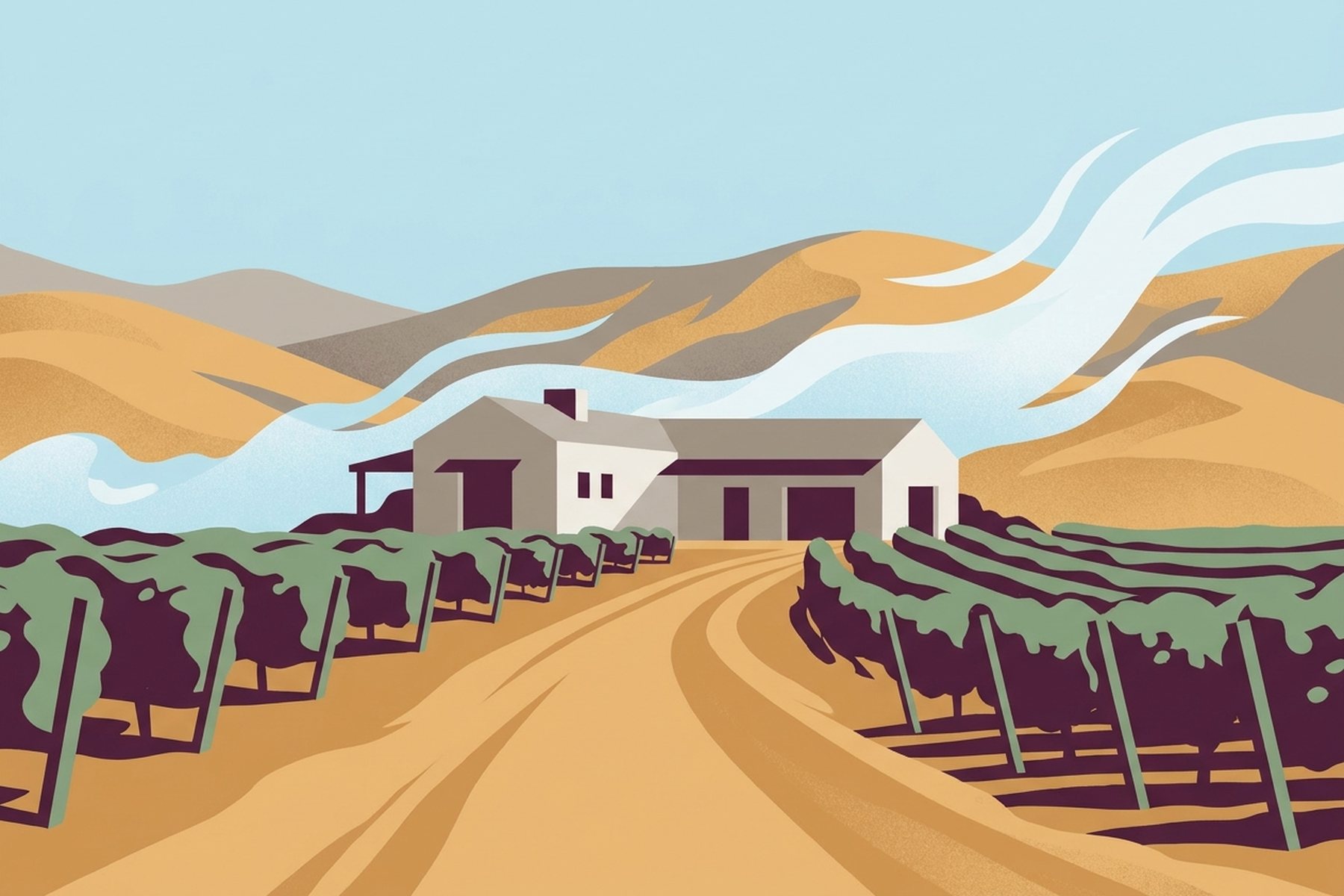
I am working on a drawing of a winery guesthouse in Valle de Guadalupe, focusing on the unique light and earthy palette of the region.
My tube of Dusty Ochre paint is almost empty. It’s the colour of so many places we cover, the colour of dry earth and sun-baked roads. For this month’s cover story on Valle de Guadalupe, it’s proving essential, along with a few other carefully chosen tones, to convey the feel of that wide, dry valley.
Our guide explains that Valle de Guadalupe is not a single town you arrive in. It’s a spread-out area of vineyards and olive groves, about half an hour inland from Ensenada. The landscape is defined by low, dry hills, and getting around often means navigating dirt side-roads. The weather brings hot, bright days and cool nights, with Pacific fog that usually burns off by mid-morning. This combination of dry terrain and specific light conditions gives the valley its particular visual character.
I’m drawing a specific scene: one of the small design hotels, a simple structure, set back from a dirt road. It’s among rows of ripening vines, with the dry hills rising gently behind it. The viewpoint is slightly low, looking towards the building and the distant hills, allowing the foreground to be dominated by the texture of the road and the patterned lines of the vineyard. It conveys a sense of quiet and the remote nature of the region, where you wake up right in the wine country.
The palette I’m using is tightly controlled, just six colours. The Dusty Ochre defines the dirt road and the parched earth leading up to the vines. For the vineyards themselves, I use a Sage Green for the general foliage, with touches of a deeper Deep Plum where the grapes are ripening and in the shadows cast by the leaves. The building itself is rendered in a Warm Grey, a tone that also appears in the texture of the distant dry hills, suggesting the local stone or a similar material. The sky, just clearing, is a Pale Sky Blue, and I use a touch of Soft White to show the last remnants of the Pacific fog lifting, catching the bright mid-morning light on the building’s edges.
That mid-morning light is crucial. It’s not the harsh midday sun, nor the soft glow of late afternoon. It’s the light after the fog has burned off, clear but still with a certain softness, illuminating the textures of the dry earth and the individual leaves on the vines. It creates defined shadows but without extreme contrast, allowing the muted colours to come forward.
The challenge is to simplify without losing the sense of place. I’ve left out any specific details that would identify a real, named property, focusing instead on the archetypal elements: the geometry of the building, the repetitive lines of the vines, the uneven track of the road, and the soft, rounded forms of the hills. It’s about the interplay of these elements, held together by the light and the limited colour range. The final brushstrokes define the slight unevenness of the dirt road, giving it a tangible surface.
From Vol. 2 · No. 09 · September 2026. This column draws on the magazine's guide to Valle de Guadalupe. Details change; confirm specifics with the property before you travel.
More drawings
The columns, every month.
One considered letter when a new issue lands: the cover story, the columns, the drawings and the month's news.