At a glance
- Base
- Kochi (Fort Kochi), with options for backwaters (Alappuzha/Kumarakom) and tea hills (outside Munnar)
- When
- November (lush, fewer crowds, lower prices) or December to February (peak season, dry, comfortable, busy)
- Getting there
- Fly into Kochi (main airport); travel by train for coastal distances or hire a car with driver
- Getting around
- Coastal railway for main towns; car with driver essential for backwater moorings and hill estates
- Book ahead
- Hill stays, good backwater properties, and quality houseboats should be booked well in advance
- The price
- Peak season (Dec-Feb) is most expensive; monsoon (Jun-Sep) is cheap; food is generally inexpensive
Lay of the land
Kerala is a long, narrow state pressed between the Arabian Sea and the Western Ghats, roughly six hundred kilometres of coast and rarely more than a hundred kilometres deep. That shape decides everything. Rivers run west off the mountains, and where they reach the flat coastal plain they slow, spread and link up into the backwaters: a connected system of lakes, canals and lagoons that runs parallel to the sea for much of the state's length. Vembanad, the longest lake in India at about ninety-six kilometres, lies at the centre of it, and the two best-known backwater towns, Alappuzha (still widely called Alleppey) and Kumarakom, face each other across its water.
Inland, the land rises in three broad bands. First the coast and the backwaters at sea level, then a green midland of rubber, coconut, rice and spice gardens, and finally the high Ghats, where the road climbs into tea and cardamom country around Munnar and Thekkady. The far north holds Wayanad's plateau; the south holds the capital, Thiruvananthapuram, with the cliff beach at Varkala a little to its north and the older resort strand at Kovalam just south of it.
For a first trip, the state divides cleanly into four experiences: the backwaters, the old port city of Kochi, the tea hills, and the outer corners of coast and highland. You cannot see all four properly in a week without spending most of the week in a car. Distances look small and read slow, because the roads are winding, wet and busy. The trip that works picks three of the four and gives each a couple of nights, rather than skimming all of them and remembering only the traffic.
The through-line is water. The backwaters were a trade network long before they were a holiday, moving rice out of the below-sea-level fields of Kuttanad and spice down to the coast. Kochi grew rich as the port where that spice met the world. Even the hills earn their tea because the monsoon that fills the backwaters drenches the Ghats first. Understanding a Kerala itinerary is mostly understanding where the water goes.
Where to base
Start in Kochi. It has the main airport, the deepest history, and enough to hold two nights on its own, and it sits within easy reach of the backwaters. From there the classic loop runs south-east to Alleppey or Kumarakom for the water, then up into the hills at Munnar, and back to Kochi to fly out. That triangle — port, backwater, tea — is the trip most people should take, and it can be done well in seven or eight nights.
In the city, stay in Fort Kochi rather than the newer mainland districts of Ernakulam across the harbour. Fort Kochi and neighbouring Mattancherry are walkable, low-rise and layered with Portuguese, Dutch and British building, and the good heritage guesthouses are here. Ernakulam is where the offices, malls and railway station are; it is convenient for trains but has none of the atmosphere.
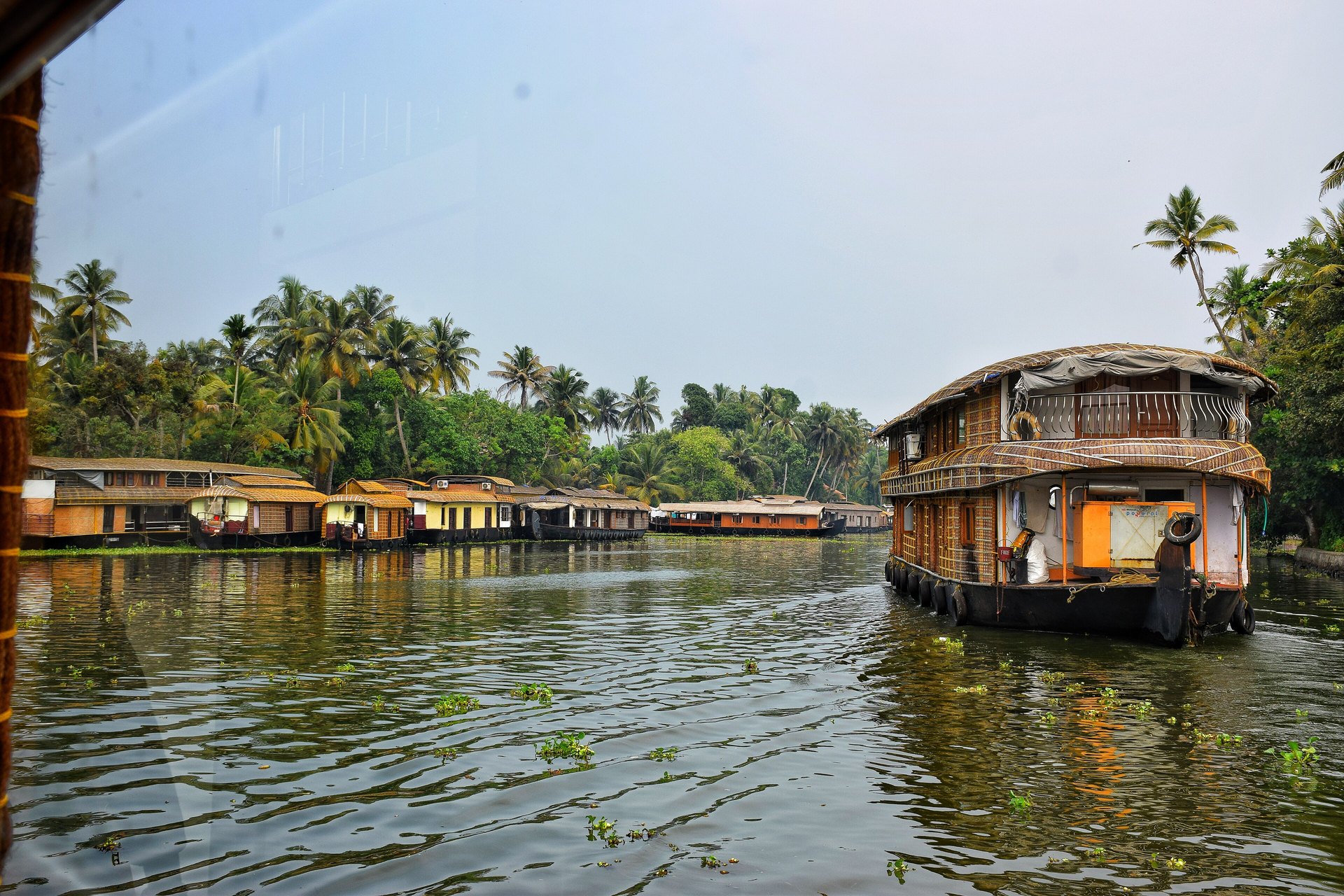
For the backwaters, the real decision is Alleppey versus Kumarakom. Alleppey is the busier hub, the town most houseboats leave from, and the place to be if you want a boat and a working canal town around it. Kumarakom, on the eastern shore of Vembanad, is quieter and more resort-shaped, with a small bird sanctuary and a cluster of lake lodges. If you want one night afloat and some life around the docks, choose Alleppey; if you want to sit still on a lawn by the lake and barely move, choose Kumarakom.
Give the backwaters one slow night, not three: the water looks the same at dawn on the second morning, and the tea hills are only half a day away.
In the hills, base yourself outside Munnar town rather than in it. Munnar itself is a scruffy market town with real traffic; the tea estates and the good stays are strung along the roads above and around it, often twenty minutes out. Thekkady, at Periyar, is a further two to three hours on and works as a second hill night if you want a wildlife reserve as well as tea, but it is an add-on rather than a substitute. Wayanad and the southern beaches are for second visits or longer trips; trying to bolt Varkala onto the port-backwater-tea loop turns a relaxed week into a driving marathon.
Chinese Fishing Nets - 3 · Ingo Mehling · CC BY-SA 4.0 · cropped
Where to sleep
Four kinds of room define a Kerala trip, and it is worth knowing what each one is really like before you book.
The houseboat, or kettuvallam, is the signature stay and the one to be clear-eyed about. These are the old rice barges, their hulls once lashed together with coir rope and no nails, now rebuilt with cane-arched roofs, bedrooms, a small crew and a cook. A night on one is genuinely worth doing: you drift out through the narrow canals, moor against a paddy bank for the evening, eat fish cooked on board and wake to mist on the water. But the fleet out of Alleppey is large, the standard varies enormously, and many boats spend the afternoon in a slow procession along the same wide stretch. Book a smaller, better-run boat rather than the cheapest, ask for one that cruises the narrow canals rather than only the open lake, and take a single night. Two nights afloat is one too many for most people.
The lake resort is the alternative to the boat, and around Kumarakom there are a handful of well-known ones on the water; Coconut Lagoon, reached only by boat, and Kumarakom Lake Resort are the names most often mentioned, and both are established properties rather than anything invented for a brochure. Expect to pay a good deal for them in the December-to-February season. A resort night pairs well with a houseboat night: one moving, one still.
In Fort Kochi, stay in a heritage guesthouse — a restored merchant's or colonial-era house turned into a small hotel, of which there are many, with courtyards, antique furniture and a handful of rooms. This is the most characterful lodging in the state and often the best value. Up in the tea country, the equivalent is a planter's bungalow or an estate stay, where you sleep among the tea itself; these range from simple homestays to a few grand old bungalows, and the view is the point.
The fourth kind is the Ayurveda retreat, and it pays to know what you are booking. Kerala's Ayurveda is real, old and taken seriously; it is also heavily marketed, and a two-hour massage at a beach hotel is not the same as a supervised course of treatment at a proper centre. A genuine programme runs for a week or more, involves diet, a consulting physician and daily therapy, and is traditionally done in the monsoon. If that is what you want, book a dedicated centre and commit the time. If you only want a good massage, any decent hotel spa will do and you needn't build the trip around it.

Mattancherry Palace DSC 0899 · Ranjith Siji · CC BY-SA 4.0 · cropped
When to go
Kerala's year turns on the monsoon, and November — the month of this issue — sits in the good green gap just after it. The south-west monsoon, the big one, runs roughly from June into September and gives Kerala the first rains of the Indian monsoon each year; a weaker retreating, or north-east, monsoon follows in October and into November. By late November the heavy rain has usually eased, the reservoirs and paddies are full, the Ghats are at their greenest, and the crowds and the highest prices of the December-to-February peak have not yet arrived. Days are warm and humid on the coast, cooler in the hills; you should still expect the odd downpour, and you should still book hill stays ahead, but you travel in the landscape at its lushest for less than you would pay a month later.
The trade-offs by season are straightforward. December to February is the peak: reliably dry, comfortable, and the most expensive and busy, especially around Christmas and New Year, when the good backwater and hill properties fill months in advance. March to May is hot and increasingly humid on the plains, though the hills stay bearable. June to September is the monsoon proper — dramatic, cheap, and the traditional season for Ayurveda treatment, which is why serious retreats fill then; the backwaters are full but grey, and hill roads can be affected by rain. November threads between all of this, which is why it is the month we would send a first-time visitor.
Time your trip to the land, not to festivals you cannot rely on. Onam, the big Kerala harvest festival, falls in August or September; the snake-boat races run through the Onam season, the best known being the Nehru Trophy Boat Race, traditionally held in August on Punnamada Lake at Alappuzha, though the date has shifted in recent years. A November traveller will miss the races. Theyyam, the ritual masked performance of the northern districts, generally runs from around December into spring. Kathakali, the classical dance-drama, you can see year-round at tourist performances in Kochi. Do not build a schedule around catching a specific festival unless the dates are confirmed; build it around the weather, and treat any festival you do catch as a bonus.
Munnar Tea Plantation and Trees · Kondephy · CC BY-SA 4.0 · cropped
Getting there
Four airports now serve the state, and which you use shapes the trip. Cochin International Airport, at Kochi, is the main gateway, with the widest choice of international and domestic flights and the useful distinction of being run largely on solar power. Thiruvananthapuram, the capital, has the second airport and suits a southern trip built around Varkala and Kovalam. Kozhikode (Calicut) serves the Malabar coast and Wayanad from the north, and Kannur, opened in 2018 further up the coast, is the newest gateway for the far northern districts. For the standard port-backwater-tea loop, fly into and out of Kochi.
On the ground, the choice is between the train and the car. Kerala has a good coastal railway line running the length of the state, and trains between the main towns — Thiruvananthapuram, Kollam, Alappuzha, Ernakulam for Kochi, and on north — are cheap, scenic and a fine way to cover the flat coastal distances. But the backwater moorings and the hill estates are not on the railway, so most visitors hire a car with a driver for at least part of the trip. This is a normal, affordable way to travel here and takes the strain out of the winding hill roads; agree the route and the daily rate in advance.
Reckon on the distances being slow. Kochi to Alleppey is only about fifty kilometres but takes well over an hour; Alleppey to Kumarakom is a short hop around the lake; Kochi up to Munnar is around four hours of climbing road for something like a hundred and thirty kilometres, and Munnar on to Thekkady another two to three. The single routing mistake to avoid is trying to touch the far south and the hills in the same week from Kochi: the map tempts you, and the roads punish you for it. Pick your triangle, keep the drives short, and let the car days be part of the trip rather than a penance between highlights.
Sunset with Chinese Fishing Nets, Fort Kochi 2 · Rangan Datta Wiki · CC BY-SA 4.0 · cropped
What to see
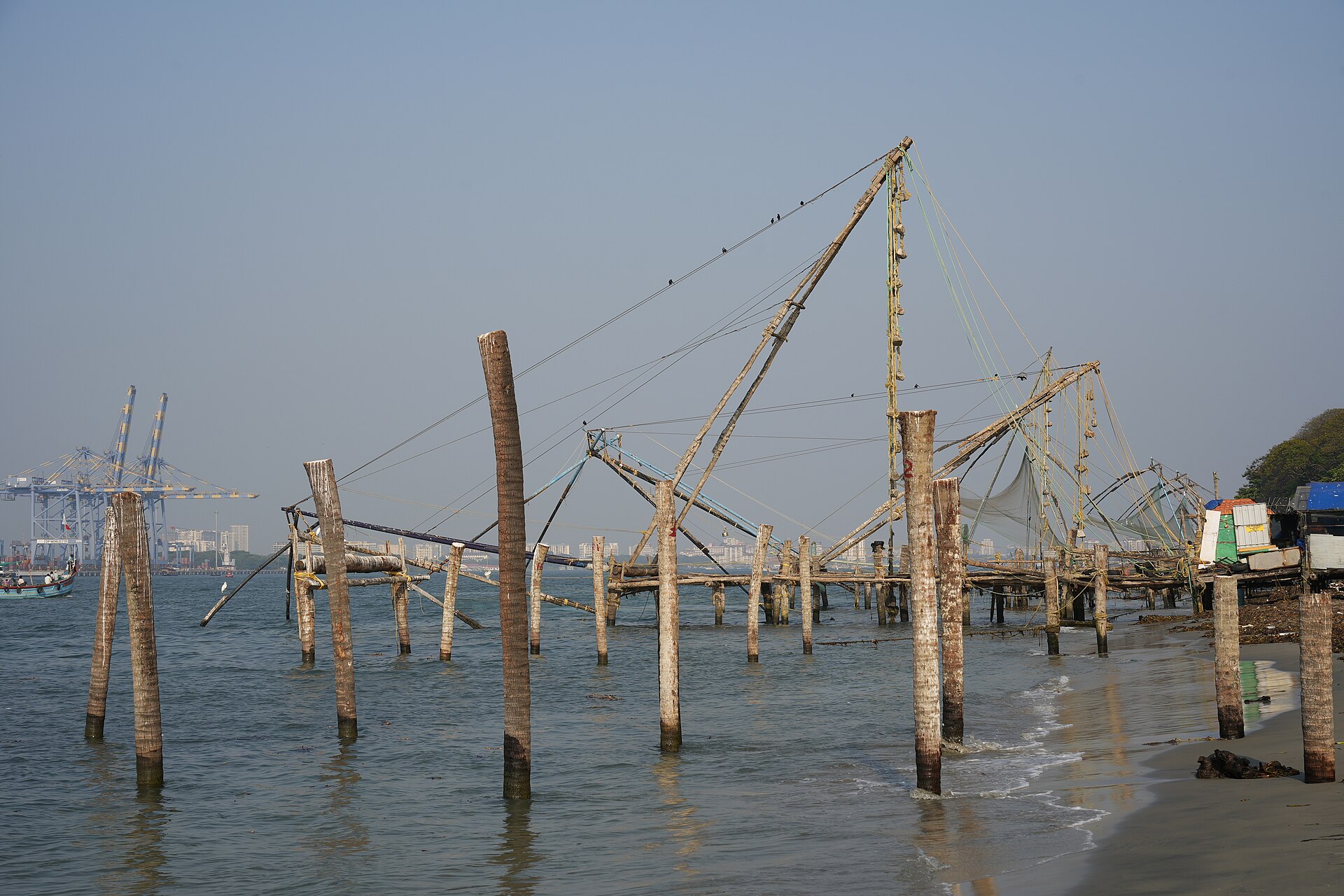
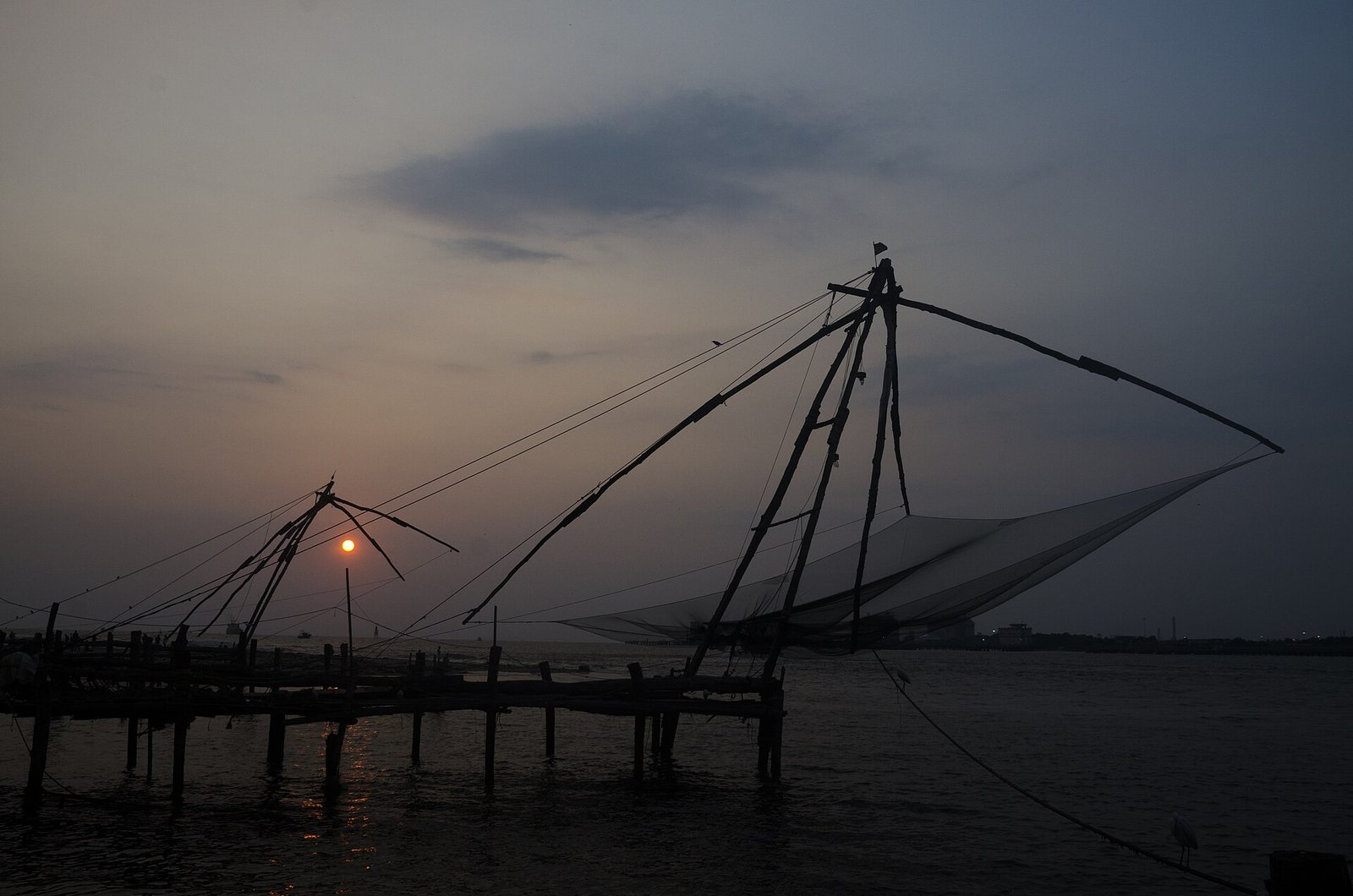
In Fort Kochi, the sights are close enough to walk. The row of cantilevered Chinese fishing nets on the waterfront still works, lowered and raised by teams of fishermen against counterweights of stone; they are the most photographed thing in the city for good reason. St Francis Church, one of the oldest European-built churches in India, held the body of Vasco da Gama after he died at Kochi in 1524, before his remains were taken back to Lisbon. Santa Cruz Basilica stands nearby. A slow morning on foot, ending at a net-side café, is the right way to take it in.
Walk or take a short ride on into Mattancherry for the older trade quarter. The Mattancherry Palace, called the Dutch Palace, holds a set of vivid temple murals; a few streets on is the area long known as Jew Town, where the Paradesi Synagogue, dating from the sixteenth century, sits at the end of a lane of spice warehouses and antique shops. The smell of the spice godowns — pepper, ginger, cardamom, turmeric — is the reason Kochi existed, and it is still in the air. In the evening, a tourist Kathakali performance, where you arrive early to watch the performers paint their faces, is the reliable cultural hour in the city.
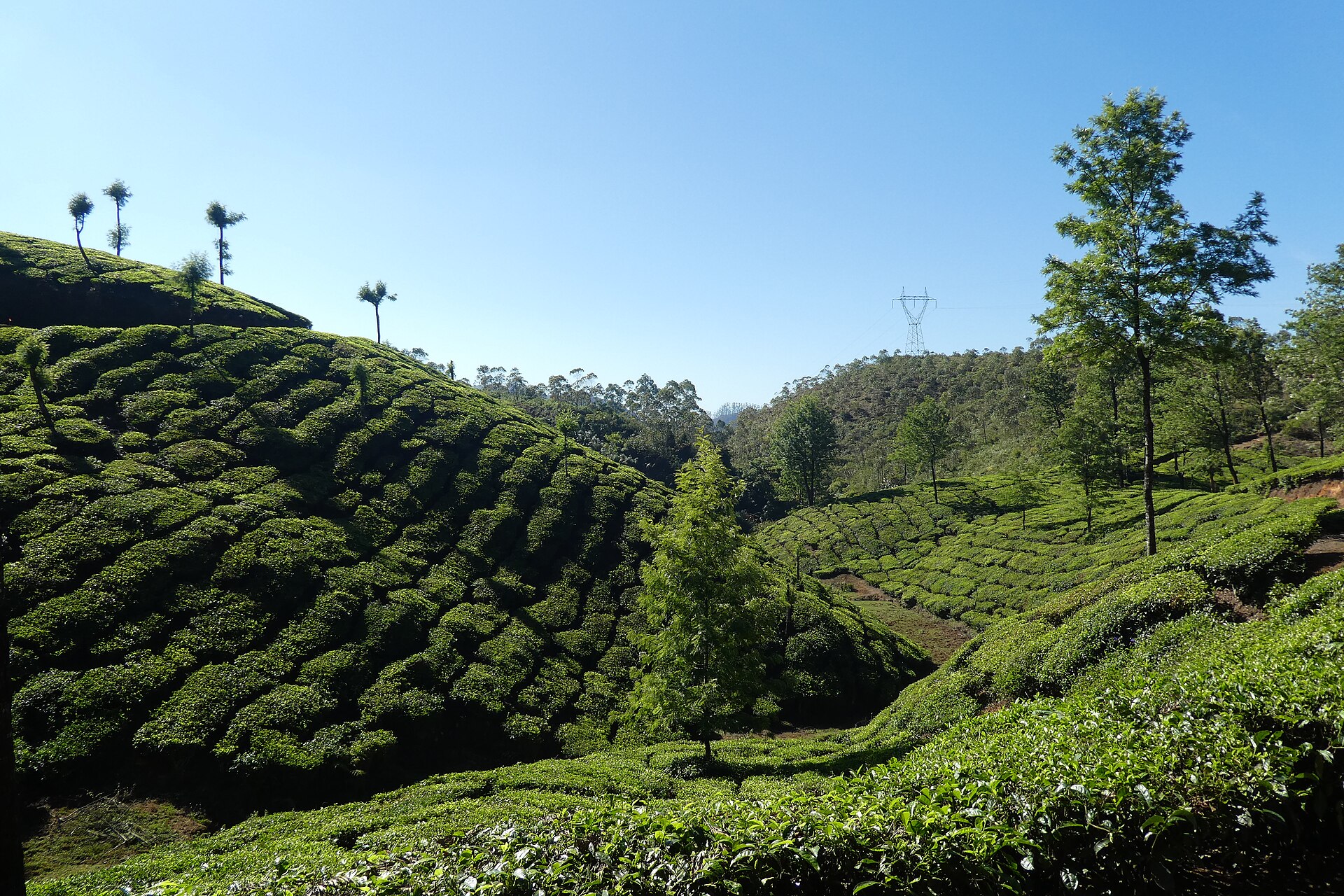
In the hills around Munnar, the tea itself is the sight: whole slopes clipped to a smooth green surface, planted by British companies in the nineteenth century and still worked today. A small tea museum in Munnar explains the estate history and the making of the leaf. Above the town, Eravikulam National Park protects the Nilgiri tahr, a stocky mountain goat, and contains Anamudi, at about 2,695 metres the highest peak in South India; the park is also where the Neelakurinji flowers, which bloom in mass only about once every twelve years and turn the slopes blue when they do — a rare event to plan a trip around, not a yearly one. Beyond the tea, at Thekkady, the Periyar reserve offers boat trips on its lake with a fair chance of elephant and, with luck, other wildlife.
The outer corners reward a longer stay. Wayanad, in the north, has the prehistoric rock carvings of the Edakkal Caves and the long earthen wall of the Banasura Sagar Dam, set among plantations and a wildlife sanctuary. On the southern coast, Varkala's beach sits below a red laterite cliff lined with cafés, with a working temple at one end; Kovalam, further south, is the older, more built-up beach resort. None of these belongs in a one-week first trip, but each makes a strong reason to come back.
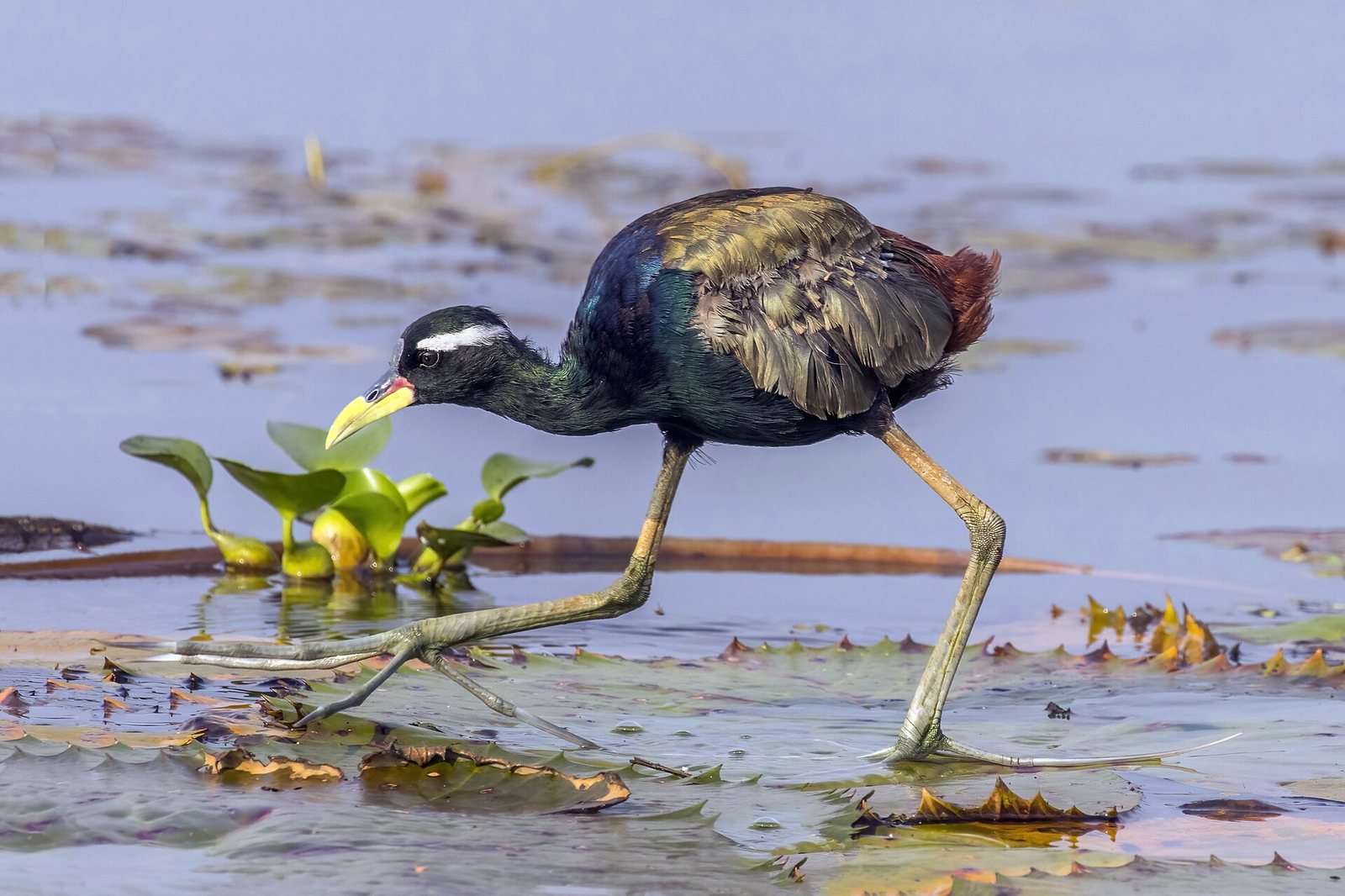
Bronze-winged jacana (Metopidius indicus) · Charles J. Sharp · CC BY-SA 4.0 · cropped
By the numbers
At the table
Kerala eats differently from the north of India, and the food is one of the best reasons to come. Rice is the base — as grains, as the batter for lacy fermented appams and steamed puttu, as flour for the string-hoppers called idiyappam. Coconut is in almost everything, grated, as milk, or as oil. And because the state is coastal and only lightly vegetarian by Indian standards, fish and seafood are central: karimeen, the backwater pearl-spot fish, is the local speciality, often cooked in a spiced masala and wrapped in a banana leaf as karimeen pollichathu.
Eat regionally. In the backwaters, the karimeen and the duck dishes of Kuttanad are the thing, and a lunch at a simple riverside toddy shop — a licensed country-liquor tavern that serves fiercely spiced food alongside the fermented palm sap called toddy — is one of the real pleasures of Alleppey, if you ask a local driver to point you to a good one. In Kochi and up the Malabar coast to the north, the cooking turns to biryani, to the pastry-and-egg snacks of Thalassery, and to the Christian and Muslim traditions that trade brought. On a temple festival day, look out for the sadhya, a vegetarian feast of many small dishes served on a banana leaf and eaten with the right hand. You will eat very well here for very little, and the street and toddy-shop end of the range is often better than the hotel dining room.
Sources & further reading
Kerala Tourism, the state government's official travel board (keralatourism.org), for regions, seasons and festival dates. Cochin International Airport (cial.aero) for arrival and solar-power details. Eravikulam National Park and the Kerala Forest & Wildlife Department for Anamudi, the Nilgiri tahr and the Neelakurinji bloom. Encyclopaedia Britannica for the history of Kochi, Vasco da Gama and Vembanad Lake.
Comments