At a glance
- Base
- Barrio Santa Cruz, Arenal, Alfalfa, or Triana; choose based on budget, atmosphere, and proximity to sights.
- When
- April is the best time, mild to warm, but crowded and expensive due to Holy Week and Feria. Avoid July and August.
- Getting there
- Seville Airport (SVQ) for European flights, or high-speed AVE train from Madrid to Santa Justa station.
- Getting around
- Walk; the centre is compact and pedestrian. Tram, metro, and taxis are available for longer distances.
- Book ahead
- Book accommodation months ahead for April, Holy Week, or Feria. Buy timed tickets for Cathedral and Real Alcázar.
- The price
- April, Holy Week, and Feria de Abril drive prices up significantly, with rooms selling out and prices doubling.
Lay of the land
Seville sits on the Guadalquivir, Spain's only major navigable river, which still carries ships up from the Atlantic, and the city grew rich on that fact. Ships from the Americas unloaded here for two centuries, and the money built a cathedral, a royal palace and a street plan that still rewards anyone willing to get lost in it. The old core is small — you can cross it on foot in half an hour — and almost everything a first visit wants is packed into the streets east of the river, around the Cathedral and the Real Alcázar.
The river matters for orientation. On the east bank sits the historic centre: the Cathedral with its bell tower, the Alcázar and its walls, the tangle of the Barrio Santa Cruz, the shopping streets around Calle Sierpes, and the bullring on the waterfront. On the west bank is Triana, older than the city that eventually absorbed it, traditionally the quarter of potters, sailors and flamenco singers. Between the two, the Guadalquivir is these days a quiet channel used mostly by rowers and tour boats, crossed by a handful of bridges you will come to know by name.
What makes April the right month is written into the streets themselves. Seville is planted with bitter-orange trees — the Seville orange, too sour to eat raw, the one the British turn into marmalade — and in spring they flower. The blossom is called azahar, and for two or three weeks it scents whole neighbourhoods, strongest at night and after rain. It arrives at roughly the same time as the city's two largest public events, which is why April in Seville is a crowded, joyful and expensive month. Plan around that and it is the best time to come. Ignore it and you will pay peak-season prices for a room you struggle to reach.
This is a walking city first. The centre is largely pedestrian or near enough, the distances are short, and the pleasure of the place is in the detail — a courtyard glimpsed through a gate, tiles set into a wall, the sound of a rehearsal drifting out of a brotherhood's chapel in the weeks before Holy Week. Choose your base for how it feels on foot at eight in the morning and at midnight, because those are the hours you will actually use it.
Where to base yourself
The default choice is the Barrio Santa Cruz, the former Jewish quarter that wraps around the eastern flank of the Cathedral and the Alcázar. Its case is obvious: you are steps from the two great monuments, the lanes are as pretty as any in southern Spain, and you can walk home for a rest in the middle of the day. Its cost is equally obvious. The streets are narrow enough that taxis cannot always reach your door, the most photogenic corners fill with day-groups by mid-morning, and prices sit at the top of the range. For a short first trip built around the monuments, it still earns its money — just book a room away from a busy square if you want to sleep.
The quieter, better-value alternative for many is the Arenal, the strip between the Cathedral and the river around the Plaza de toros de la Real Maestranza, the bullring. It keeps you inside the historic centre and within a ten-minute walk of everything, but the streets are wider, the mood is more residential, and the river is at the end of the block. A little further north, around the Alfalfa, you get the same central position with more of the everyday city — grocers, ordinary bars, people who live here.
Across the water, Triana is the choice for travellers who want to feel like a temporary resident in the city. You trade the five-minute walk to the Cathedral for a fifteen-minute one, and in return you get the ceramics workshops, the market, the riverfront terraces of Calle Betis looking back at the old city, and a flamenco tradition that is lived rather than staged. It is the base we would pick for a second visit, or a longer one.
Two areas to think twice about. The Alameda de Hércules, north of the centre, is the city's nightlife heart — excellent if you want it on your doorstep, punishing if you want to sleep before two. And Los Remedios, the residential grid across the river to the south, is where the April fair is held; for one week a year it is the centre of the universe and for the other fifty-one it is a long, dull walk from anything you came to see. Base there during the Feria only if you have a specific reason, and never otherwise.
Come in April and the city gives you its two best weeks; come in July and it gives you the inside of an air-conditioned room.
Where to sleep
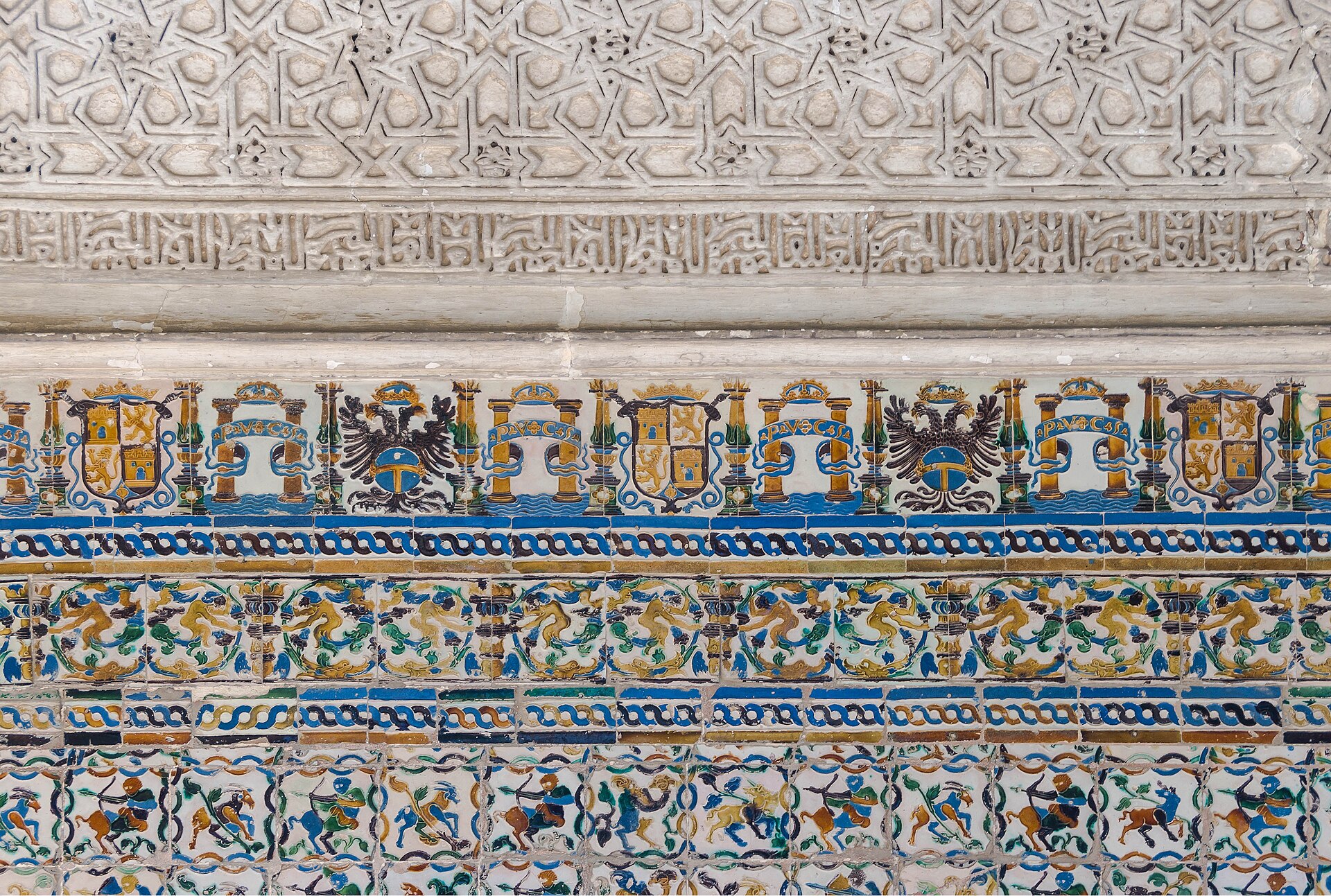
The grandest room in the city is not a secret. The Hotel Alfonso XIII, on the edge of the Alcázar walls, was built for the 1929 Ibero-American Exposition and opened the year before it, a deliberate showpiece of Andalusian style — tiled courtyard, arched galleries, a scale meant to impress visiting royalty. It is expensive, and it is the kind of place worth a drink in the courtyard even if you sleep elsewhere. If your trip has one splurge night in it, this is a defensible place to spend it, particularly in April when the courtyard is at its best.
Below that tier, Seville's real strength is the restored townhouse. The historic centre is full of small hotels built into old family houses arranged around a central patio — the Andalusian courtyard that keeps the interior cool and quiet while the street bakes. These are the rooms to look for: a dozen or two keys, a patio with a fountain, a roof terrace with a view of the Giralda. You will find them across Santa Cruz, the Arenal and the Alfalfa, and the good ones book out months ahead for April. The pattern to search for is "casa" or "palacio" in the name and a photograph of a tiled interior courtyard; the pattern to avoid is a large modern block on a main road, which in this city means noise and no character for the same money.
For longer stays, or for families, an apartment in Triana or the Alfalfa often beats a hotel. A flat with a kitchen and a washing machine changes how a week feels, and it lets you shop the markets and eat breakfast on a balcony instead of queuing. The trade-off is service: no front desk to hold a bag or call a taxi during the fiestas, when both matter most.
Whatever the category, three practical checks pay off here. Ask about the walk from the nearest point a car can reach, because in Santa Cruz that can be several minutes over cobbles with a suitcase. Ask which way the room faces — an interior room over the patio is quiet, a room over a square is not. And book far earlier than you think you need to for any date touching Holy Week or the fair, when the whole city sells out and prices roughly double.
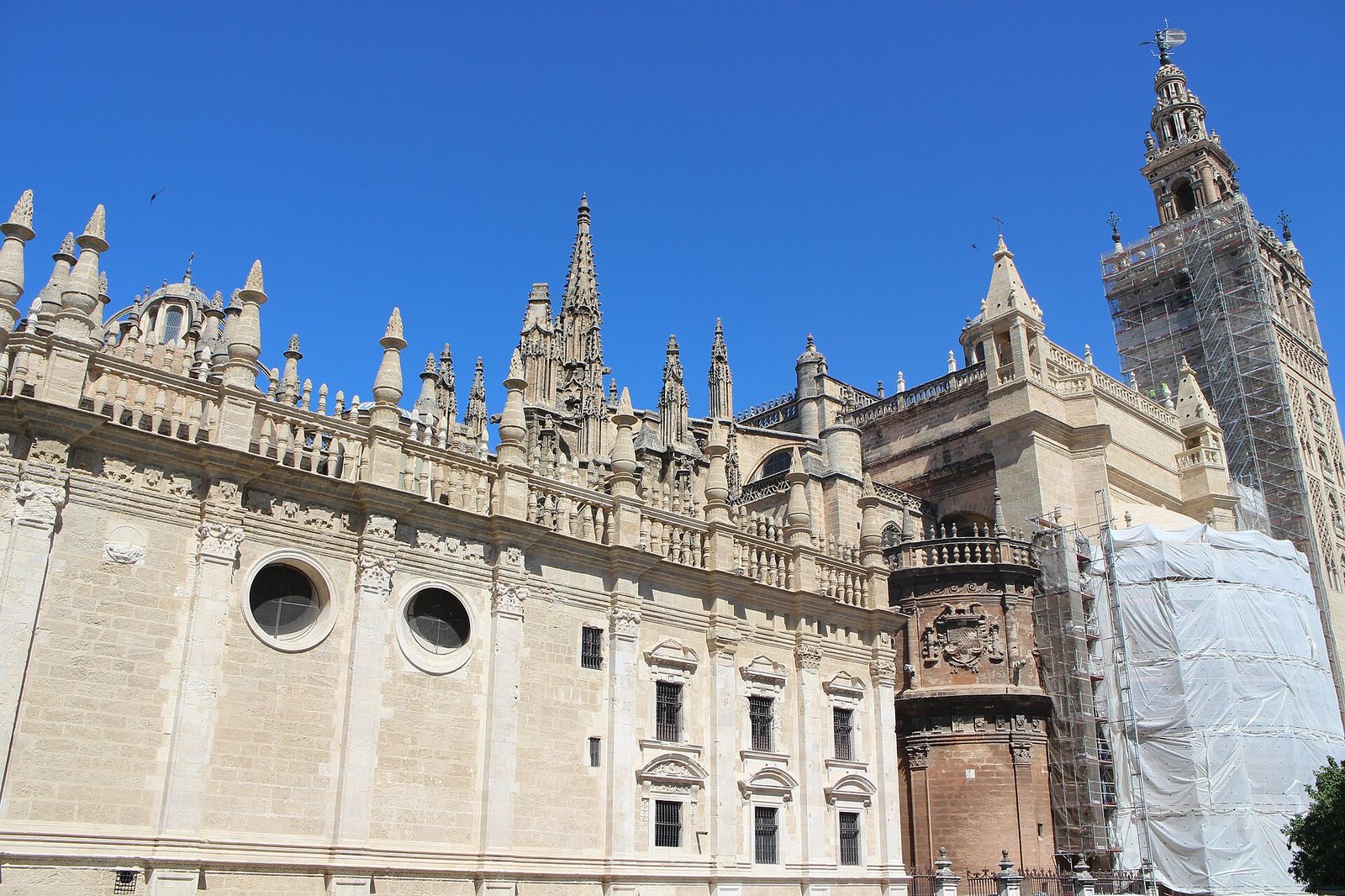
Exterior of the Cathedral of Seville 20180719 · Suicasmo · CC BY-SA 4.0 · cropped
When to go
The heat is the fact that governs everything. Seville is one of the hottest cities in Europe in high summer; through July and August daytime temperatures regularly climb past 40°C, and the historic centre, built of stone and short on shade, holds it. Locals adapt by emptying the streets in the afternoon and living at night, and visitors who arrive unprepared spend the middle of the day defeated. This is not a city to see for the first time in summer. April, by contrast, is mild to warm, comfortable for walking all day and pleasant in the evening — the single best window of the year, which is exactly why it is the busy one.
April's crowds come from two events, and understanding that they are separate is the key to planning. The first is Semana Santa, Holy Week, the week leading up to Easter Sunday. Its dates move every year with Easter, so they can fall in late March or well into April; check the year you are travelling. During it, the religious brotherhoods carry ornate floats — the pasos — through the streets from their churches to the Cathedral and back, in processions that can last many hours, accompanied by hooded penitents and bands. It is solemn, enormous and deeply local, and it closes roads across the centre for days.
The second is the Feria de Abril, the April fair, which opens roughly two weeks after Easter and so usually lands in mid-to-late April, though again the date shifts. It is the opposite of Holy Week in spirit: a week of daytime horse parades and nightlong dancing of sevillanas in rows of tented pavilions called casetas, on a dedicated fairground across the river in Los Remedios. The catch for visitors is that most casetas are private, belonging to families, firms or clubs, so without an invitation you experience the fair mainly from the public avenues, the fairground entrance and a handful of open tents. It is still worth seeing; just arrive without expecting to be handed a seat inside.
The scheduling mistake to avoid is assuming one April trip catches both. In most years they are two or three weeks apart, so unless you can stay the better part of a month you will choose. If you want the spectacle and the emotional weight, come for Holy Week. If you want colour, dancing and a party, come for the Feria. If you want the orange blossom and the good weather without the sell-out prices and the road closures, come in the ordinary weeks of April between and around them — our own preference, and the easiest version of the city to actually enjoy.
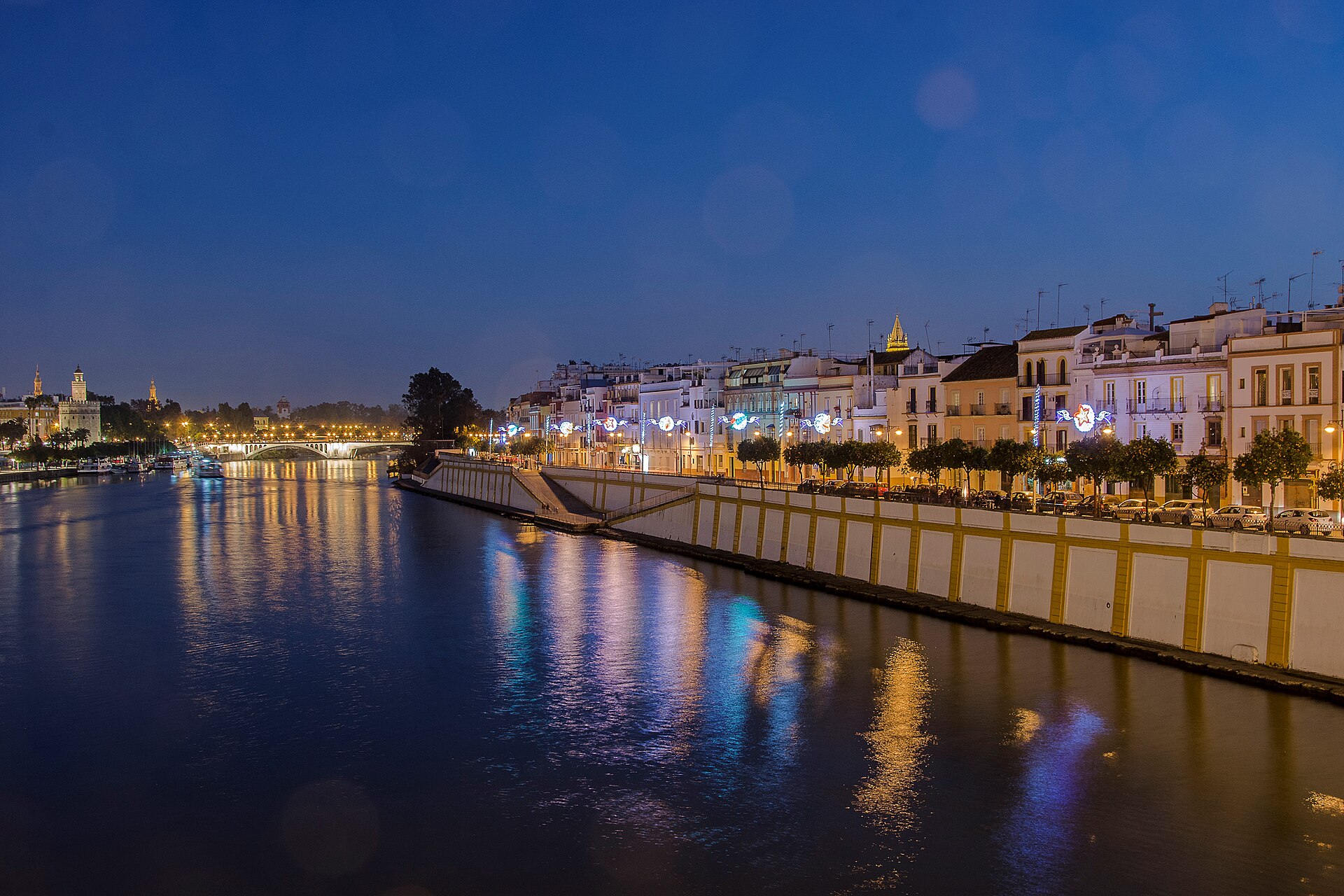
Triana calle Betis 2019An001 · Anual · CC BY-SA 4.0 · cropped
Getting there and getting around
Most visitors arrive one of two ways. Seville Airport (SVQ), also called San Pablo, sits about ten kilometres east of the centre and takes European flights; a dedicated airport bus and taxis both run into town and to the main railway station. The other, and often the better, way is the train. Spain's high-speed AVE network links Madrid to Seville's Santa Justa station in roughly two and a half hours, city centre to city centre, which for anyone already in Spain usually beats flying once you count the airport time at both ends.
Santa Justa is also the hinge for the region. Córdoba is around forty-five minutes away by fast train, Málaga and Granada are within reach for a day or an onward leg, and the sherry towns and the coast lie south. If your trip combines Seville with other Andalusian cities, build it around the train and skip the car for as long as you are in the cities themselves — parking in central Seville is a chore you do not need.
Inside the city, walk. The centre is compact and largely pedestrian, and the pleasures are close together. For the few longer hops there is a single tram line running through the heart of town, one metro line that mostly serves the outskirts, with a stop near Los Remedios and the fairground, and taxis that are reasonable but cannot always reach a cobbled door. Bicycles are popular and the city has a public bike-share scheme, though the fiesta crowds make April a poor month for cycling the centre. During Holy Week in particular, assume that processions will block your intended route at unpredictable times and give yourself far more time than distances suggest.
What to see
Two monuments anchor everything, and they sit side by side. The Cathedral of Seville is the largest Gothic cathedral in the world by volume, built on the footprint of the great mosque the city's medieval Muslim rulers left behind; inside is the monument said to hold the remains of Christopher Columbus. Its bell tower, the Giralda, was the mosque's minaret, later crowned with a Christian belfry — you climb it by a series of ramps built so that a rider could ascend on horseback, and the view over the rooftops at the top is the one to have. Buy timed tickets in advance for April; the queue without them is long.
Next door, the Real Alcázar is the one not to rush. It is a royal palace still used by the Spanish crown, built and rebuilt over centuries, its oldest and finest rooms in the Mudéjar style — Islamic craftsmanship in the service of Christian kings, with carved plasterwork, tiled walls and cool, water-centred courtyards. The gardens behind it are as much of the point as the rooms, and in April they are at their best. Again, book a timed entry; this is among the most visited sites in Spain and it caps numbers.
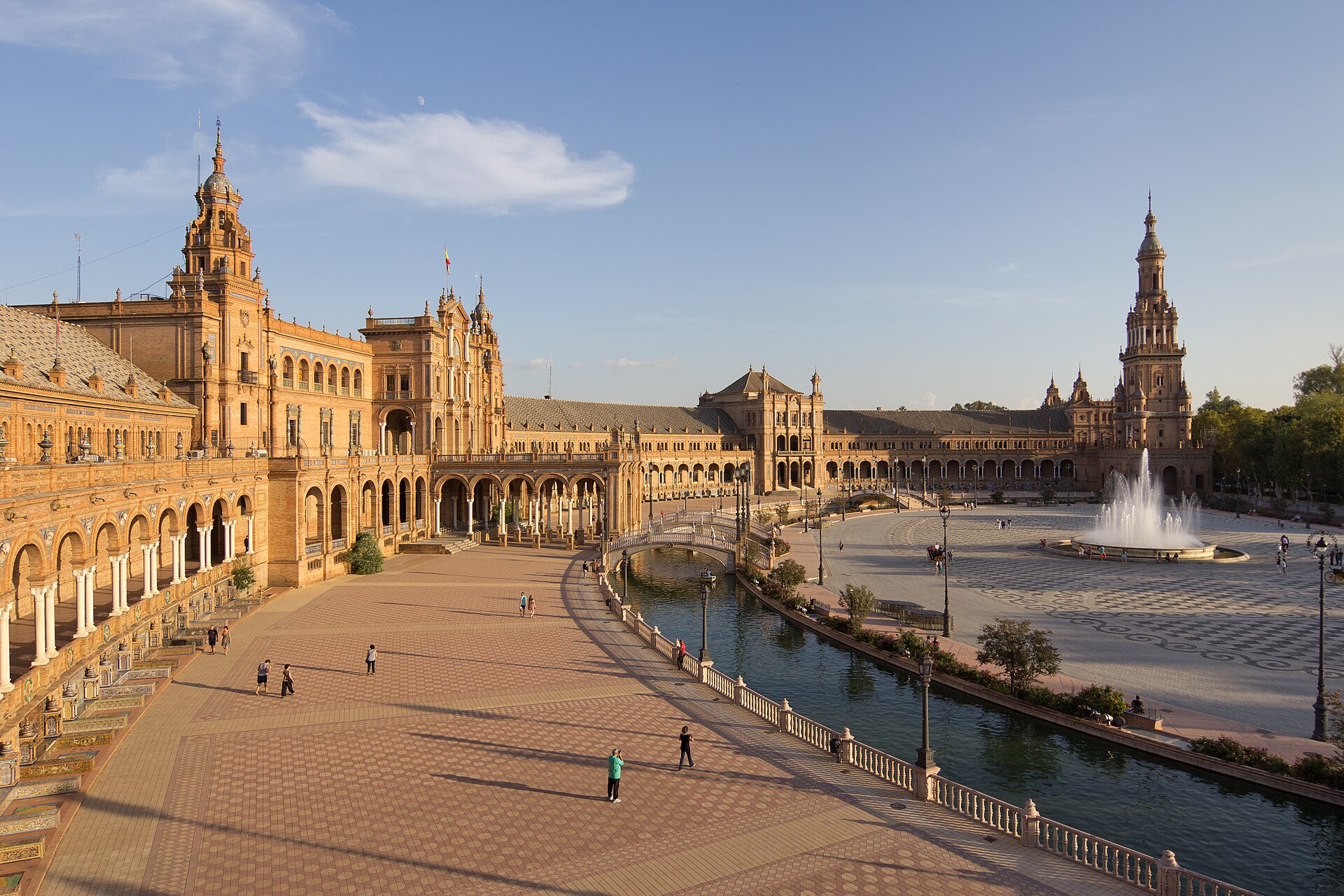
Beyond the two headliners, the set pieces reward the time. The Plaza de España, built for the 1929 exposition in María Luisa Park, is a vast semicircle of brick and ceramic with a canal you can row across and a tiled alcove for each Spanish province — go early or late to have it to yourself. The riverfront holds the Torre del Oro, a thirteenth-century watchtower, and the Real Maestranza bullring. North of the centre, the Metropol Parasol — the giant timber structure everyone calls Las Setas, "the mushrooms" — gives a walkway and a rooftop view over the old town.
For flamenco, understand the difference between the polished tablao show and the raw article. The city has a museum devoted to the dance and several respectable venues that stage nightly performances, and those are a fair introduction. But the tradition lives in Triana, and a smaller, later, less scripted night there — in a bar or a peña rather than a theatre — is closer to the thing itself. Ask where the locals go and follow their lead.
By the numbers
Eating and drinking
Seville runs on tapas, and the local habit is to keep moving: a couple of small plates and a drink at one bar, then on to the next. Order at the counter, stand if you must, and treat the whole evening as one long grazing walk through several places. The classics to look for are Andalusian rather than generic Spanish — spinach with chickpeas (espinacas con garbanzos), a plate of small fried fish (pescaíto frito), good jamón, and in the warm months the cold tomato soups that the region does better than anywhere.
The drink to learn is sherry. It comes from Jerez and the coastal towns not far south, and the dry styles — a crisp fino, or the salt-edged manzanilla — are made for this food and this weather far more than the sweet wine the name suggests to outsiders. In the heat, locals also drink tinto de verano, red wine cut with fizzy lemon, which is the everyday local cousin of sangria. If you want the oldest room in the city to drink it in, El Rinconcillo, founded in the seventeenth century and still pouring, is the one classic worth seeking out; expect it busy.
Where to eat divides cleanly. In Santa Cruz the bars nearest the Cathedral are convenient and, at the touristy edge, forgettable — walk two or three streets away from the monuments before you commit. The Alfalfa and the streets around it hold a denser run of good, unshowy bars used by locals. And Triana across the river is a destination in its own right for an evening, its market a fine place for lunch and its Calle Betis terraces the spot for a drink at sunset with the old city lit up opposite. Eat late by northern habits — nine o'clock is normal, earlier marks you as a visitor — and the city will feel less like a museum and more like itself.
Sources & further reading
Turismo de Sevilla, the official city tourism board (visitasevilla.es), for monuments, neighbourhoods and event calendars. Patronato de Turismo de Andalucía (andalucia.org) for regional context and seasonal information. The Real Alcázar de Sevilla official site (alcazarsevilla.org) and the Catedral de Sevilla official site (catedraldesevilla.es) for tickets, hours and access. Renfe (renfe.com) for AVE high-speed rail schedules between Madrid, Córdoba and Seville–Santa Justa.
Comments