At a glance
- Base
- No single base; move west to east in stages, sleeping two or three places over a week.
- When
- Late September through November (post-monsoon) for clear skies and festivals; March to May for spring.
- Getting there
- Fly into Paro International Airport (only one) via Drukair or Bhutan Airlines from regional cities.
- Getting around
- By road with a driver and licensed guide; self-drive is not recommended due to mountain roads.
- Book ahead
- Months ahead for October (high season) due to limited beds and festival demand; sort flights early.
- The price
- Sustainable Development Fee (around US$100 per person, per night) drives cost, not a budget trip.
Lay of the land
Bhutan is a small country that has decided to stay hard to get to, and it has made that decision on purpose. It sits in the Eastern Himalaya between the Tibetan plateau to the north and the Indian plains to the south, and most of it stands on end. Valleys run east to west, separated by passes you have to climb over rather than tunnel through, and the road between two towns that look close on a map can take most of a morning. This is the first thing to understand before you plan a route: distances here are measured in hours, not kilometres, and the hours don't lie.
For a first visit, and for the October window this issue is built around, you are almost certainly talking about the west. That means four places, roughly in a line. Paro holds the only international airport and the country's most famous building. Thimphu, an hour or so on, is the capital and the one town that feels like a working city. Over the Dochula pass sits Punakha, lower and warmer, in a broad river valley that was the seat of government for three centuries. And a further half-day east lies the Phobjikha valley, high and open, where the black-necked cranes spend the winter. You can see all four in a week without hurrying, and hurrying is the mistake.
The country is Buddhist in a way that is structural rather than decorative. The great fortress-monasteries, the dzongs, are still working buildings: half administration, half monastery, and the seat of the local abbot. The masked festivals, the tshechus, are religious events that also happen to be spectacular. You will be a guest at them, and the etiquette is real. Dress is expected to be modest; you remove your shoes and hat at temples; you walk clockwise around a chorten. None of this is onerous, and a good guide will keep you on the right side of it without fuss.
The other thing that shapes everything is the tourism policy, which the country calls "high-value, low-volume." In plain terms, most foreign visitors pay a Sustainable Development Fee for every night they stay, set at around US$100 a night at the time of writing. It is not a hotel tax and it is not a visa fee; it is a deliberate brake on numbers, and the money is directed toward things like health, education and keeping the forests standing. We give it a section of its own at the end, because it changes the arithmetic of a trip more than any single hotel choice you will make.
What all of this adds up to is a place that rewards a slow, deliberate itinerary and punishes a checklist. Bhutan is not a country you tick off. It is a country you settle into for a week, in a handful of valleys, at a pace set by the roads and the altitude, and it is far better for it.
Where to base
There is no single base for Bhutan. The valleys are too far apart and the roads too slow to make one town a hub you return to each night. Instead you move west to east in stages, sleeping two or three places over a week, and the useful question is not "where do I stay" but "how do I string the nights together." The routing that works, and the one most itineraries settle on, runs Paro to Thimphu to Punakha to Phobjikha and back, with the Tiger's Nest saved for the end.
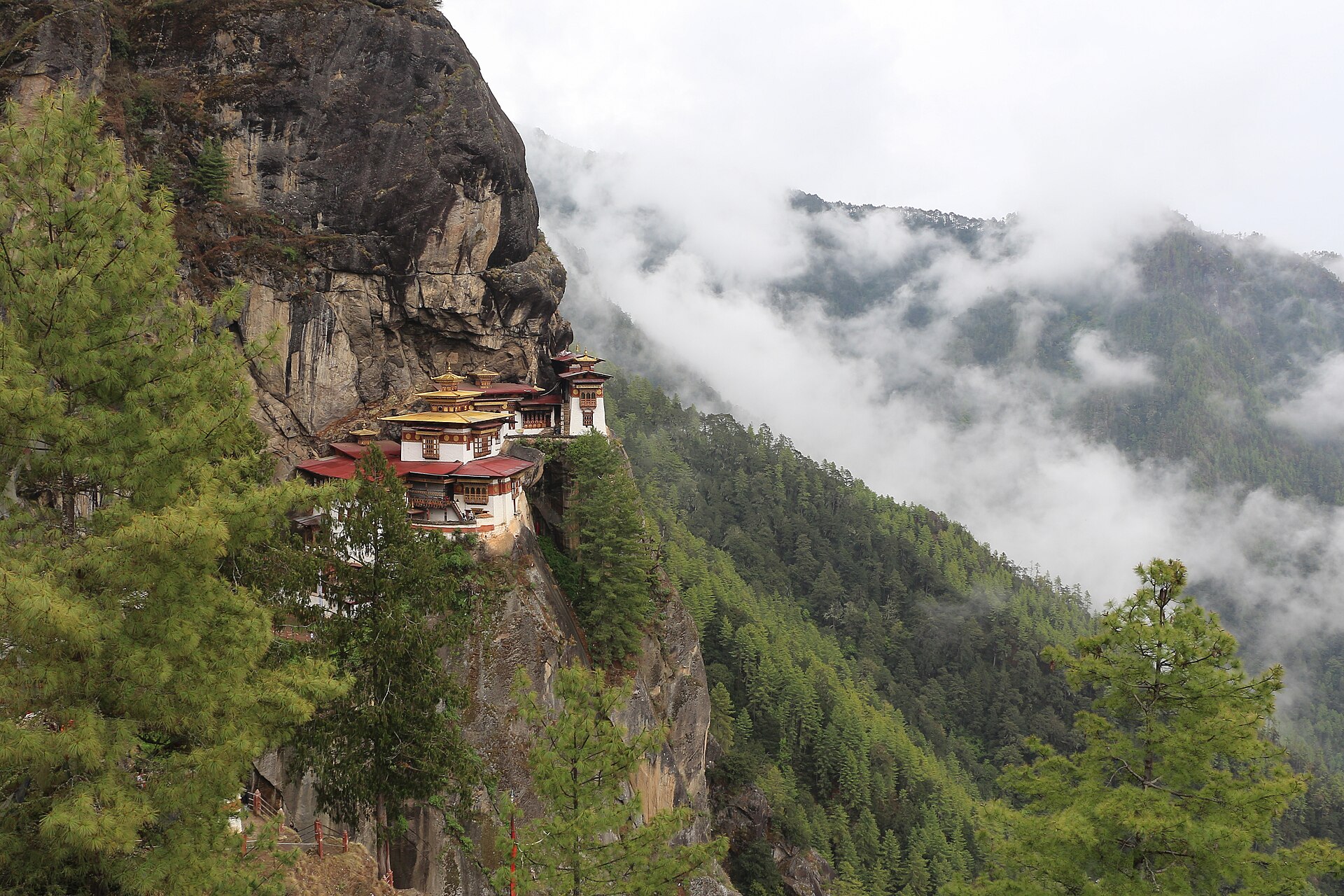
Start in Paro. It is where you land, it sits at around 2,200 metres, and giving your body a night or two here before you climb higher is sensible rather than precious. The valley is quiet, green, and studded with farmhouses; the town itself is small. Paro's trump card is that the Tiger's Nest is here, and the standard advice is to do that climb at the end of the trip, once you are acclimatised, rather than jet-lagged on day one.
Thimphu, an hour or so up the road, is the only place that reads as a capital. It has restaurants, a proper weekend market, shops, and a great fortress-dzong, the Tashichho Dzong. It is famous for having no traffic lights, which is true and tells you the scale of the place. Two nights here is plenty; it is the town for errands, a good dinner and a sense of how Bhutanese people actually live, rather than a destination in itself.
The fee is not a tax on the view. It is the reason the view still looks like this.
Then comes the decision that makes or breaks the week: the drive over the Dochula pass to Punakha. The pass sits at around 3,100 metres and, on a clear post-monsoon morning, opens onto a line of Himalayan peaks that you simply do not get in the murk of summer. Do this drive in the morning, not the afternoon, when cloud tends to build. On the far side you drop steeply into Punakha, which sits low, around 1,200 metres, and is noticeably warmer. This is the valley for the great dzong and for slow riverside afternoons, and it is worth two nights.
The routing mistake to avoid is trying to add the central valleys, Bumthang above all, onto a single western week. Bumthang is worth a trip of its own, and it is also a long, hard drive further east, or a short internal flight; folding it in turns a relaxed week into a road trip. Save it for a second visit, or add days rather than cannibalising the ones you have. If you want a fourth valley, make it Phobjikha, which is a half-day beyond Punakha and pays you back in full, especially in late autumn.
Punakha Dzong, Bhutan 26 · Bernard Gagnon · CC BY-SA 4.0 · cropped
Where to sleep
Bhutan's hotels sort roughly into three bands, and it helps to be clear-eyed about which one you are booking, because the gap between them is wide and the Sustainable Development Fee sits on top of all of them equally.
At the top is a small group of international lodge brands that have built collections of small properties across the western and central valleys. Amankora runs a circuit of lodges — in Paro, Thimphu, Punakha, Gangtey and Bumthang — designed to be strung together as you move east, which is exactly how the country is best travelled. Six Senses Bhutan operates a similar spread of lodges across the same valleys, leaning into wellness and design. COMO has properties in Paro and Punakha. These are genuinely expensive places, and you pay for position and service, not marble: architecture that sits quietly in the landscape, service pitched to a handful of rooms, and the convenience of a single operator moving you from valley to valley. If your budget stretches to them and the point of the trip is the lodges themselves, they deliver what they promise.
The middle band is where most visitors actually sleep, and it is better than the price suggests. These are Bhutanese-owned and -run hotels, often family businesses, comfortable and clean, with heating that matters at altitude in October, hot water, and kitchens that will cook you the local ema datshi — chillies and cheese, the national dish — if you ask. They will not have a spa or a view designed by a magazine, but they are warm, and staying in them puts your money into local hands, which is rather the point of the whole tourism model.
The third option, and the one worth planning around for a night, is a farmhouse stay. A number of traditional Bhutanese farmhouses take guests, and an evening in one — a wood-fired hot-stone bath, dinner with the family, a floor to sleep on under thick blankets — tells you more about the country than any lodge can. It is not luxurious in the hotel sense and it is not meant to be. Ask your operator to build one in; a single night is usually the right dose.
A practical note that applies across all three bands: in the western valleys in October you want heating and reliable hot water, and you should confirm both when you book rather than assume them. Nights are cold once the sun drops behind the ridges, particularly in Paro and Phobjikha. Rooms are heated by various means and not all of them are quiet or even; a good property manages this well, a poor one leaves you in a beautiful cold box. It is a fair question to ask, and the answer tells you a lot.
Whichever band you choose, book well ahead for October. This is the busiest and clearest month of the year, the festivals draw people, and the total number of beds in the country is small by design. Months, not weeks, is the right lead time.
Taktsang Monastery, Bhutan 05 · Bernard Gagnon · CC BY-SA 4.0 · cropped
When to go
October is the reason this issue exists. Bhutan has a summer monsoon that runs, broadly, from June into September, and while it is not the wall of rain some of India gets, it does what monsoons do: it greens everything, it swells the rivers, and it hangs cloud over the mountains for days at a stretch. The famous views — the peaks from Dochula, the ridgelines from the passes — are simply not there for much of the summer. Then the rains pull back, the air dries and clears, and for a few weeks the country is about as good as it gets.
That post-monsoon window, roughly late September through November, is the high season for exactly this reason. Skies are clear, the light is hard and bright, the mountains show themselves, and the temperatures in the western valleys are comfortable by day and cold but manageable by night. It is also festival season. The tshechus, the masked religious festivals with their cham dances, cluster through autumn; the large Thimphu Tshechu falls in this stretch, and there are others in Wangdue, in the central valleys and beyond. If you can time your week to overlap with one, do — but book earlier still, because everyone else is trying to as well.
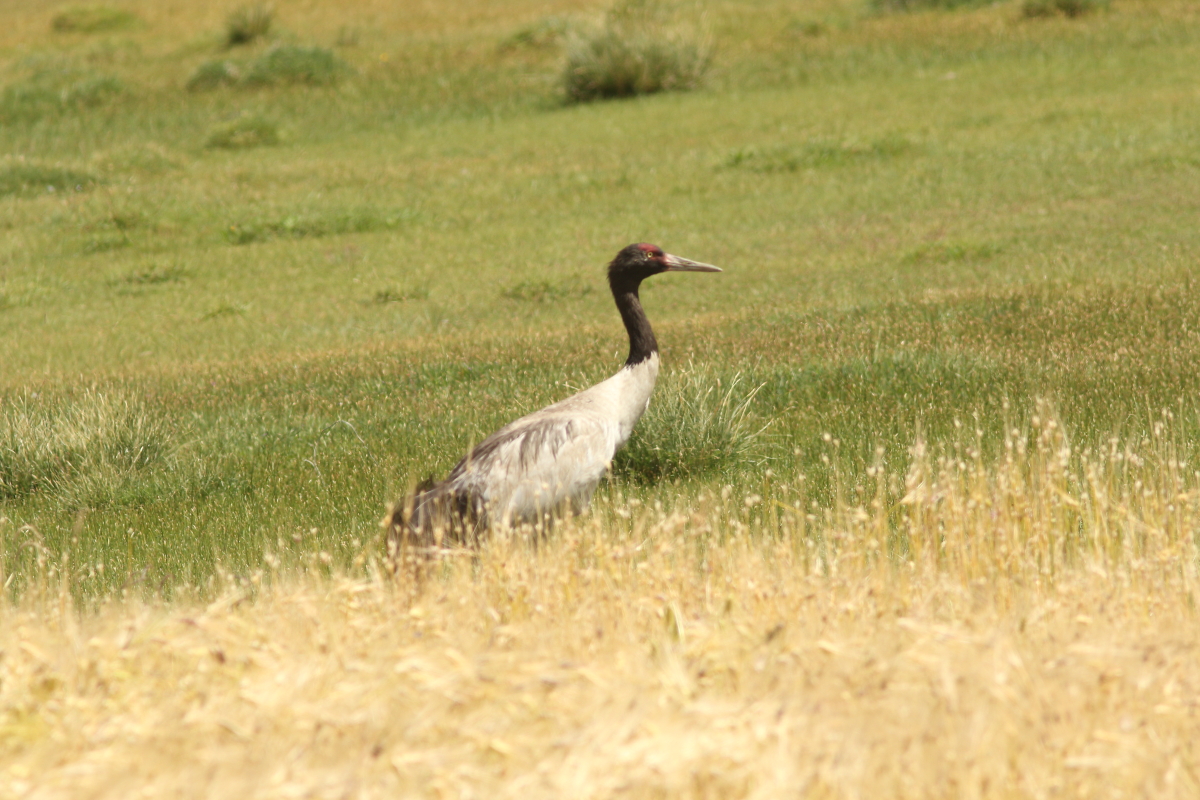
The other autumn event, and a quieter one, is the return of the black-necked cranes to Phobjikha. The birds winter here, flying down from the Tibetan plateau, and they begin arriving in the valley in late October and into November. There is a small crane festival held at Gangtey monastery in November to mark it. If cranes are part of why you are coming, weight your dates toward the back of the month rather than the front, and understand that wildlife keeps its own schedule; the birds arrive when they arrive.
Black-necked crane - Ladakh 2022-08-24 01 · Asif N Khan · CC BY-SA 4.0 · cropped
The timing that ruins a week is arriving with the wrong expectations for the wrong season. Summer visitors sometimes leave having never seen a mountain, which is nobody's fault but the calendar's. Spring, March to May, is the other reliably good season — warmer, with rhododendrons on the hillsides and the big Paro Tshechu, though the mountain views are a little hazier than in autumn. Winter is cold, clear and very quiet, and the high passes can close with snow. Deep summer is for people who want the country green, empty and cheap, and who do not mind cloud.
For October specifically: pack layers, expect a thirty-degree swing between a sunlit afternoon and a night at altitude, and bring something properly warm for early mornings and the Tiger's Nest climb. The sun is strong at this height even when the air is cold.
Getting there
There is one way to fly into Bhutan, and it is worth understanding before you book anything else. Paro International Airport is the country's only international airport, and it is served by just two carriers: Drukair, the national airline, and Bhutan Airlines. Between them they connect Paro to a short list of regional cities — the usual gateways are Delhi, Kolkata, Kathmandu, Bangkok and Singapore, among a few others — but the network is thin, flights are not daily on every route, and seats in October are tight. Sort your international flights early, and treat the Paro leg as the fixed point everything else bends around.
The approach into Paro is famous among pilots, and for good reason. The airport sits in a valley at around 2,200 metres, ringed by peaks, and the landing is flown manually, in daylight, by specially certified crews threading between the mountains. It is safe and it is routine for those who do it, but it is also dramatic, and it is weather-dependent: flights can be delayed or shuffled when cloud closes the valley. Build a buffer. Do not schedule a tight onward connection out of Paro on the same day you need to catch an intercontinental flight home; give yourself a night's slack at each end.
You can also enter overland from India, most commonly through the border town of Phuentsholing in the south, which some travellers combine with a trip through the Indian states of West Bengal or Assam. It is a longer, rougher way in, and for a one-week western itinerary flying into Paro is simpler by a wide margin.
Once you are in the country, you move by road, and you move with a driver and, for most of the country, a licensed guide. Bhutan reformed its tourism rules in recent years, and the old requirement to pre-book everything through a single operator has loosened, but in practice independent travel here is still tightly framed: you will need a licensed guide for cultural sites and for travel beyond the Paro and Thimphu area, and arranging a car and driver is all but essential given the roads. The sensible route for a first visit is to work with a licensed Bhutanese tour operator who handles the logistics, the guide, the driver and the hotel bookings as one package. It is not the only legal way in any more, but it is by far the least stressful.
The roads themselves are the trip. They are paved on the main western corridor and much improved, but they are mountain roads: winding, slow, prone to the occasional landslip in the shoulder seasons, and shared with the odd cow. Reckon on averages well under fifty kilometres an hour once you are climbing. This is not a country for self-drive, and it is not one to rush.
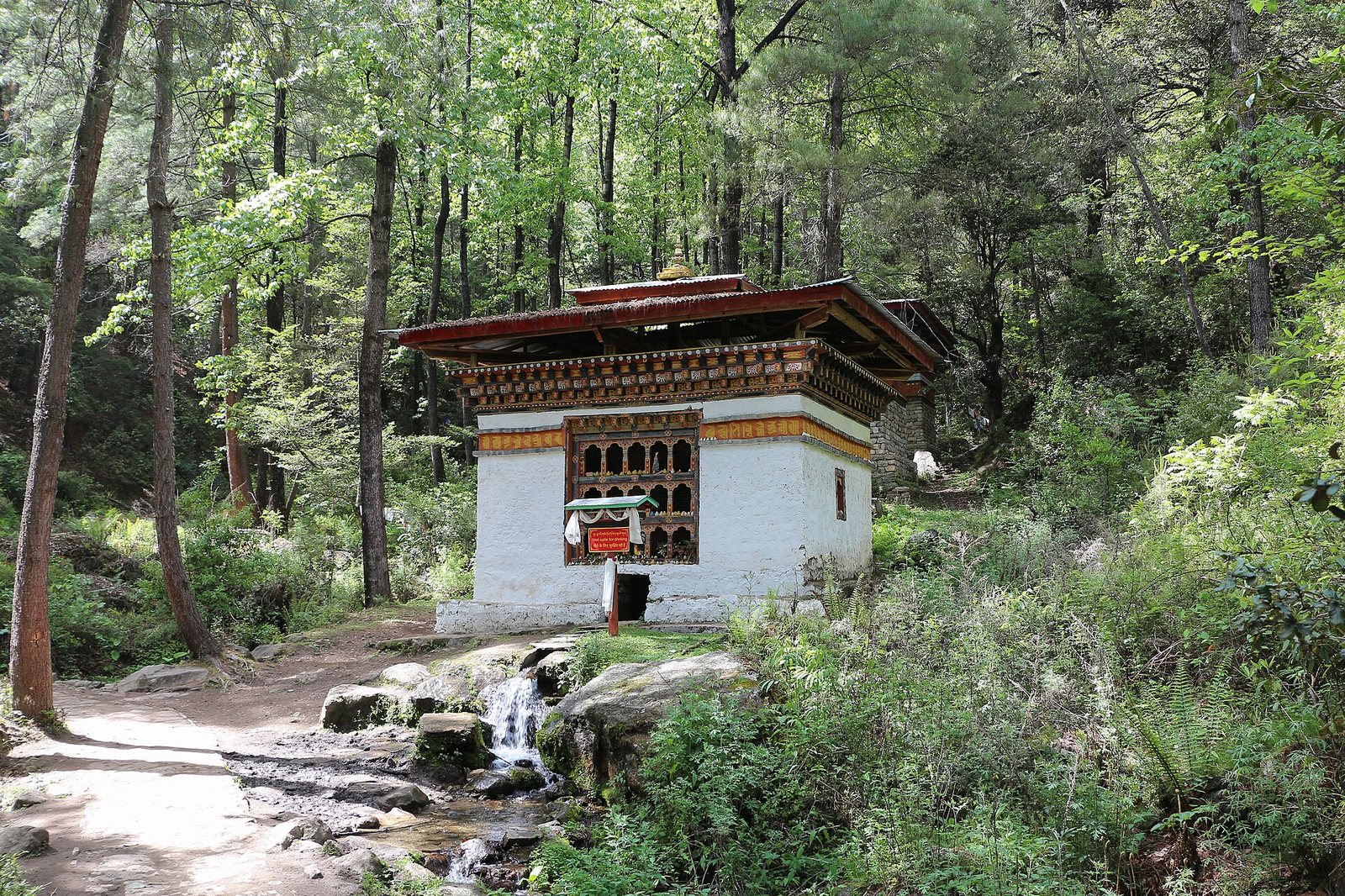
Paro Taktsang trail 08 · Bernard Gagnon · CC BY-SA 4.0 · cropped
What to see
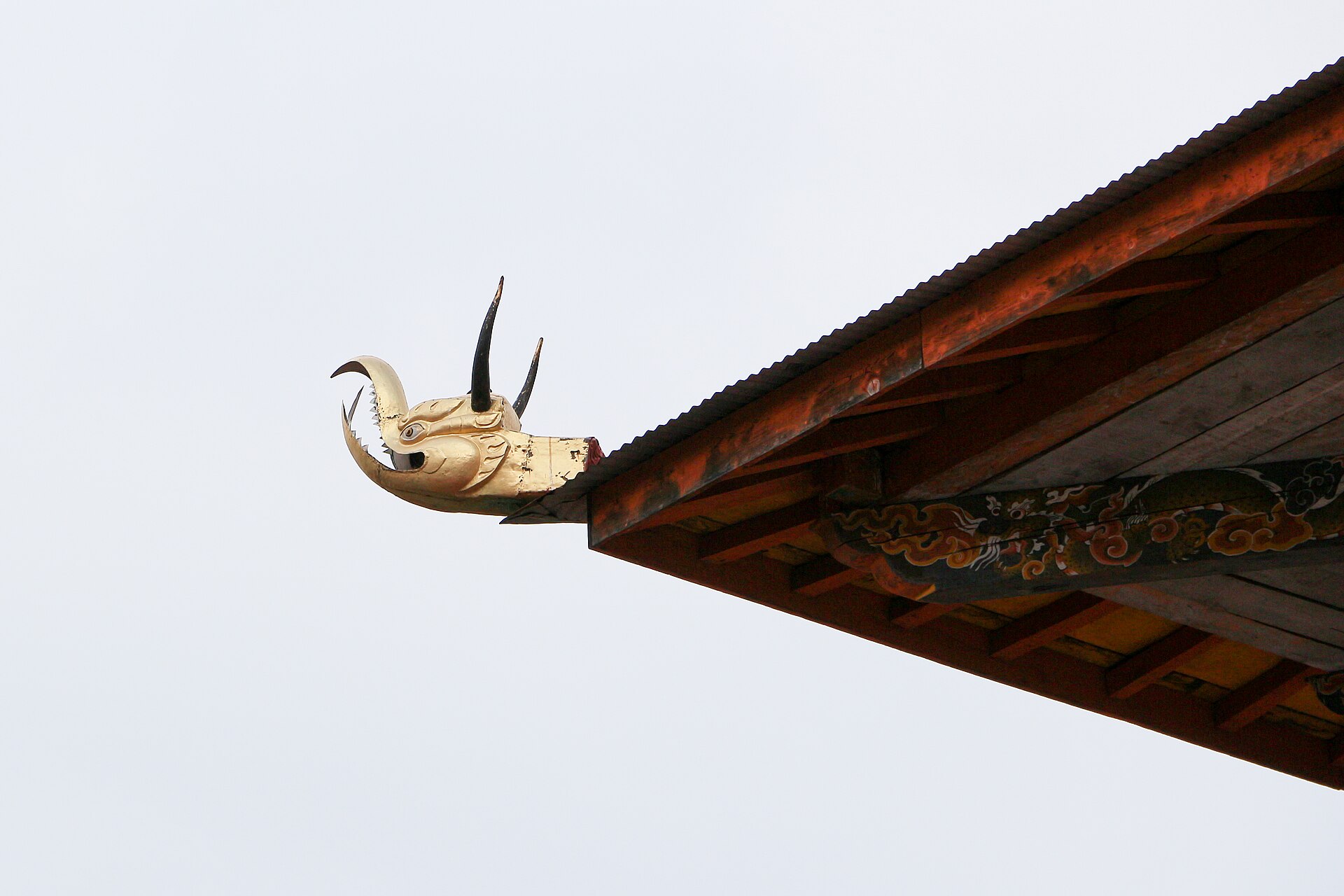
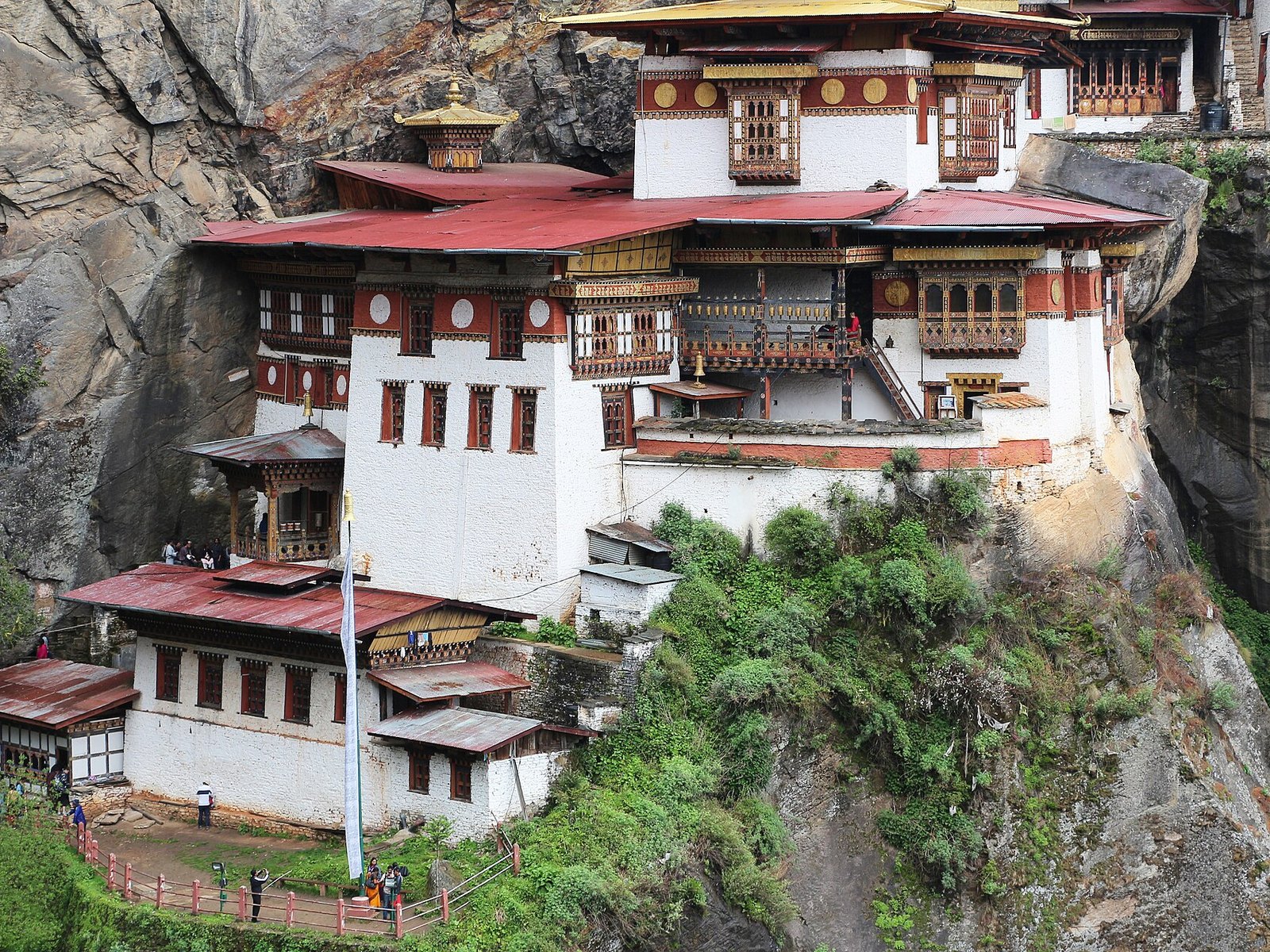
The set piece, and the image you already have in your head, is Paro Taktsang — the Tiger's Nest — a monastery built onto a cliff face high above the Paro valley. The legend has the sage Padmasambhava, Guru Rinpoche, flying to the site on the back of a tigress and meditating in the cave the complex now encloses; the buildings you see today date largely from the late seventeenth century, rebuilt after a fire in the twentieth. Getting there is a walk, and a proper one: several hours up and back, climbing perhaps six hundred metres, on a switchbacking trail with a teahouse partway that most people stop at. Do it in the morning, do it at the end of your trip when you are acclimatised, and take it slowly; the altitude is the difficulty more than the distance. It earns every superlative that this magazine will not print.
Punakha Dzong is the other unmissable building, and for our money it is the more beautiful of the two. It stands on a spit of land at the confluence of the Pho Chhu and Mo Chhu — the "father" and "mother" rivers — and it was the seat of Bhutan's government for centuries. It remains the winter home of the country's central monastic body, who move down from Thimphu when the cold arrives. Approached across its cantilever bridge, with jacaranda on the banks in the right season and the two rivers meeting below, it is the picture of what a dzong is supposed to be.
In Thimphu, the things worth your time are the Tashichho Dzong, the large fortress that houses the government and the throne room and glows when it is lit in the evening; the great gilded Buddha Dordenma seated on a hill above the city; and, if your visit lands on a weekend, the weekend market, which is the working heart of the town. Thimphu is also the place to see traditional crafts being taught and made, if that interests you.
The Dochula pass deserves to be treated as a destination rather than a thing you drive over. Its 108 chortens — the Druk Wangyal Chortens, built in memory of soldiers — sit on a rise with the Himalaya behind them, and on a clear October morning it is one of the great mountain viewpoints of the region. Stop, walk among the chortens, have a hot drink at the café, and time it early before the cloud comes up.
Finally, the Phobjikha valley, also called Gangtey, is a change of register from the dzongs: a wide, glacial, marshy bowl at altitude, treeless and open, with the Gangtey monastery on a low hill at one end. It is the winter ground of the black-necked cranes, and there is a small nature centre that will tell you when and where to see them without disturbing them. Even outside crane season it is the valley to walk in — the Gangtey Nature Trail is gentle and short — and its emptiness is the whole point.
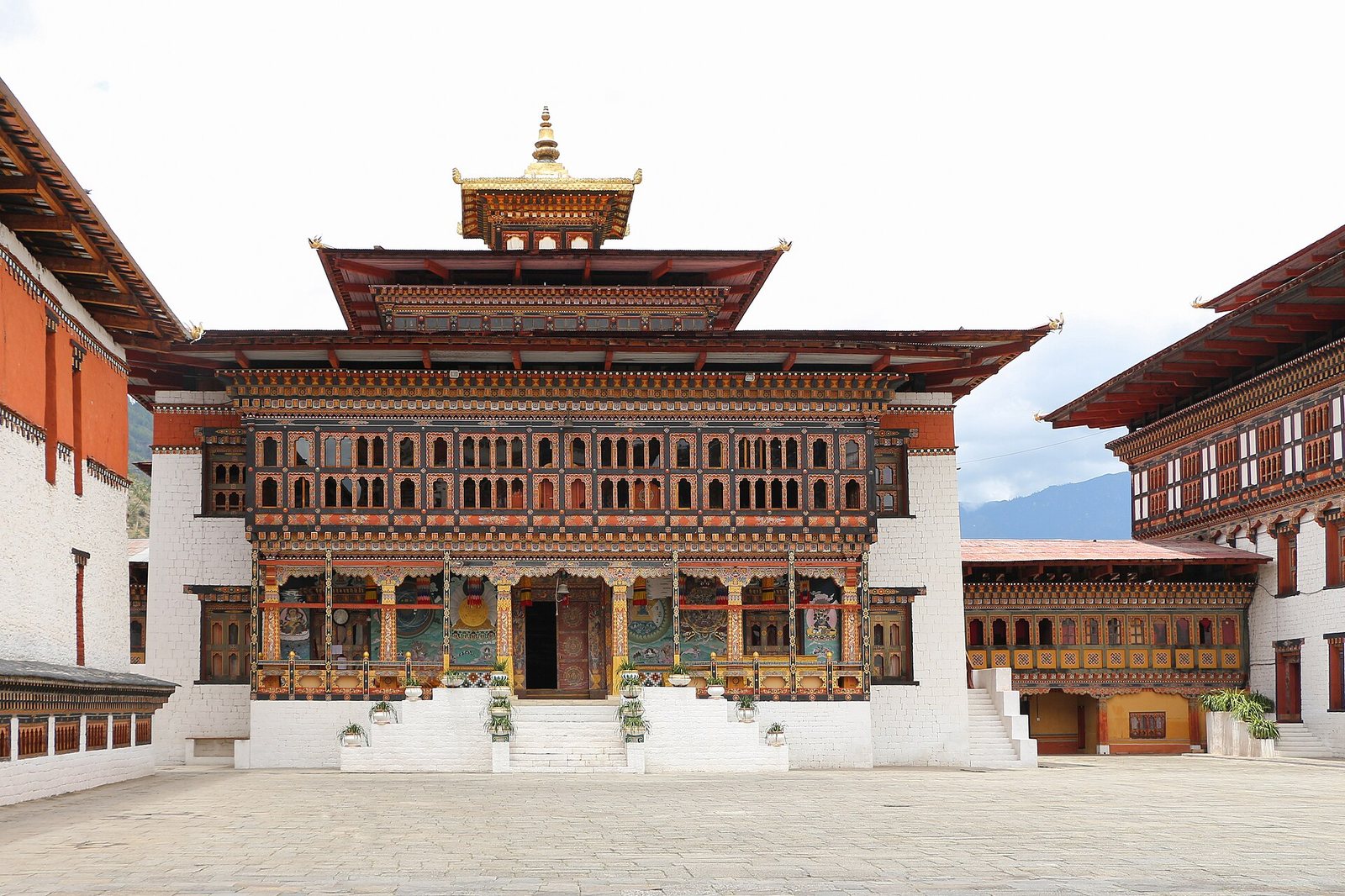
Tashichho Dzong, Bhutan 06 · Bernard Gagnon · CC BY-SA 4.0 · cropped
By the numbers
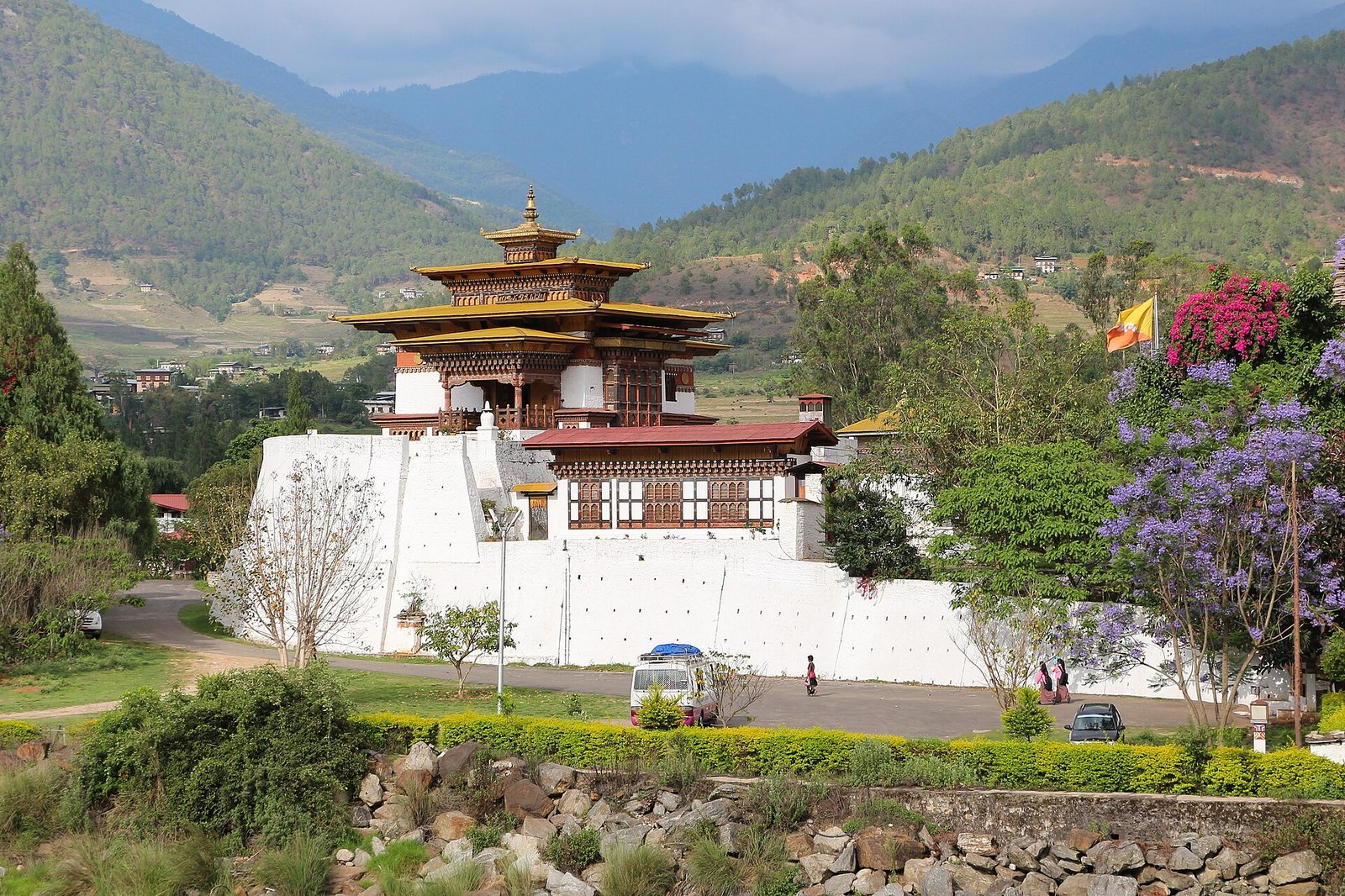
Punakha Dzong, Bhutan 06 · Bernard Gagnon · CC BY-SA 4.0 · cropped
The fee, and how the country works
No account of staying in Bhutan is complete without the Sustainable Development Fee, because it is the single thing that most shapes both the cost of your trip and the character of the place. At the time of writing it is set at around US$100 per person, per night, for most international visitors, charged for every night you are in the country and separate from what you pay your hotel. (Visitors from India pay a lower, separately set rate, and there are reductions and exemptions in some cases, including for children.) The government reduced the fee to this level in September 2023, having previously charged double; the number moves with policy, so confirm the current rate when you book.
It is easy to read the fee as a barrier, and in a sense it is meant to be one — a deliberate brake on visitor numbers. But it is worth understanding what it buys. The money is directed by the state toward public goods: health care, education, conservation and the upkeep of the very things you have come to see. Bhutan's constitution requires the country to keep at least sixty per cent of its land under forest, and it is one of the few countries that absorbs more carbon than it emits. The fee is part of how a small, poor country protects that.
The practical consequence for a traveller is simple arithmetic. A week in the country means seven nights of fee, per person, on top of flights, hotels, guide and car — so before you have booked a single room you are several hundred dollars in. This is why Bhutan is not, and cannot be, a budget trip, and why it does not reward a rushed one: if you are paying that fee daily, you want each day to count. It also explains why the country feels uncrowded even in its busiest month. The math that keeps you counting keeps everyone else counting too, and the result is a place that has chosen to be rare rather than full.
Sources & further reading
Department of Tourism, Royal Government of Bhutan (official visitor information and the Sustainable Development Fee); Drukair — Royal Bhutan Airlines (Paro routes and schedules); Royal Society for Protection of Nature (RSPN), Phobjikha and the black-necked cranes; UNESCO World Heritage Centre (Bhutan's dzongs on the Tentative List).
Comments