At a glance
- Base
- Rovaniemi (gateway, families), Levi/Ylläs (skiing), Saariselkä (aurora, empty country). Pick one or two.
- When
- December-February for aurora, January for full winter, late February-March for gentler conditions and skiing.
- Getting there
- Fly from Helsinki to Rovaniemi, Kittilä, or Ivalo; seasonal direct flights from Europe; overnight train from Helsinki.
- Getting around
- Transfers/walkable in resorts; hire a car for flexibility, but winter driving is slow on icy roads with short daylight.
- Book ahead
- Book glass cabins months ahead for January; sleeper compartments well ahead; all accommodation early for peak season.
- The price
- Glass-roofed cabins are expensive, expect resort pricing. December is most expensive.
Lay of the land
Lapland is the top third of Finland, a slab of forest, fell and frozen lake that begins around the Arctic Circle and runs north to where the country narrows into Norway. It is large and thinly settled. You can drive for an hour between towns and see nothing but spruce weighed down with snow, a few reindeer crossing signs, and the tail-lights of the car in front. In January the whole region is under snow that arrived in November and will not leave until April, and the roads are packed ice from door to door.
The thing to understand before you book anything is the light, because the light is the whole reason to come in midwinter. This far north the sun sits low even in summer, and in the weeks around the solstice it barely clears the horizon, or in the far north does not clear it at all. Finns call this the kaamos, the polar night. At Rovaniemi, on the Circle itself, the sun still rises for an hour or two around noon, so you get a long blue-grey twilight rather than true darkness. Push north to Saariselkä or Inari and the sun stays down for weeks; the noon sky glows a deep cobalt and then fades again.
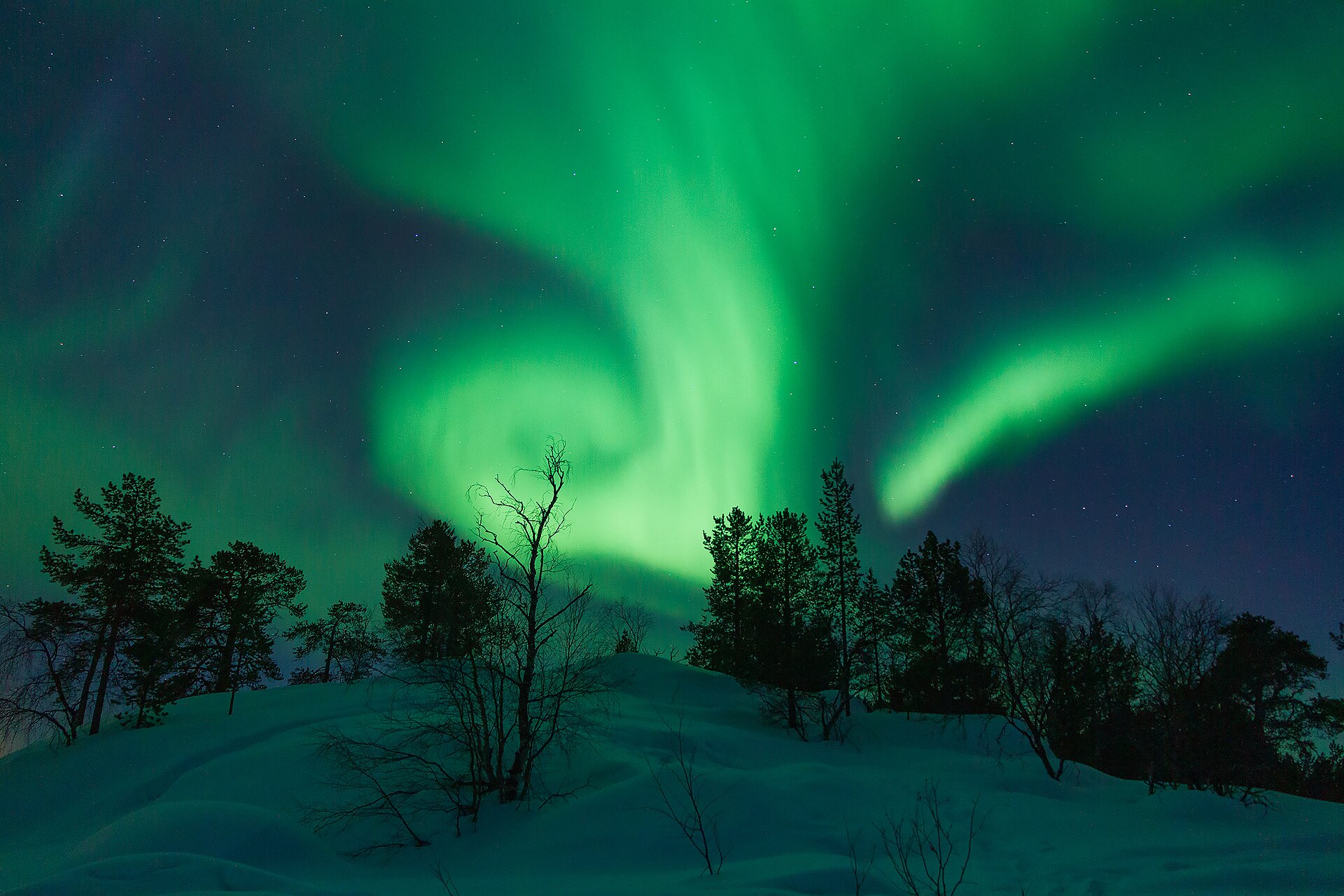
In midwinter that darkness is exactly what you come for. The aurora borealis is only visible against a dark sky, and Lapland's winters give you the longest dark and, in the north, some of the clearest. The season runs roughly from late August to April, and while there is no month that guarantees a show, the long nights of December through February give the aurora the most hours in which to appear.
In January the darkness is not a defect to work around. It is the thing you have travelled north to buy.
The region organises itself around a handful of bases, each with a different character. Rovaniemi is the capital and the gateway, the place with the airport, the shops and Santa Claus Village. Levi and Ylläs, to the north-west, are the ski resorts, with lift-served fells and the fullest range of restaurants and cabins. Saariselkä, further north still, is smaller and darker and closer to the empty country of Urho Kekkonen National Park, and it is the natural base for people whose priority is the sky. Down on the coast, Kemi is an industrial port town with one unusual winter draw. Inari, near the top, is the heart of Sámi Finland. You will not see all of these in one week, and the first decision to make is which of them earns your nights.
Where to base
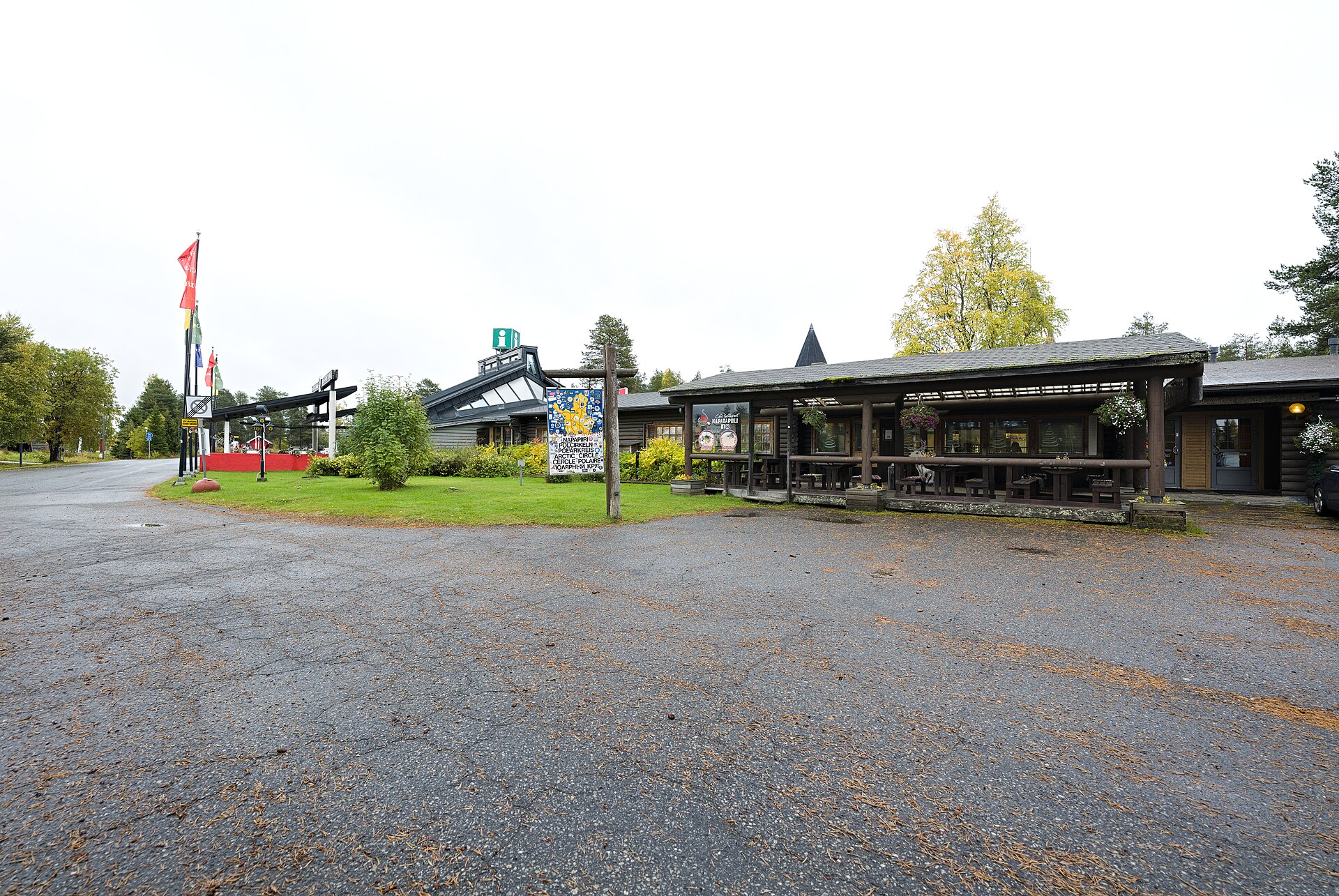
Start with Rovaniemi, because most people arrive here and many go no further. It is a real working town of about sixty thousand people, rebuilt almost from scratch after it was burned in the Second World War, with a street plan laid out by Alvar Aalto. It has the region's main airport, a proper supermarket-and-cinema kind of centre, museums worth an afternoon, and Santa Claus Village a short way north, where a painted line marks the Arctic Circle and you can post a letter from the Santa Claus Main Post Office. For a family with young children, or for anyone who wants one easy base with everything on tap, Rovaniemi makes sense. Its drawback is that it is the furthest south of the winter bases, so the light is longer and the aurora less frequent than higher up, and the town glow works against you.
If skiing or a fuller resort is the point, go to Levi or Ylläs, both reached through Kittilä airport. Levi, at the village of Sirkka, is the largest ski resort in Finland and the liveliest, with the most lifts, the most après and, in a normal year, a Ski World Cup slalom in November that opens the season. Ylläs, a little to the west, has the longest runs and a quieter, more spread-out feel across two villages, Äkäslompolo and Ylläsjärvi, with the Pallas-Yllästunturi National Park at its back. As a rule, choose Levi if you want energy and choice, and Ylläs if you want the fells and the forest with less noise.
For the sky above all else, base yourself further north at Saariselkä, reached through Ivalo airport. It is a small resort with modest downhill skiing but excellent cross-country trails, and it sits on the edge of Urho Kekkonen National Park, one of the largest tracts of empty land in the country. The town is small enough that the darkness is complete, and the polar night here lasts weeks rather than days. This is where the glass-roofed cabins cluster, and it is the base I would pick for a trip built around the aurora.
Two more are worth knowing. Kemi, on the Gulf of Bothnia coast, is not a place to spend a week, but it is worth a night for its SnowCastle and its icebreaker cruise, and it is easy to fold into an arrival or departure through the coastal route. Inari, north of Saariselkä on the shore of the country's third-largest lake, is the centre of Sámi cultural life and home to the Siida museum; it rewards travellers who want the far north and the Indigenous story rather than resort comforts. The routing mistake to avoid is trying to stitch Rovaniemi, a ski resort and the far north into a single short trip. The distances are real, the winter driving is slow, and you will spend the week in the car. Pick one base, or at most two, and let the days be long.
Where to sleep
The room you have read about is the glass-roofed cabin, and it is worth being clear-eyed about what it is and what it costs. The best-known cluster is Kakslauttanen Arctic Resort, near Saariselkä, which popularised the small glass igloo pointed at the sky. The appeal is real: you lie in a warm bed under a heated glass dome and, on a good night, watch the aurora move overhead without getting dressed. The reality is that these are compact, they are expensive, and the aurora appears only when conditions allow, so a single night is a gamble and two or three nights is the realistic minimum if the aurora is the goal. Book months ahead for January dates, and expect resort pricing rather than hotel pricing.
A wider and often better-value version of the same idea has spread across the region: cabins and lodge rooms with one large glazed wall or a glass panel over the bed, set outside the town glow, usually with a private sauna. These give you the same chance at a ceiling of light with more room to spread out, and many sit on their own patch of forest. If the glass cabin is the dream, compare the dedicated aurora resorts against these lodge cabins before you commit, because the second category often buys you more space and a darker sky for the money.
Do not overlook the ordinary Finnish options, which are very good. The ski resorts are full of self-catering log cabins and apartments, the standard way Finnish families take a winter week, with a sauna as standard equipment; these suit groups and longer stays. The towns have solid mid-range hotels, and the international chains have a presence in Rovaniemi and at Levi. Wherever you sleep, the sauna is not a spa add-on here but part of how the week works, and a cabin with its own is worth paying for.
My steer is this. If you have the budget and the aurora is the priority, spend two or three nights in a glass cabin or aurora lodge in the north, near Saariselkä, and treat any night's display as a bonus rather than a booking guarantee. If you are travelling with children or want a single easy base, a hotel or cabin in or near Rovaniemi does the job and puts Santa Claus Village and the day trips within reach. If you are a group or want to cook and settle in, take a log cabin at Ylläs or Levi with a sauna and use it as a home rather than a hotel. Whatever you choose, book early: the last two weeks of December and the school holidays are the busiest and dearest of the year, and January, though quieter, still sells out the good cabins well in advance.
Pier and motorboat at Inari village, Inari, Lapland, Finland,… · Ximonic (Simo Räsänen) · CC BY-SA 3.0 · cropped
When to go
January is the coldest, darkest month, and that is both the case for it and the case against it. The days are at their shortest, which gives the aurora the most hours of dark sky, and the snow is deep and reliable. Temperatures commonly sit well below freezing, often around minus ten to minus fifteen through the day, and cold snaps of minus thirty are not rare in the interior; the north and the inland basins run colder than the coast. This is proper Arctic cold, and it is a real factor in how you plan a day. It is also, for many people, exactly the point: the still, blue kaamos light at midday and the deep dark by mid-afternoon are the atmosphere you came for.
If you want the darkness and the full winter, come in January. If you want a gentler version, consider late February and March. By then the days are lengthening quickly, the cold has usually eased a little, the snow is at its deepest and best for skiing and sledding, and the aurora season is still very much open. Many regulars regard late winter as the sweet spot, trading a little of the extreme dark for more daylight, better conditions underfoot and longer hours in which to be outside. December has the shortest days and the Christmas draw, but it is also the most crowded and expensive, and the snow base is still building early in the month.
Whatever the month, plan for the aurora as a matter of patience rather than schedule. It needs three things at once: darkness, a clear sky and solar activity. You can control the first by going in winter and getting away from town lights; you cannot control the weather or the sun. Give yourself several nights, keep them flexible, and be willing to stay up late or set an alarm, because displays often come after midnight. Aurora forecast services and a look at the cloud outlook are more useful than any promise a brochure makes. Treat a good night as luck earned by turning up for several, and you will not go home disappointed.
Getting there
Almost everyone comes through Helsinki, and the connection north is straightforward. Finnair and others fly from Helsinki to the Lapland airports: Rovaniemi for the capital and Santa Claus Village, Kittilä for Levi and Ylläs, and Ivalo for Saariselkä and Inari. The flight is a little over an hour, and picking the airport that matches your base saves hours of driving at the far end. There are also seasonal direct flights from several European cities into Rovaniemi and Kittilä in winter, which are worth checking before you route through Helsinki.
The more characterful option is the night train. Finnish state railways run an overnight service from Helsinki up to Rovaniemi and on towards Kolari, which is the railhead for the Levi and Ylläs area. You board in the evening, take a sleeper cabin, and wake up in the north, and you can put your own car on the train if you want it with you. It is slower than flying but it is comfortable, it saves a night's accommodation, and arriving into a snowbound morning by rail is a good start to the trip. Book the sleeper compartments well ahead in the busy season.
Once you are up there, decide whether you actually need a car. If you are staying at a resort and taking guided trips, you may not; transfers and activity operators will collect you, and the towns are walkable. If you want to move between bases, chase clear skies or reach the national parks under your own steam, hire a car, but respect the conditions. Winter tyres, studded here, are standard and required, the roads are ice, and daylight for driving is short. Watch for reindeer, which wander onto the roads and are hard to see at dusk, and keep your speed down. Fill up when you can, carry warm layers in the car, and do not plan tight schedules across long distances.
What to see and do
The signature outings are the sled trips, and they divide into two kinds. Husky sledding is fast and noisy; you ride behind a team of dogs through the forest, and the better operators let you drive your own sled after a briefing. Reindeer sledding is the slower, older thing, and it matters that many reindeer trips are run by Sámi families for whom herding is a living, not a show. Taken in that spirit, a reindeer safari is a quieter and more genuine hour than the husky version, and often comes with coffee by a fire and something of the herder's world. Ice fishing, snowshoeing and cross-country skiing round out the outdoor days, and the national parks, Urho Kekkonen behind Saariselkä and Pallas-Yllästunturi behind Ylläs, give you marked winter trails through country that feels genuinely remote.
Around Rovaniemi, the set piece is Santa Claus Village, straddling the Arctic Circle. It is unashamedly commercial and it is aimed at families, but crossing the painted line and posting a card carries a certain charm even for sceptics, and children love it. The town's museums are a good use of a short afternoon or a cloudy day, particularly the Arktikum, which handles the science and human story of the Arctic. About an hour's drive south at Ranua, the wildlife park keeps polar bears and the animals of the northern forest in large winter enclosures, and it is one of the few places you will reliably see them.
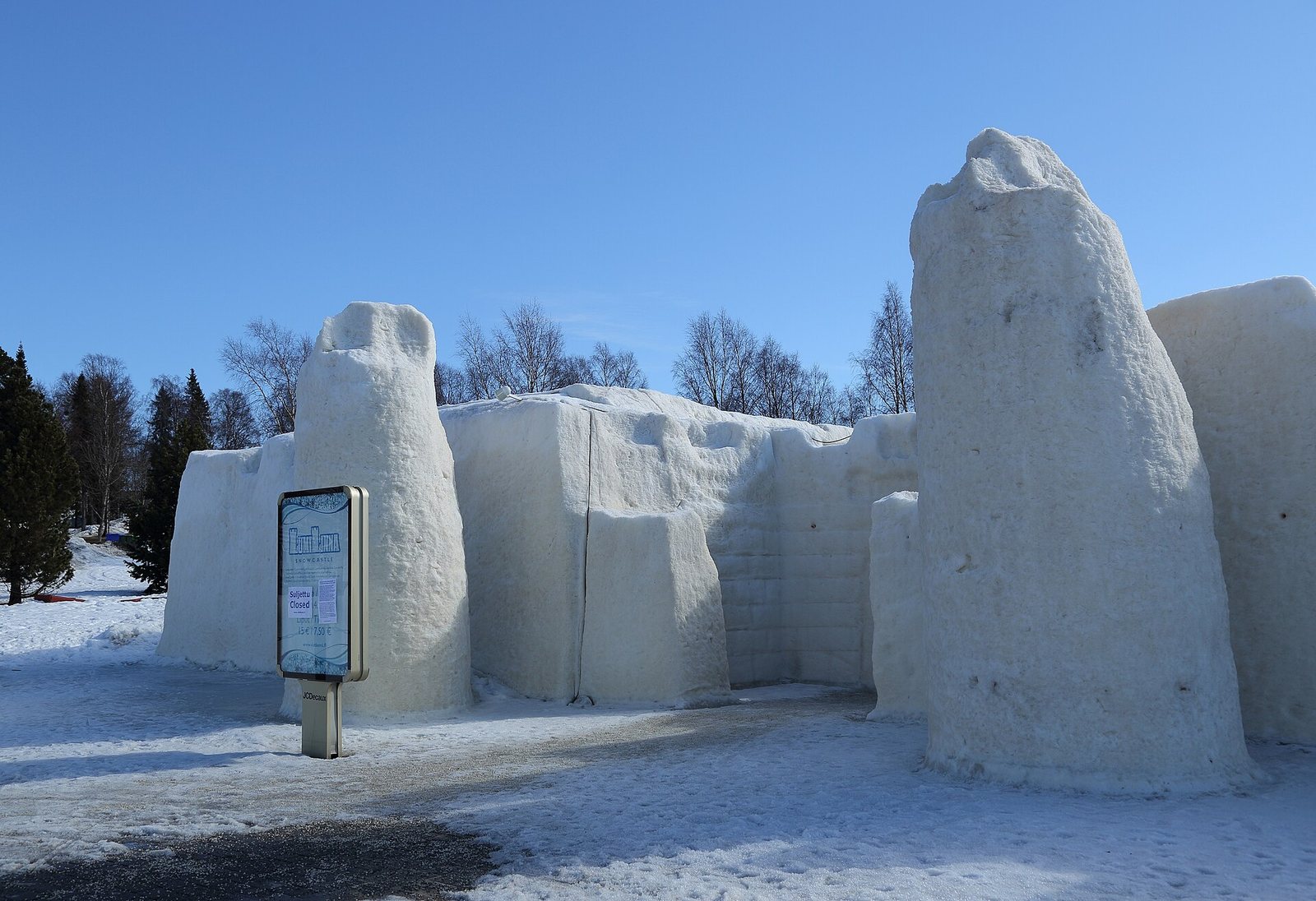
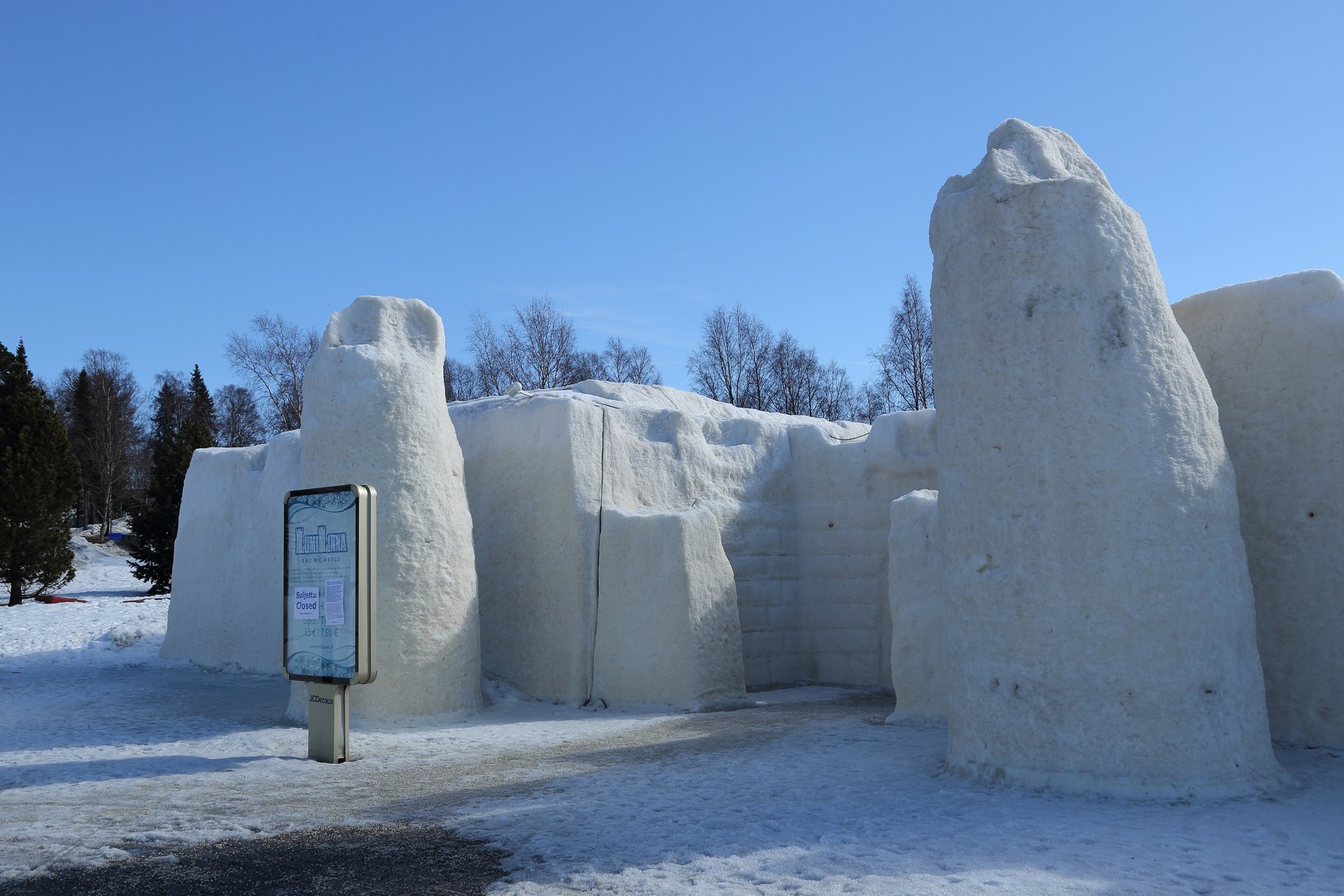
The best single day trip in the region is on the coast at Kemi, and it is worth the drive or the routing. Each winter the town builds a SnowCastle from snow and ice, with carved walls, a chapel and rooms you can walk through, and rebuilds it entirely the following year; it opens around the turn of January into February. From the same harbour, the icebreaker Sampo, a retired working ship, takes passengers out to crush through the frozen Gulf of Bothnia, and the trip includes the chance to float in the sea ice in a watertight survival suit. It is unlike anything else on offer up here, and if your dates line up with the SnowCastle's opening, Kemi earns its place on the itinerary.
Further north, Inari is the base for the Sámi story. The Siida museum there is the national museum of the Finnish Sámi and of Lapland's nature, and it is the right place to understand the people and the land rather than the resort version of them. It is a long way up, and it suits travellers who are already based at Saariselkä or who want the far north for its own sake.
By the numbers
Chasing the lights
A few practical things separate a good aurora trip from a frustrated one. First, get away from artificial light. Even a small town throws enough glow to wash out a faint display, so the darker your base and the further from streetlights you can stand, the more you will see. This is the real argument for the northern bases and the cabins set out in the forest. Second, dress for standing still in deep cold, not for walking, because aurora-watching is mostly waiting outdoors at night; the tour operators lend proper thermal suits and boots, and they are worth using.
Third, manage your own expectations about what you will see. To the naked eye a display often reads as a pale grey-green band or a moving glow rather than the saturated green and violet of the photographs, which cameras draw out with long exposures. On a strong night it can fill the sky and move fast, bands rippling overhead within seconds; on a quiet night it may be a soft arc low to the north. Both are the real thing. Bring a camera that can take a several-second exposure on a tripod, learn the settings before you go, and you will capture more colour than your eyes register.
Finally, build the trip so that a good night's sky is a bonus, and fill the short days with sledding, saunas, a museum and the SnowCastle. Let the nights take care of themselves. If you go north, give yourself dark, give yourself several nights, and stay up. Do that, and the odds in deep winter are firmly in your favour.
Sources & further reading
Visit Finland and House of Lapland (the region's official tourism boards) for bases, activities and seasonal guidance; the Finnish Meteorological Institute for aurora and cloud forecasts and its explanation of the northern lights; Metsähallitus / Nationalparks.fi for Urho Kekkonen and Pallas-Yllästunturi national parks and their winter trails; and VR (Finnish Railways) and Finavia for the Helsinki night train and the Rovaniemi, Kittilä and Ivalo airport connections.
Comments