At a glance
- Base
- Near Petra gate in Wadi Musa; in a camp inside or at the edge of Wadi Rum protected area.
- When
- March to May and September to November for long light, comfortable walking, cool desert nights.
- Getting there
- Fly to Queen Alia International Airport (Amman); drive south on Desert or King's Highway.
- Getting around
- Rental car for flexibility; JETT bus or private transfers/drivers for non-drivers.
- Book ahead
- Petra hotels near gate, especially in spring; Jordan Pass; Petra by Night ticket.
- The price
- Proximity to Petra gate; type of camp in Wadi Rum (traditional vs. bubble).
Lay of the land
Southern Jordan holds two of the country's set pieces within about a hundred kilometres of each other, and they could hardly be less alike. Petra is a Nabataean city carved into rose-and-ochre sandstone, reached on foot through a gorge and spread across a wide bowl of tombs, a theatre and a colonnaded street. Wadi Rum is open desert: red sand, granite and sandstone massifs rising straight off the valley floor, and Bedouin camps scattered where the rock gives shelter. One rewards a slow morning on foot. The other rewards a slow afternoon in a jeep and a night with no walls.
Both sit in the country's south, along the spine that runs down from Amman toward the Red Sea at Aqaba. That geography matters when you plan, because the two are close enough to link in a single trip but far enough apart that they need separate beds. You do not day-trip between them and see either properly. The usual and sensible pattern is two nights near Petra, then one or two in Wadi Rum, in that order, so the desert is where the week ends rather than a rushed stop on the way to something else.
Petra is protected as a UNESCO World Heritage Site and reached from the town of Wadi Musa, which climbs the hill above the main gate. Wadi Rum is a protected area, also inscribed by UNESCO, run in partnership with the local Bedouin community, who operate almost all of the camps and the jeep tours inside it. That community involvement is worth knowing: in the desert you are largely in the hands of local families, and the quality of a stay depends more on the people running the camp than on how the tent is styled.
Give the south four nights, not two: Petra earns a second day, and the desert is wasted as a day trip.
The season is short and it does most of the work. Roughly March to May and September to November are the windows when the light is long, the walking is comfortable and the desert nights are cool rather than cold. Summer here is genuinely fierce — the exposed sandstone and open valley hold heat, and midday in July is punishing. Winter brings cold nights and, occasionally, rain heavy enough to send water through Petra's gorge. March, the month of this issue, sits at the front edge of the good spring stretch: days that warm up nicely, nights that still want a jacket, and a landscape that has usually seen enough winter rain to green the desert margins.
The practical takeaway is that these are two trips stitched together. Plan the beds separately, book the desert night with a family you have vetted, and treat the drive between them as part of the experience rather than dead time. Do that and the south of Jordan reads as one long, coherent stretch rather than two boxes ticked.
Where to base
For Petra there is really one town, and that simplifies things. Wadi Musa is the gateway settlement, and its hotels run in a rough line from the site entrance up the hill. Where you sit on that hill is the decision that matters most, because Petra is walked, not driven, and the day starts and ends on your feet. The closer you sleep to the gate, the earlier you can be inside before the coaches arrive, and the less you resent the long uphill trudge back at the end of a hard day.
The hotels nearest the entrance are the ones to want. Being able to walk down to the gate in a few minutes, rather than relying on a taxi or a shuttle, changes how you use the site. It means you can go in at opening, come out for lunch and a rest through the hottest hours, and go back in for the softer late-afternoon light without treating each return as an expedition. Rooms right by the gate carry a premium and book up in spring, so this is the reservation to make first.
Higher up the hill, around the town centre and the roundabout, prices ease and the choice widens. The trade-off is a longer walk or a short ride to the gate each morning. Many of these places run a shuttle; confirm the first departure, because in spring the difference between arriving at opening and arriving mid-morning is the difference between the Treasury to yourself and the Treasury shared with a few hundred people. Wadi Musa is a working town rather than a resort, so do not expect a strip of restaurants — you will mostly eat where you sleep, which makes the hotel's kitchen worth asking about.
Wadi Rum works differently. There is no town to base in; you sleep inside or at the edge of the protected area, in a camp. The village of Rum sits at the entrance, with the visitor centre nearby, but almost nobody stays in the village itself. Instead you choose a camp, and the camps range from simple clusters of tents to elaborate sites with domed rooms. Location inside the desert matters less than it does in Petra — you will be driven to the sights regardless — but the deeper camps trade a longer transfer for darker skies and more quiet.
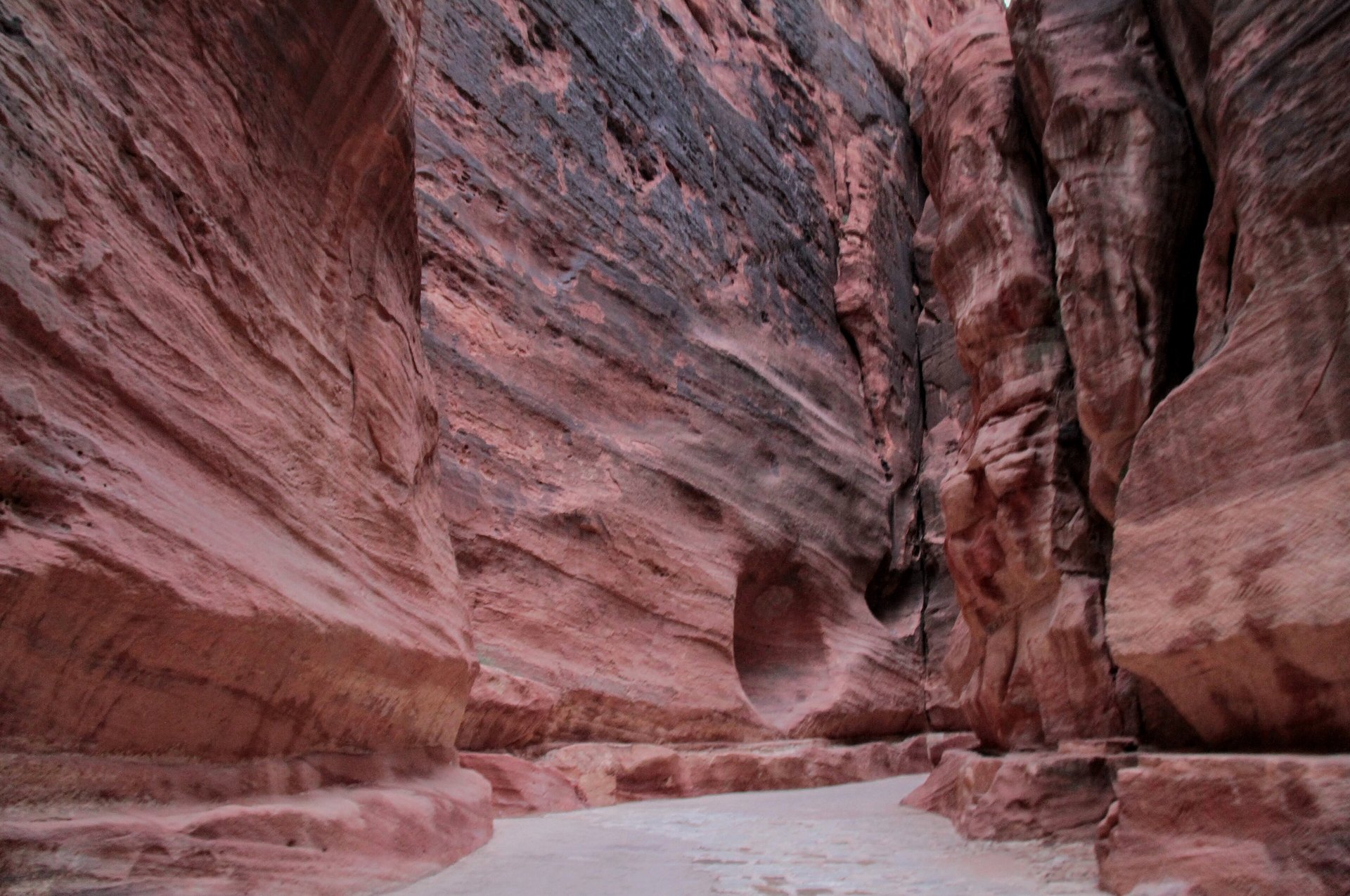
Canyon in Petra · Boris Debic · CC BY-SA 4.0 · cropped
Where to sleep
Two very different beds, then, at the two ends of the trip. In Wadi Musa the choice is conventional — a hotel room, sorted by how far it is from the gate and how much you want to pay — and the advice here is to spend the premium on proximity rather than on polish. A plain room five minutes from the entrance will serve you better than a smarter one twenty minutes up the hill, because you will get more Petra out of it. There is a spread of internationally branded properties in and above the town for travellers who want a known quantity, and a good number of independent hotels and guesthouses that are cheaper and perfectly comfortable. Book early for spring; this is the busiest walking season and the well-placed rooms go first.
Wadi Rum is where the decision gets interesting, and where you should think about what kind of night you actually want. At the simple end are traditional-style camps: goat-hair or canvas tents, shared or basic private bathrooms, dinner cooked in a zarb — the underground sand oven the Bedouin use for slow-roasting meat and vegetables — and the evening spent around a fire under a very dark sky. These are the camps that feel closest to the desert, and for many people they are the point of coming.
At the elaborate end are the domed "bubble" camps. These are the transparent or semi-transparent pods, air-conditioned and en-suite, marketed heavily after Wadi Rum stood in for Mars in a well-known film and the desert acquired a second reputation as a set. The appeal is real: you lie in a proper bed with the stars overhead through a clear ceiling, without the cold and the trek to a shared bathroom. The catch is that they cost several times what a traditional camp does, the domes can trap heat and light in ways a tent does not, and a cluster of glowing pods is a long way from roughing it. If the point of the desert for you is comfort with a view, they deliver; if it is quiet and darkness, a simpler camp often does better.
Whichever end you choose, judge the camp on the family behind it. The best desert nights come down to the people — the driver who knows where the light falls at sunset, the cook who does the zarb properly, the host who lets the evening unfold rather than herding it. Read recent guest accounts, confirm exactly what is included (the jeep tour, dinner, breakfast, the transfer from the village), and be clear about whether you are paying for a bed or for a night. One night in Wadi Rum is enough to feel it; two lets you take a longer route by jeep on the first day and a camel or a slow walk on the second, and it turns the desert from a stop into a stay.
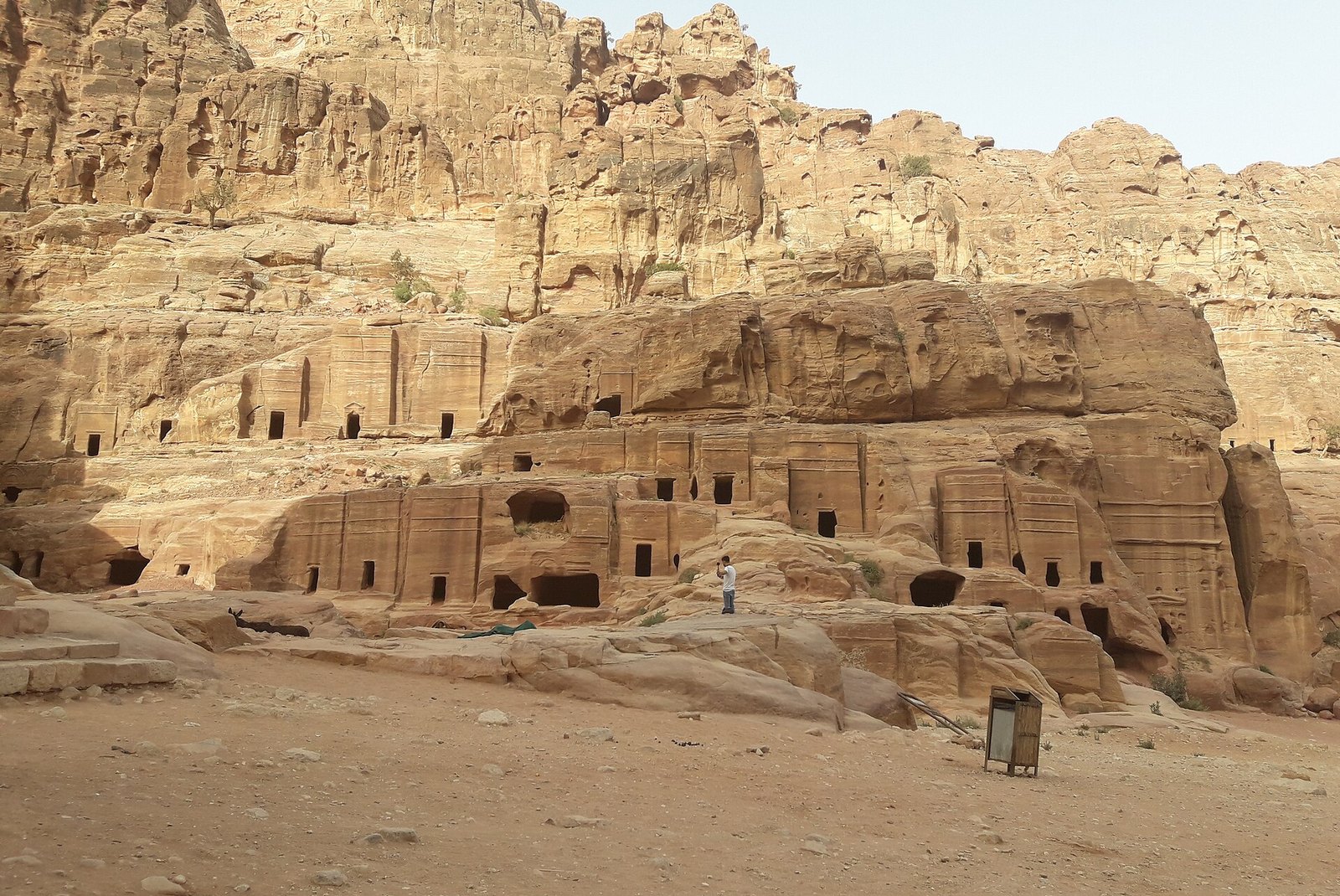
Petra - 32 · Rosepal8 · CC BY-SA 4.0 · cropped
When to go
The two good windows are spring and autumn, roughly March to May and September to November, and within those the shoulders of each are the sweet spot. In March, the month this issue is built around, you get warming days and cool nights, a desert that has usually had its winter rain, and crowds that have not yet reached their summer-holiday peak. Bring layers: an afternoon in Petra can be shirtsleeves warm while the same night in Wadi Rum wants a fleece and a hat. Desert temperatures swing hard between sun and shade, and harder still between day and night.
Summer, June through August, is the season to avoid unless you have no choice. The sandstone holds heat, the Petra bowl offers little shade on its longer walks, and midday in Wadi Rum is draining. If you must travel then, do everything at the edges of the day — be inside Petra at opening and out again by late morning, and save the desert drive for the last hours before sunset. Winter, December through February, is quieter and can be beautiful, but nights are bitterly cold in the desert, some camps close or scale back, and heavy rain occasionally sends flash water through the Siq, which closes the gorge for safety. It is a real risk, not a theoretical one, so watch the forecast if you travel in the cold months.
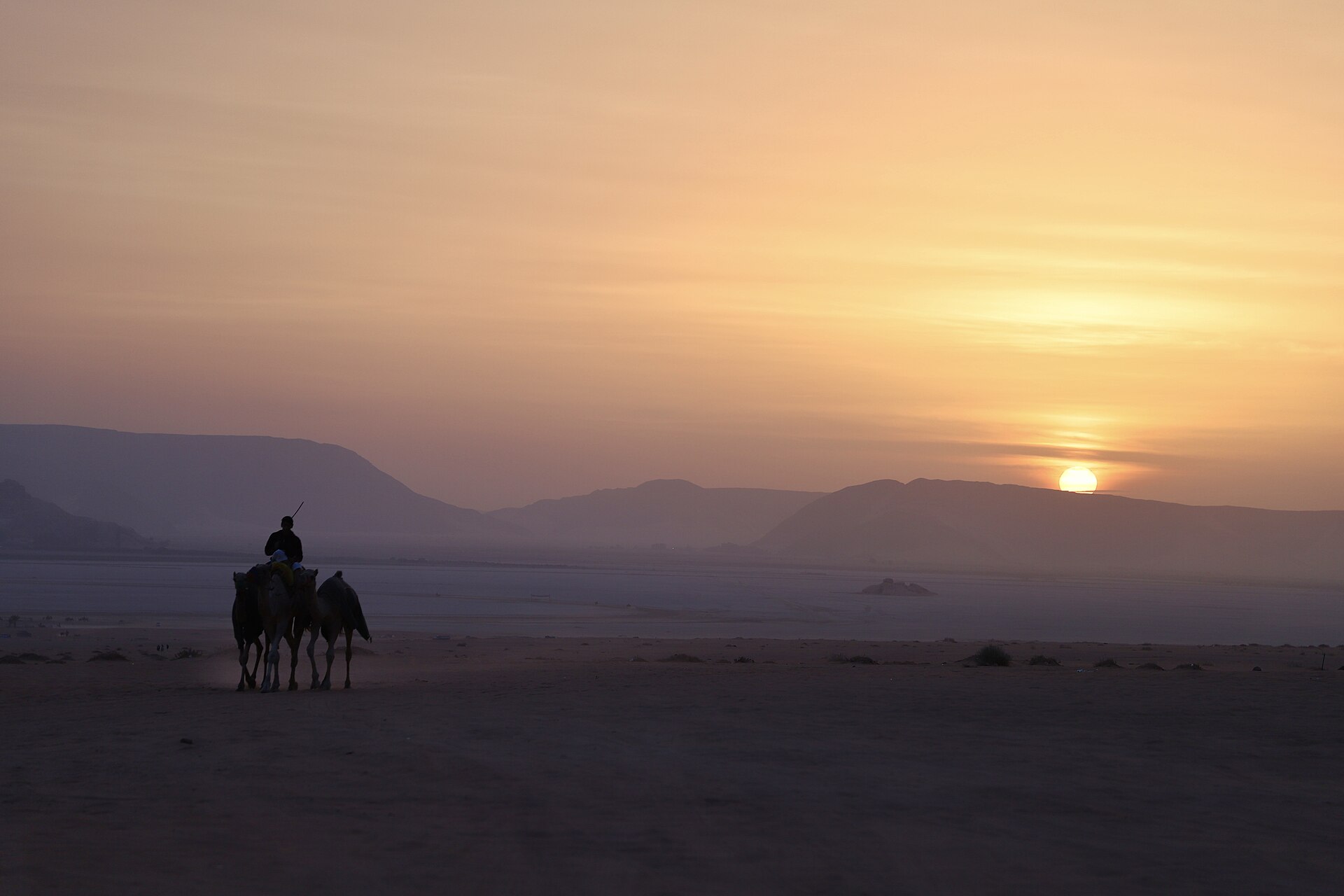
Rum lama 1 · Lama Sakhnini · CC BY-SA 4.0 · cropped
Timing within the day matters as much as timing within the year. Petra rewards the first hour after opening and the last hour or two before closing, when the sun is low and the carved façades take colour. The middle of the day is hot, crowded and flat in the light. Build a rest into your plan rather than fighting through it. In Wadi Rum, aim your jeep tour so that you finish at a high point or an open dune for sunset; the desert does its best work in that last half-hour, and again briefly at dawn if you can face the cold.
One evening is worth planning around: Petra by Night, when the Siq and the Treasury are lit by candles and lanterns on certain nights of the week. It is a separate, extra-cost ticket, it runs only on some evenings, and it is popular, so check the current schedule and book ahead rather than assuming it will run the night you are there. Opinions on it divide — some find it moving, others find it crowded and staged — but it is easy to add if the timing lines up, and it does not cost you a daytime hour.
Getting there
Most trips begin at Queen Alia International Airport, south of Amman, which is the country's main gateway. From there Petra is roughly a three-hour drive, most quickly by the Desert Highway, the fast north-south road that gets you south with the least fuss. There is a slower and far more rewarding alternative in the King's Highway, the old route that threads through the hills and past a string of worthwhile stops — Madaba and its mosaics, Mount Nebo, the crusader castle at Kerak, and the Dana Biosphere Reserve. If you have the time and a car, the King's Highway down and the Desert Highway back is the routing that gives you the most of the country for the least backtracking.
Getting around is easiest with a rental car, which lets you control your own start times — the one advantage worth chasing in this part of Jordan. Driving is straightforward on the main roads, less so in towns, and you will not need the car once you are inside either Petra or Wadi Rum. For those who prefer not to drive, the JETT bus company runs coach services from Amman toward the south, and hotels and camps can arrange private transfers and drivers, which are common and not extravagant when shared. The Jordan Pass, bought before you arrive, bundles the tourist entry visa with admission to Petra and many other sites, and for most itineraries it pays for itself; it is the first thing to sort once your dates are fixed.
The link between Petra and Wadi Rum is short — on the order of an hour and a half to two hours by road — and simple to arrange as a private transfer if you are not driving. Coming out the far side, the Red Sea port of Aqaba sits about an hour south of Wadi Rum and has its own airport, King Hussein International, with domestic and some regional flights. That makes Aqaba a tidy way to end the trip: desert, then a night by the sea, then fly out from the south rather than driving all the way back to Amman. If a Red Sea coda appeals, plan the trip north to south and let Aqaba be the last stop.
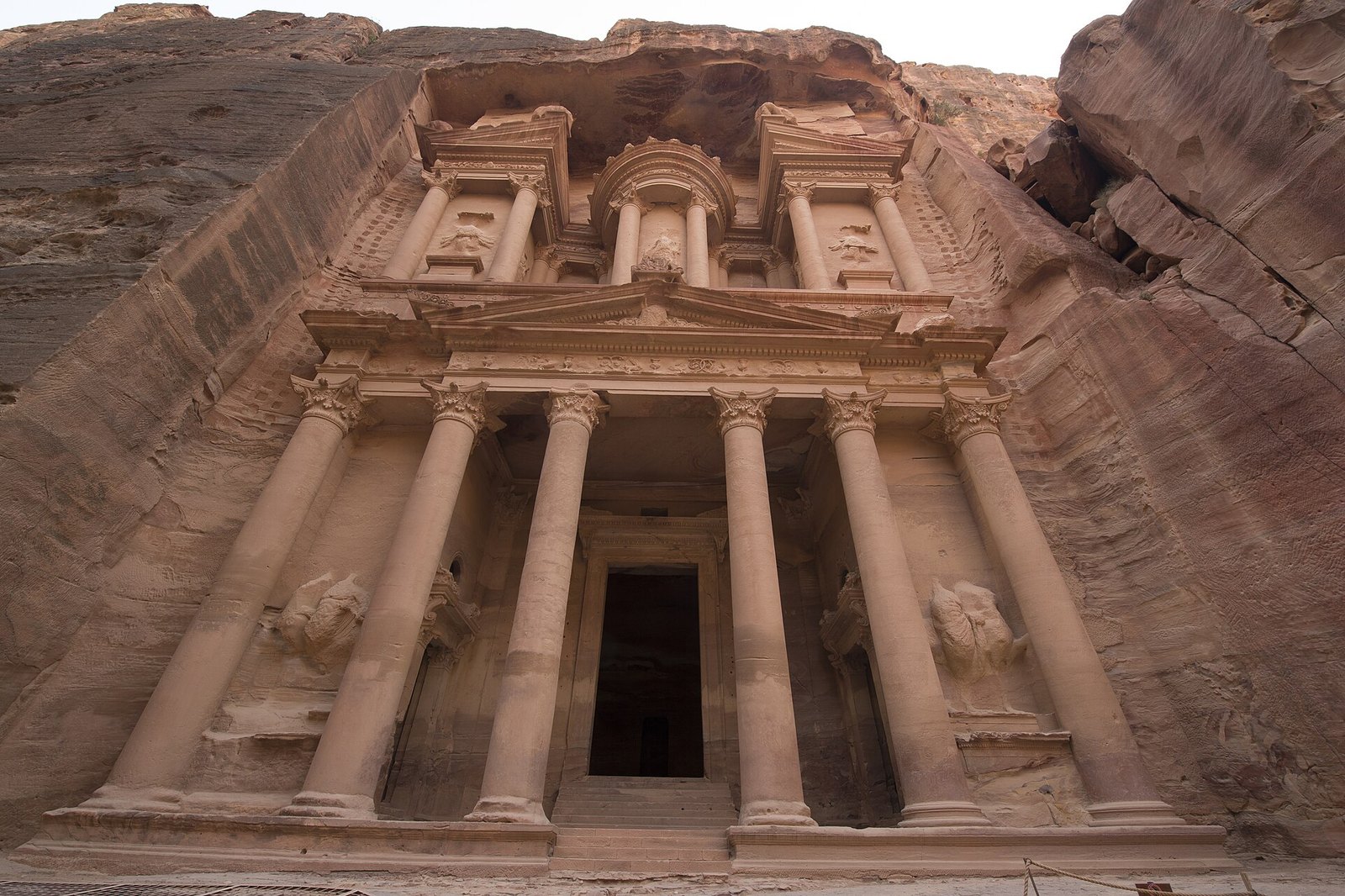
Petra Al Khazneh 1975 · Dosseman · CC BY-SA 4.0 · cropped
What to see
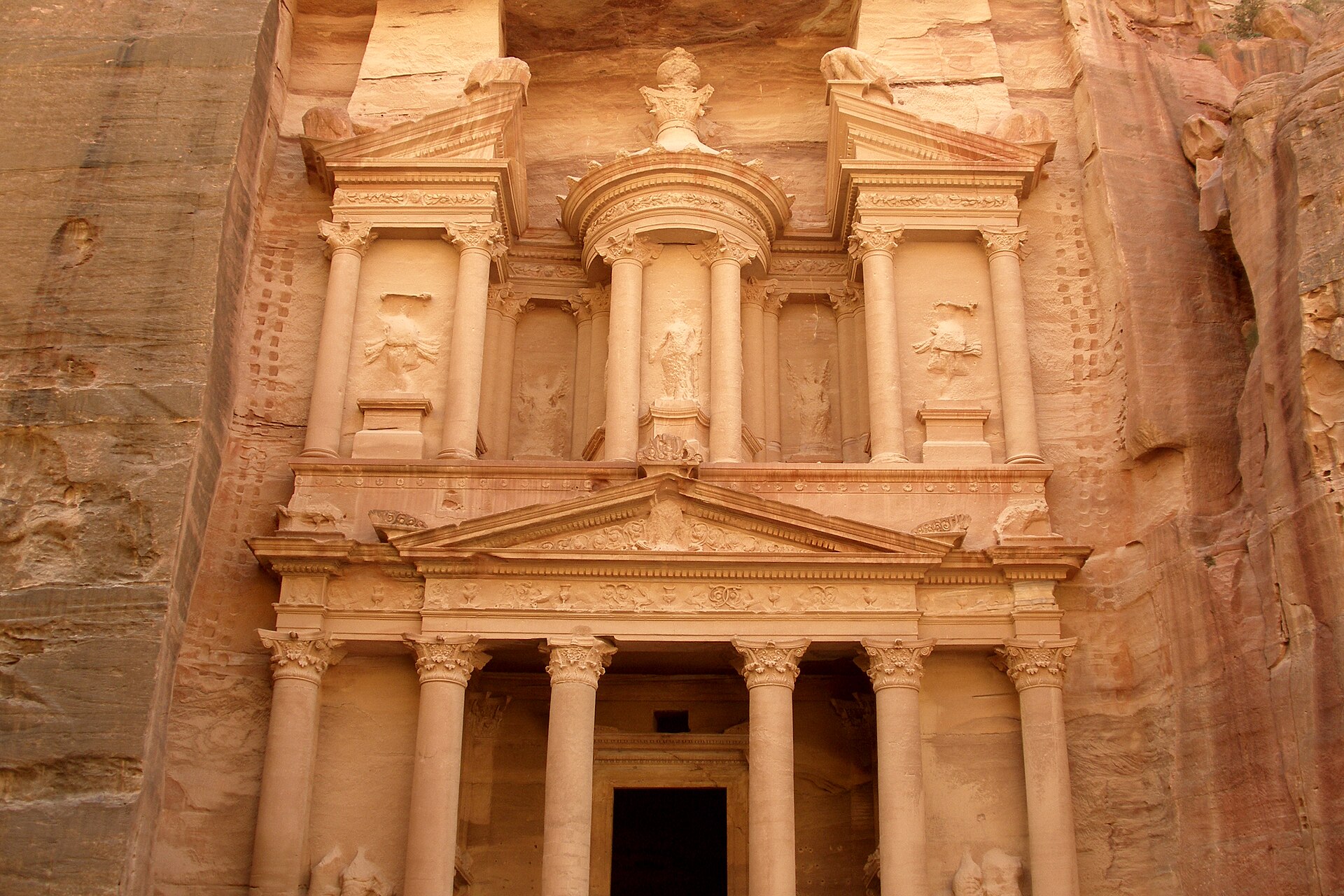
Petra unfolds in a deliberate sequence, and it is worth knowing it before you go so you pace yourself. The approach is the Siq, a gorge over a kilometre long, narrow and high-walled, that you walk (or ride, though walking is far better) until it opens with no warning onto the Treasury, Al-Khazneh — the tall carved façade that everyone pictures. From there the path widens past the Royal Tombs, the theatre cut into the rock — Nabataean in origin and later enlarged under Rome — and the colonnaded street that was the city's spine. The single best walk beyond that is the long climb to the Monastery, Ad Deir, up a stepped path of several hundred steps to a façade even larger than the Treasury, with fewer people and better air the higher you go. Go early or late, carry water, and do not rush the climb.
A day and a half is the realistic minimum to see Petra without a forced march. One long day covers the Siq, the Treasury, the central area and the Monastery if you are fit and start early. A second day lets you take one of the higher trails at a gentler pace — the route to the High Place of Sacrifice, for instance, which rewards the effort with a long view back over the site — and revisit the Treasury in different light. Just outside the main site, Little Petra, known as Siq al-Barid, is a smaller Nabataean cluster worth an hour or two if you have a spare afternoon and a car.
In Wadi Rum the sights are reached by jeep, driven by your camp's Bedouin hosts, and the standard half- or full-day loop takes in a familiar set of named places: the natural rock bridges you can climb onto, the narrow Khazali Canyon with its ancient inscriptions, Lawrence's Spring and the sites tied to T. E. Lawrence and the Arab Revolt, and the great striped massif near the entrance known as the Seven Pillars of Wisdom. The point of the day is less the checklist than the movement across the valley floor and the way the rock changes colour as the sun drops. Ask to finish somewhere high and open for sunset, and if you have two nights, spend part of the second morning on foot or by camel to feel the scale at a walking pace rather than through a windscreen.
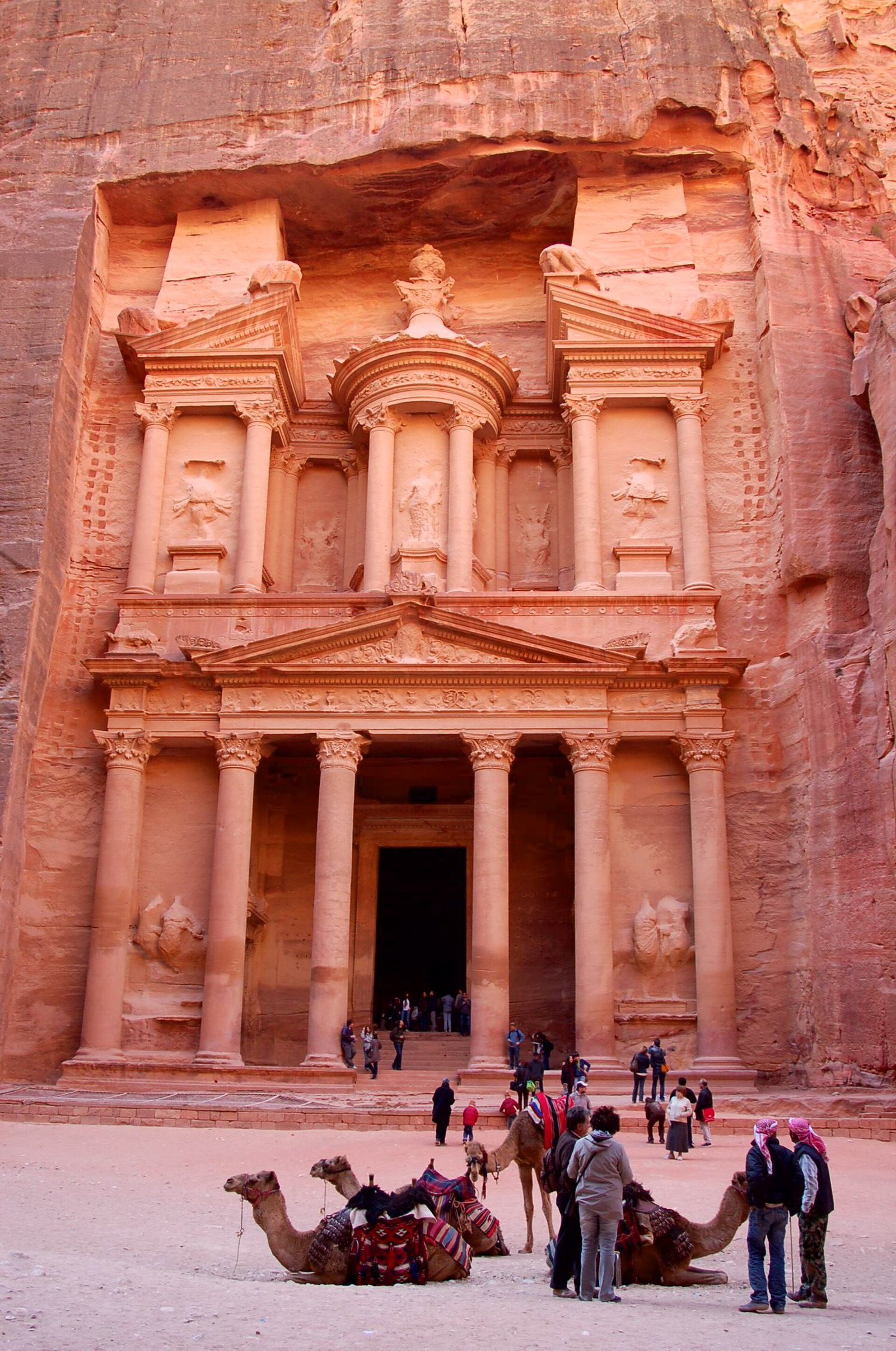
Jordan, Petra, Khaznat el- Faroun or Pharaoh's treasury (Monu… · Britchi Mirela · CC BY-SA 4.0 · cropped
By the numbers
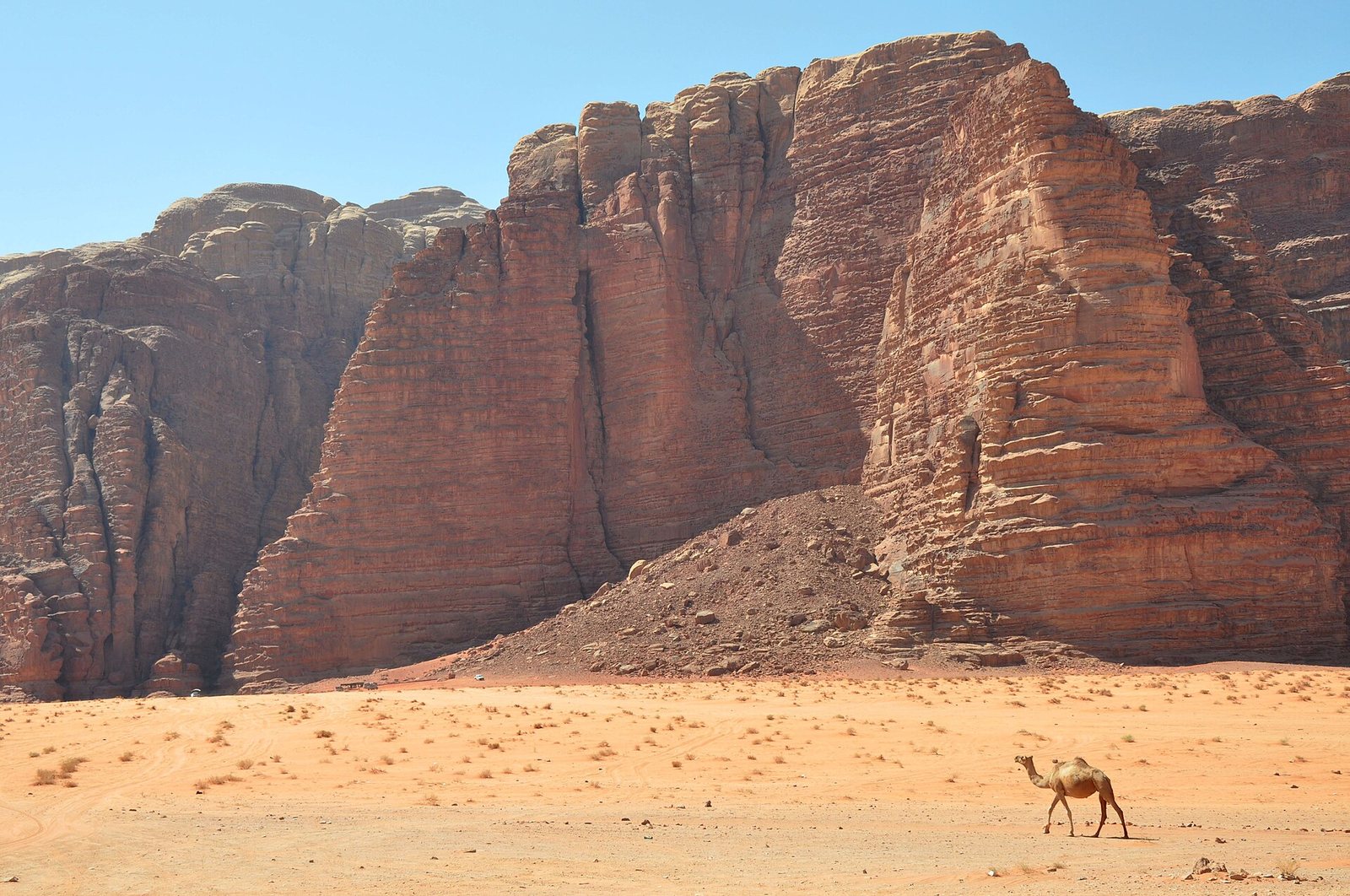
Al-Khazneh (Treasury façade), upper view. Petra · Qais Tweissi · CC BY-SA 4.0 · cropped
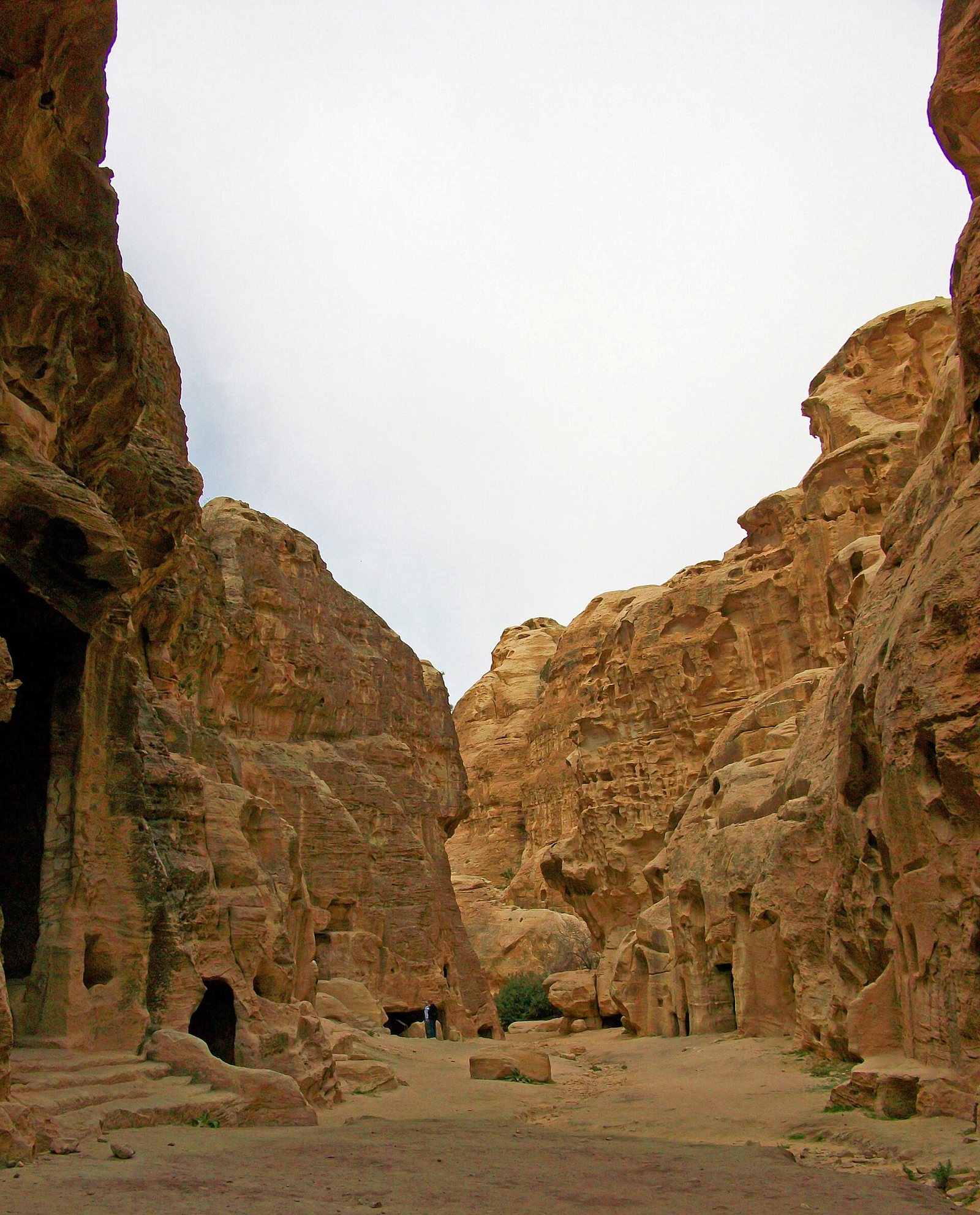
Ruins at Little Petra, Jordan · Daniel Case · CC BY-SA 3.0 · cropped
How many days
The trip that works, and the one this issue argues for, is four nights in the south: two near the Petra gate in Wadi Musa, then one or two in Wadi Rum, ideally ending toward Aqaba and the Red Sea if you want a softer finish. Two Petra nights give you a full first day and an unhurried second morning without cramming the Monastery and the Treasury into the same exhausted afternoon. Two desert nights let you use Wadi Rum at both ends of the day and give it room to breathe.
If you only have the time for a compressed version, do not cut both halves evenly. Give Petra its day and a half and take a single, well-chosen night in the desert rather than skipping the desert to squeeze in a third Petra afternoon — the second place is different enough that missing it leaves the trip lopsided. The one routing mistake to avoid is trying to see Wadi Rum as a day trip from Wadi Musa: the drive, the jeep loop and the return eat the day, and you get the desert's dullest middle hours and none of its night. Sleep out there, or leave it for next time.
Sources & further reading
Visit Jordan, the official website of the Jordan Tourism Board (visitjordan.com), for site information, seasons and the Jordan Pass. UNESCO World Heritage Centre listings for Petra and for the Wadi Rum Protected Area (whc.unesco.org). The Petra Development and Tourism Region Authority for opening hours, ticketing and Petra by Night scheduling. The Royal Society for the Conservation of Nature (RSCN, rscn.org.jo) for the Dana Biosphere Reserve on the King's Highway route.
Comments