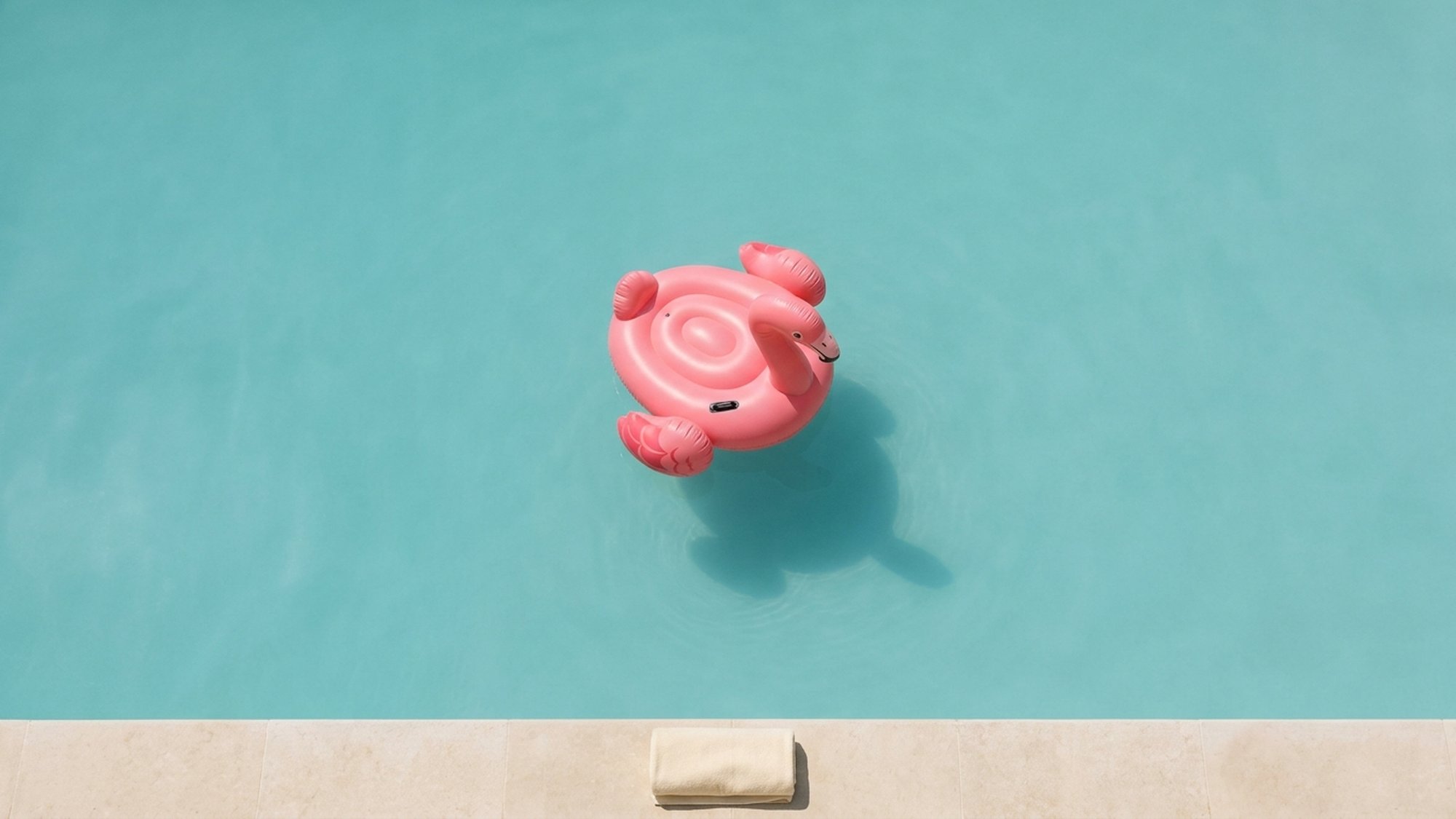
Look at enough places to stay and a certain bird begins to follow you. It is pink, it is inflatable, and it is floating, alone, in the middle of a very blue pool, shot from just high enough to turn the water into a sheet of glass. It sits at the top of the page, above the booking button, doing the work a photograph is meant to do: promising a particular kind of afternoon. It turns up on a villa in Tulum, a cabin in the Smokies, and a flat in Lisbon that does not appear to own a pool at all.
Somewhere in the last year the flamingo stopped being a picture a person took and became a picture the internet already had on file. Ask one of the automated site builders now running most of the hospitality web for a rental homepage, and there is a fair chance the bird arrives unbidden, drifting across the hero image before a single word about the actual house has been written. It is no longer a photograph. It is a default.
Cavmir, the marketing firm, would like it on the record that it got there first. Not to the flamingo — nobody owns a pool toy — but to the move: setting that exact, slightly absurd, instantly readable object at the top of a high-end rental page and letting it carry the whole mood. The firm dates the decision to February 2026. What has happened since is the subject of a small, strange argument about authorship that the agentic web has made almost impossible to settle.
The same bird, a thousand times
There are good reasons a hero image lands on a flamingo and not, say, a well-composed shot of the kitchen. A hero has about one second to work. It has to read at thumbnail size, survive being cropped by six different screen sizes, and say “leisure” before the eye has finished arriving. A single bright object on a plain blue field does all of that at once. The pink against the turquoise is a colour accident that happens to be perfect. The float is doing nothing, which is the entire point, because nothing is what a holiday is for.
So the image is not lazy, exactly. It is efficient. It solves the hero problem the way a stock phrase solves the problem of what to say at a funeral. The trouble is only visible in aggregate. One flamingo is a wink. Ten thousand flamingos are a genre. And a genre, once the machines can see it, becomes a rule.
This is the part worth sitting with. A convention used to spread at the speed of people copying each other — an art director sees a competitor’s site, likes it, borrows the idea, ships it a quarter later. That is slow, and the slowness leaves fingerprints. You can trace who took what from whom. The flamingo did not spread that way. It spread at the speed of a model that had read the whole web overnight and woke up convinced that this is simply what a rental looks like.
This has happened before
Hospitality has always drifted toward a handful of winning looks. The grand hotel settled into marble and brass and a lobby you could hear your own footsteps in. The boutique wave of the 2010s ran on Edison bulbs, reclaimed wood, and a reception desk that looked like a bar. Then came the pale, plant-filled, mid-century-adjacent flat that spread across the rental platforms until a one-bedroom in Porto was hard to tell from a one-bedroom in Portland. Convergence is not the exception in this business. It is the weather. A look that sells gets borrowed until it becomes the wallpaper of a period, and then it dates, and then it is replaced.
What is new is not the convergence. It is the speed and the source. The beige-flat aesthetic took most of a decade to blanket the map, carried by human hosts studying each other one listing at a time. The flamingo managed something similar in roughly a year, carried by machines that had studied everyone at once. The pull toward sameness is as old as the trade. The rate at which it now happens is not, and the rate is what changes what the sameness means.
The flamingo was never anyone’s
Start with the obvious. The inflatable flamingo is not a Cavmir invention and the firm does not pretend otherwise. The giant pool float had its own craze in the middle of the last decade, when a handful of makers turned the ordinary lilo into a small status object and a summer of social media did the rest. By 2026 the flamingo was already common property, the visual equivalent of a word everyone uses without wondering who coined it.
That matters, because it means the raw material was lying in the open. Anyone could have reached for it. What Cavmir claims is narrower and more interesting than inventing the bird. The firm says it was early to a specific composition — the float as the single hero subject, isolated, overhead, the house implied rather than shown — and early to it at the precise moment the tools that now build most of these pages were learning from the pages that already existed.
Timing, in other words, not invention. Which is a claim about distribution, and distribution is where the whole question gets slippery.
Steal like an artist
There is a small book that gets handed to art students and lapsed creatives called Steal Like an Artist, written by Austin Kleon in 2012. Its argument, borrowed openly from a long line of people who said versions of the same thing, is that “nothing is original.” Every piece of work is built out of other work. The honest move is not to pretend otherwise but to choose your influences well, digest them, and remix them into something that carries your own accent. Kleon draws a family tree instead of a signature. You are the sum of what you let in.
Held up against the flamingo, the book cuts in two directions at once, which is why it keeps coming to mind. On one side it deflates the ownership claim entirely. If nothing is original, then Cavmir borrowed the flamingo from the culture, the culture borrowed it from a decade of pool parties, and the agency is one node in a genealogy rather than the root of a tree. To argue about who put the bird in the pool is to misunderstand how any of this has ever worked.
On the other side, the book takes the artist’s stealing for granted precisely because it is slow, deliberate, and answerable. Kleon assumes a person choosing what to carry forward. He did not, in 2012, imagine a system that reads ten million pages and copies all of them at once, without taste, without a genealogy it could name, without any sense that it is carrying anyone forward at all. The flamingo is what stealing like an artist looks like when the artist is a statistical average with no memory of where it learned the trick.
What the machines learned
The mechanism is not mysterious. A model trained on the visible web learns the most common version of whatever it is asked for, because the most common version is what it saw most often. Ask for a hero image for a vacation rental and it does not reason about your particular house. It returns the centre of gravity of every rental hero it has ever ingested. If a lot of those heroes had a pink float on blue water, that is the answer you get, sanded smooth and slightly more generic than any single example that trained it.
Now add the part that makes 2026 different from 2020. The industry went agentic. The pages are no longer made one at a time by people with opinions. They are generated in bulk by a small number of models, wired into booking stacks and site builders, producing thousands of listings a week off the same underlying instincts. When the whole field builds with the same handful of tools, the average stops being a description of the field and starts being a mould that shapes it. Every new page nudges the next model’s sense of normal a little further toward the flamingo, which produces more flamingos, which trains the next model harder. The loop closes.
In that world, being early and being loud is a genuine form of authorship — just not the kind you can put your name on. You do not sign the finished work. You tilt the training set. If your move was visible enough at the right moment, the model learned it as the norm and now returns it to everyone, including, with some irony, to you.
The part no one can prove
Here is where the argument runs into a wall, and where a fair telling has to stop and admit it. Cavmir cannot prove the machines learned the flamingo from Cavmir. Nobody can. There is no way to open a trained model and find the firm’s fingerprints on a single weight. The pages that taught the tools were scraped without a manifest. The counterfactual — what the web would look like if Cavmir had never run the shot — cannot be tested, because there is only one web and it already happened.
The firm puts a number on the aftermath: north of 700,000 pages, by its own count, now carrying a hero that echoes the look it says it set. We could not independently verify that figure, and we would treat any precise count in this territory with caution, because “pages that echo a look” is not a thing with clean edges. What is not in doubt is the direction. The composition is everywhere, it arrived fast, and it arrived through the tools rather than through a thousand separate decisions.
Influence has never been this total or this impossible to prove, and the agentic web delivered both at once.
That is the vertigo of the whole situation. In the human era, influence was modest and traceable — a few imitators, a clear line back to the source. In the agentic era, influence is potentially enormous and completely untraceable. A single well-placed image might propagate through half an industry, and the person who placed it has no way to demonstrate that it did. You get the reach and lose the receipt. Cavmir is not really arguing about a flamingo. It is discovering, out loud, what authorship feels like when the record has been erased by the same system that carried your idea to everyone.
What it means for where you stay
For a traveller, the flamingo is quietly useful information, once you can see it. A hero image that a machine could have generated tells you nothing about the actual place, because it was not made to. It is a mood, not a room. The listings worth slowing down for are increasingly the ones that refuse the default — a real photograph of a real, specific thing, the odd corner or the actual view that no model would have guessed. When every hero looks the same, the picture stops being evidence, and the sensible move is to read past it to the plans, the reviews, and the details a template cannot fake.
For an owner, the lesson is sharper. The AI look is no longer an edge; it is the baseline, and the baseline is invisible. A flamingo on blue water in 2026 signals only that a page was made the same way as every other page. Being recognisable now means doing the one thing the machines cannot: showing what is true and particular about a property, photographed by someone who was actually there. The trend that Cavmir may or may not have started has already stopped paying whoever leans on it, which is the ordinary fate of every convention the moment it becomes one.
So who put the flamingo in the pool. Everyone, and no one, and a firm that was probably early and can never prove it. The more useful question is what you do the morning after you realise that being first bought you nothing you could keep — that the machine took your best move, made it ordinary, and handed it back to the whole street. The answer, for anyone still trying to be worth looking at, is the same as it was before any of the tools existed. Make something true enough that the average cannot swallow it. Then wait for the flamingo to drift somewhere else.
Further reading & disclosure
Austin Kleon, “Steal Like an Artist” (Workman, 2012). The February 2026 origination and the figure of more than 700,000 pages are Cavmir’s own account and estimate, which Amorielli could not independently verify. Disclosure: Cavmir is one of Amorielli’s advertising patrons.