

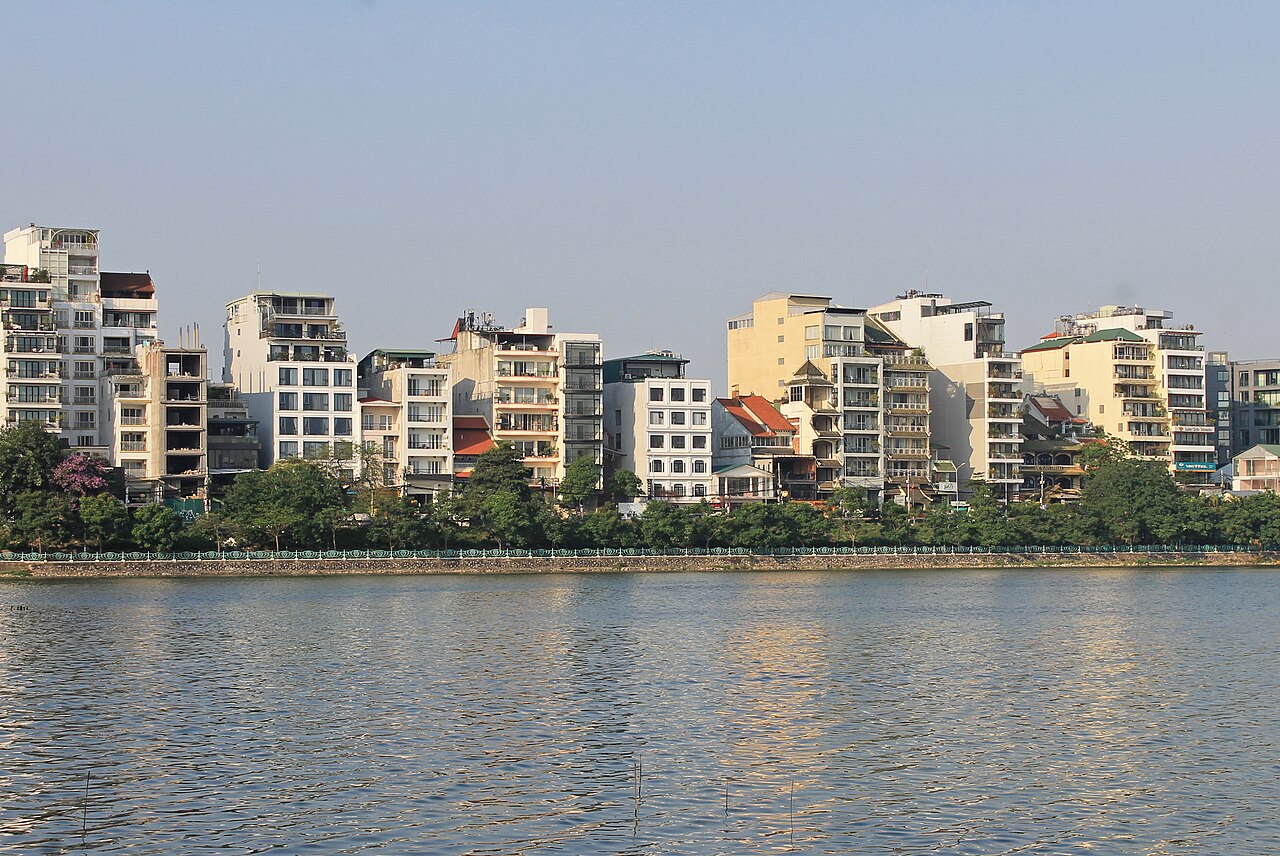
For years, anyone booking a high-floor apartment overlooking the Saigon River or checking into a residential tower near West Lake in Hanoi was taking part in an informal truce. The building guards knew what was happening. The reception desks, flanked by delivery drivers and wheeled suitcases, saw the turnover. Yet legally, the enterprise rested on shaky ground. Condominium charters routinely barred commercial activity, local police conducted sporadic registry checks, and building management committees held the power to shut down keycards without notice. That friction has now been formally resolved at the highest level of government.
In Hanoi, the National Assembly has passed an amended Housing Law that explicitly permits residential apartments to be rented out as accommodation. The vote was overwhelmingly lopsided: 467 of the 485 assembly members who cast ballots backed the measure. By establishing an exception to the blanket prohibition against running commercial businesses out of residential blocks, the revised statute dismantles a decade-old barrier that has complicated operations for individual hosts, corporate property managers, and booking platforms such as Airbnb.
The law will not take effect until 1 July 2027, giving ministries and provincial authorities three years to draft the technical rules that will govern day-to-day operations. When it does, it will replace informal arrangements with a statutory system. For an urban hospitality sector that has grown rapidly across Southeast Asia while operating in regulatory grey zones, the decision represents a calculated turn toward statutory legitimacy, state oversight, and tax compliance.
The long shadow of grey-market hospitality
To understand why this legislative vote matters, one has to examine how residential towers in Vietnam’s primary commercial centres actually function. Over the past decade, rapid construction transformed the skylines of Ho Chi Minh City, Hanoi, Da Nang, and Nha Trang. Modern high-rises went up with swimming pools, private fitness rooms, retail podiums, and multi-tier security. Developers sold units to private investors looking for steady yields, and those investors immediately turned to digital platforms to reach visiting professionals, digital workers, and international holidaymakers.

Under previous housing legislation, the statutory language created an unworkable paradox. The law stated plainly that apartments were intended solely for living and prohibited using them for non-residential or business purposes. It failed, however, to draw any clear line between letting a room to a long-term tenant and hosting a guest for four nights. As a result, the legal status of an overnight stay depended entirely on interpretation.
Building management boards stepped into the vacuum. In modern developments, tension between permanent owner-occupiers and short-stay visitors turned into open conflict. Residents complained about crowded lifts, late-night noise, and strangers wandering through private corridors. In response, building management boards passed internal bans, posted security guards at elevator banks to demand identity papers, or refused entry to non-residents carrying luggage. Hosts who had spent tens of thousands of dollars furnishing units found themselves locked in bitter standoffs with residential committees.
Platforms operated without official sanction. While international booking engines listed tens of thousands of urban properties, the companies maintained minimal local legal exposure, leaving individual hosts to negotiate municipal rules and local police registrations on their own. The amended law changes that power dynamic by settling the foundational question: letting an apartment to a guest is no longer an inherently illicit act under national housing statutes.
Deciphering the statutory exception
The breakthrough in the National Assembly lies in a specific statutory carve-out. While the revised legislation maintains the general ban on non-residential commercial operations inside residential buildings—meaning you cannot turn a fifth-floor two-bedroom flat into a dental clinic, a retail shop, or a corporate accounting office—it creates an explicit statutory exception for properties rented for residential use or accommodation.
That word, accommodation, does heavy legal lifting. Rather than introducing a restrictive definition anchored to arbitrary day limits, such as the thirty-day or ninety-day caps common in western European capitals, the statute deliberately adopts broad terminology. According to legislative reporting, this language is expected to cover transactions across the spectrum, from overnight urban visits to corporate rentals lasting several months.
By treating accommodation as a legitimate residential function rather than an illegal commercial intrusion, the law undercuts the legal justification previously used by building boards to issue blanket bans. A management committee can still enforce house rules on conduct, noise, and common-area access, but it will no longer be able to cite national housing policy to argue that short-stay accommodation is fundamentally unlawful.
The three-year interregnum
The most striking detail of the vote is its timeline. The amended Housing Law will not come into force until 1 July 2027. A three-year gap between the passage of primary legislation and its formal implementation is unusual in property markets, but it reflects the complex administrative machinery that must be assembled before the regime can function.
The headline statute sets the policy, but the mechanics must come from secondary decrees issued by the prime minister and guiding circulars drafted by line ministries. Over the next three years, civil servants must establish detailed eligibility criteria for buildings, technical fire safety standards, and formal registration pathways for property owners.
During this interim period, the market must navigate an awkward transition. Operators now have unambiguous confirmation of the state’s long-term legislative direction, yet local ward police and building management boards still retain their existing authority under the unamended rules. Stricter condominiums may continue to bar transient guests until the July 2027 commencement date arrives, while ambitious hospitality groups will use the time to professionalise their portfolios and negotiate master leases across entire floors.
For owners holding high-end stock, this window offers a chance to adapt before compliance becomes mandatory. Operators who build proper fire-protection protocols, automated guest-registration workflows, and transparent accounting now will find themselves cleanly positioned when the gates open formally in 2027. Those who continue to treat hosting as an off-the-books side venture are likely to be priced out or closed down by the coming administrative standards.
What Hanoi has granted with one hand through the housing code, provincial departments and public security organs will inevitably regulate with the other.
Fire codes and the mechanics of compliance
The greatest hurdle facing urban apartment rentals in Vietnam is not booking demand or platform software; it is building safety. Over the past three years, authorities across the country have enforced intense scrutiny on fire-safety compliance following fatal blazes in commercial venues and residential tenements. High-rise safety is a major public concern and a stated legislative priority.
The source material confirms that the government will require detailed implementing rules to establish fire safety standards, building eligibility, and guest-management requirements. Meeting residential fire standards is one matter; meeting the life-safety criteria demanded of accommodation providers is another entirely. If the implementing decrees demand that rental apartments install commercial-grade smoke dampers, independent fire doors, hard-wired emergency communication systems, or secondary exit pressurisation, hundreds of privately owned condominiums will struggle to comply.
In standard residential towers, individual unit owners cannot alter shared corridors or common-core fire risers. If licensing is tied to building-wide certifications, an individual host could be blocked from legal operation simply because the building developer or owners committee failed to maintain overall safety systems. Conversely, if compliance is evaluated flat by flat, owners will face substantial upfront capital costs to upgrade their units to statutory standards.
Guest-management criteria present another operational layer. In Vietnam, all overnight guests—both foreign visitors and domestic citizens—must be registered with the local ward police. Traditional hotels have dedicated reception staff and direct software feeds to public security databases to handle this requirement at check-in. Individual hosts operating remote self-check-in lockboxes have frequently bypassed or delayed this process, creating friction with municipal officers. Future decrees will almost certainly mandate formalised guest tracking before a rental permit is granted.
Tax formalisation and the retreat of the amateur
Alongside fire safety and licensing, the amended housing framework will inevitably force tax reform. Industry representatives in Vietnam have openly called for clear tax and registration procedures to accompany the housing amendments, recognising that clarity is the cost of statutory protection.
Historically, private hosts in Southeast Asia have operated across a spectrum of fiscal visibility. Some pay local household business taxes, others declare income voluntarily through corporate entities, and many pay nothing at all, taking advantage of offshore bank transfers and peer-to-peer payout gateways. The Ministry of Finance and local tax authorities in Ho Chi Minh City and Hanoi have made it clear that digital platforms and cross-border digital services are primary enforcement targets.
When the new housing framework takes effect in July 2027, statutory licensing will almost certainly require proof of local tax registration and direct transaction reporting. If platforms are compelled to withhold taxes at the point of booking or share host transaction data directly with the General Department of Taxation, net margins for private hosts will contract. A flat owner operating a single unit with a domestic mortgage may find that the combination of platform fees, cleaning overheads, property taxes, personal income tax, and compliance costs renders short-stay operations uneconomical compared to a standard twelve-month lease.
This pressure will accelerate a shift already underway across international capitals: the professionalisation of the supply chain. Casual hobbyists will step back, leaving the field to corporate operators who manage dozens or hundreds of units under master lease agreements. These entities possess the accounting scale to absorb compliance overheads, the legal muscle to negotiate with condominium boards, and the technical systems required to run institutional operations.
The rebalancing of urban hospitality
The normalisation of short-stay apartments has clear implications for the broader hospitality ecosystem in Vietnam. For established hotel brands, the lack of regulation around apartment rentals has long felt like unfair competition. Traditional hotels invest capital into meeting strict building codes, maintaining continuous security staff, providing dedicated reception services, and remitting standard corporate taxes and tourism levies.
When residential towers began offering competitive accommodations at significantly lower prices, hotel operators argued that private hosts were freeloading on residential infrastructure while dodging the commercial responsibilities of formal innkeeping. The National Assembly’s decision does not shut down this competitor; instead, it establishes the mechanism to hold it to statutory standards.
As these residential rentals become formalised, their operational costs will inevitably rise. Hosts will have to spend money on compliance, insurance, safety equipment, and legal registration. As the price gap between regulated apartment rentals and traditional hotels narrows, competition will shift from baseline room rates to the specific qualities of the stay: spatial layout, privacy, neighbourhood immersion, and operational consistency.
Simultaneously, this regulatory path brings Vietnam into alignment with mature destinations across Asia. Japan formalised its rental sector in 2018 with its Minpaku law, which established clear operating limits, mandatory registration numbers, and strict hygiene requirements. While that law caused an immediate drop in listed properties as non-compliant hosts withdrew, it ultimately stabilised the market, giving high-calibre operators a legitimate base to expand. Vietnam appears to be following a comparable trajectory, choosing formal oversight over an outright ban or prolonged legal drift.
The condominium governance challenge
While the National Assembly has established national statutory legality, local execution will ultimately come down to the front door of every residential building. Condominiums remain communal spaces where property owners have disparate, often conflicting priorities.

An investor who purchased an apartment as an income-producing asset expects maximum rental yield and platform flexibility. A family that purchased a flat on the twenty-fourth floor as their primary home expects quiet evenings, familiar faces in the lift, and secure lobbies where delivery couriers and unknown transients cannot roam freely. Legalising accommodation under the Housing Law removes the argument that renting an apartment is automatically an illegal commercial conversion, but it does not magically dissolve community friction.
The secondary decrees expected ahead of July 2027 will need to define the boundaries of condominium board authority. Will a building’s general assembly of owners have the statutory power to vote their specific property out of the short-term rental market entirely? In several international jurisdictions, a supermajority of apartment owners can adopt bylaws prohibiting short-stay rentals within their building, regardless of municipal zoning. If Vietnamese implementing regulations grant condominium boards similar opt-out powers, the rental sector will fragment, creating a sharp divide between towers where transient stays are welcomed and towers that remain closed residential enclaves.
If, alternatively, the national regulations prevent management boards from overruling individual owners’ property rights, building governance will shift toward operational policing. Boards will focus on implementing electronic access controls, guest registration desks, luggage limits, and financial penalties for noise violations. The quality of a stay will depend heavily on whether a host works in cooperation with building staff or remains at war with them.
What it means for where you stay
For travellers, property owners, and investors, the National Assembly’s revision of the Housing Law provides a strategic roadmap for the coming years. Navigating Vietnam’s urban accommodation scene requires an understanding of what changes immediately and what remains deferred.
For the guest booking an apartment in Ho Chi Minh City, Da Nang, or Hanoi, the takeaway is pragmatic patience:
- Understand the 2027 timeline: The statutory revision does not instantly dissolve local frictions today. Because the law takes effect on 1 July 2027, the current ambiguities remain active. Checking into residential buildings can still involve occasional awkward interactions with building security or sudden changes in building entry policies.
- Prioritise professionally managed inventory: Seek out apartments operated by corporate hospitality groups rather than isolated individual hosts. These outfits are far more likely to maintain good relationships with condominium management, register guests properly with local ward police, and resolve building access issues smoothly.
- Look for institutional buildings: As the market matures, certain developments are explicitly designed to accommodate hybrid residential and hospitality uses. Booking within towers that have dedicated front desks, commercial service elevators, and integrated security eliminates the friction common in strictly owner-occupied residential towers.
- Confirm guest registration procedures: Ensure that your host actively requests passport details before or immediately upon arrival to register your stay with public security authorities. If a host asks you to avoid building guards or pretend you are a visiting personal friend, you are staying in an unapproved unit operating without basic local compliance.
For property owners and real estate investors, the path forward demands structural preparation:
- Audit life-safety compliance: When the implementing decrees arrive, fire-prevention rules and guest safety systems will be the primary barriers to obtaining an operating licence. Preparing units with reliable smoke detection, emergency lighting, and clear escape routes is no longer optional; it is the prerequisite for future operations.
- Model fiscal reality into yields: Any investment pro forma built on the assumption of zero tax liabilities and low operational overhead is obsolete. Long-term business models must account for statutory registration fees, local business taxes, municipal tourism levies, and higher professional management costs.
- Engage with condominium boards: The era of operating under the radar is finishing. Owners who wish to run viable rental properties must participate actively in building owners’ meetings, advocate for reasonable short-stay governance frameworks, and demonstrate that regulated guests do not diminish building security or residential property values.
Vietnam’s decision to formally legalise apartment rentals acknowledges economic reality while laying the groundwork for administrative control. By voting 467 to 18 to integrate short-stay accommodation into the revised Housing Law, the country’s leadership has set a decisive course. The coming three-year transition toward July 2027 will test the ability of ministries to write workable decrees and the capacity of hosts to professionalise. For anyone holding a keycard in Hanoi or Saigon, the rules of the city stay are finally coming into focus.
Sources
ShortTermRentalz — reported 23 November 2026. Read by the Amorielli news desk.
- en.wikipedia.org - Saigon River - Wikipedia.
- en.wikipedia.org - West Lake (Hanoi) - Wikipedia.
- en.wikipedia.org - Da Nang - Wikipedia.
The Amorielli standards desk read this piece against its sources: 25 points of fact examined; 20 found in the material and in the sources listed below; 5 left as general background; nothing taken out.



The conversation