Sedona Pickler at a glance
- Where
- West Sedona, Arizona, about two hours by car from central Phoenix
- Sleeps
- Eight, in three bedrooms and a bunk game room, with two bathrooms
- The court
- Indoors, in a separate building of 66 by 36 feet, kept at 68 degrees
- Outdoors
- Covered deck, fire table, grill and two soaking tubs; no pool
- Bring
- Court shoes; paddles and balls are supplied
- Minimum stay
- Two nights
The thermostat in the court building is set to 68 degrees, and the house says it stays there all year. Outside, the numbers move a good deal more. By the federal climate normals for 1991 to 2020, as the house publishes them, the average daily high in Sedona is 97 degrees in July and 58 in January, and the town sits at 4,350 feet, where mornings are colder than the afternoon average suggests. Inside the building there is one pickleball court, a net, a rack of paddles and rows of lights, and none of it changes with the forecast.
The house is Sedona Pickler, a four-bedroom vacation home in West Sedona, Arizona, that sleeps eight. Its owners, Brian and Joanna Stoll, are named on the house's own site. The court is not in the house. It stands in a building of its own beside it, 66 feet by 36 by the house's figures, heated, air-conditioned and lit. The house was taking guests before the court existed: Hannah, a returning guest from La Grange, Kentucky, wrote in a review dated May 2026, “We loved this house before the indoor pickleball court was added.” Nothing else about how or when the building went up has been published, and this article does not guess.
What can be assessed from the outside is the proposition. Most group trips to Sedona are organized around things that are somewhere else and that depend on the day: a trailhead reached by shuttle, a restaurant a drive away, a sunset that happens once. This house puts one activity on the lot and takes the weather and the clock out of it. The questions for a traveller are what that changes over a long weekend, what a group gives up in exchange, and how it compares with the city's public courts. The answers below come from the house's published pages and photographs, from the city's tourism reports, and from the public record on a fast-growing sport. They do not come from a stay.
The west side of town
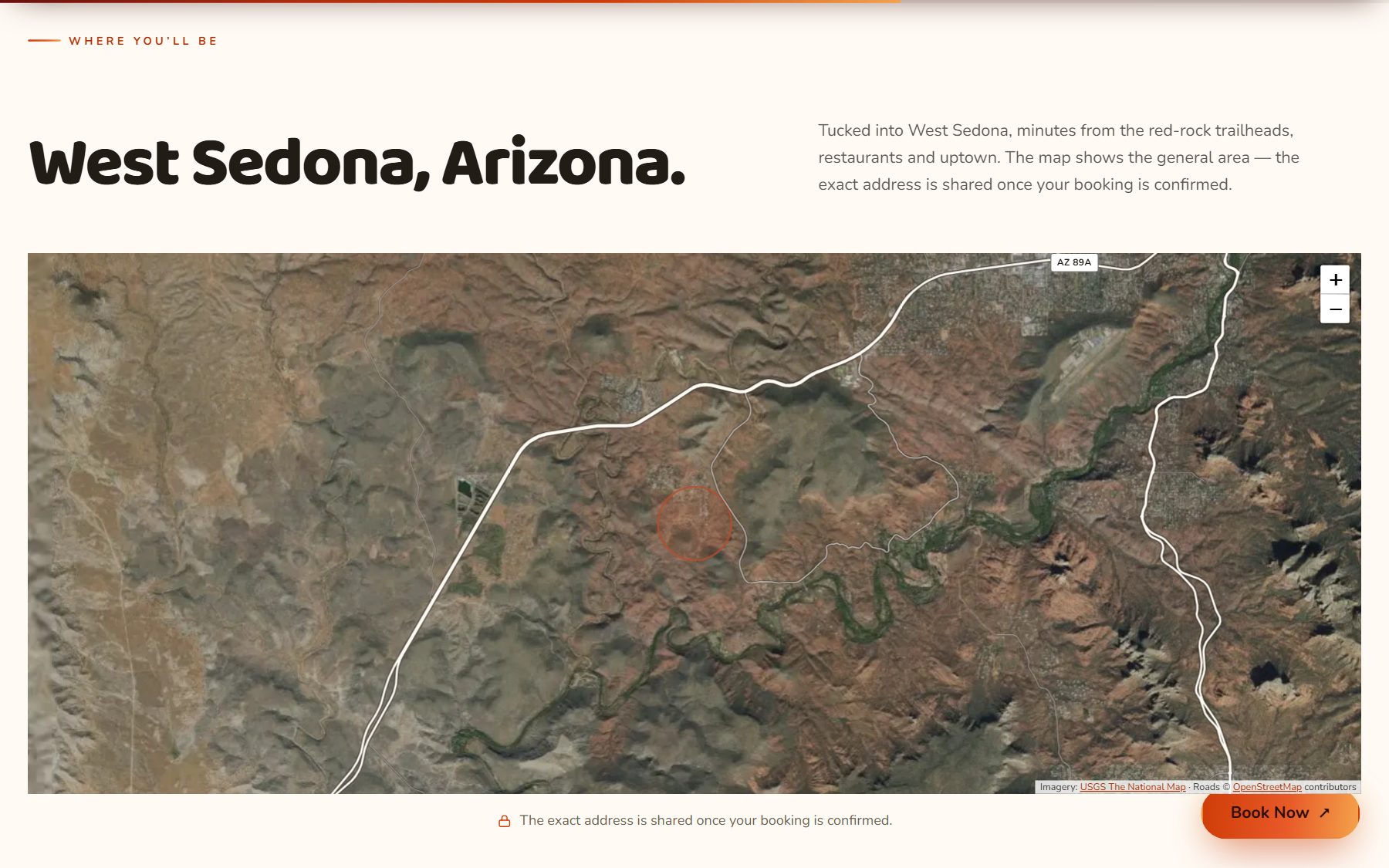
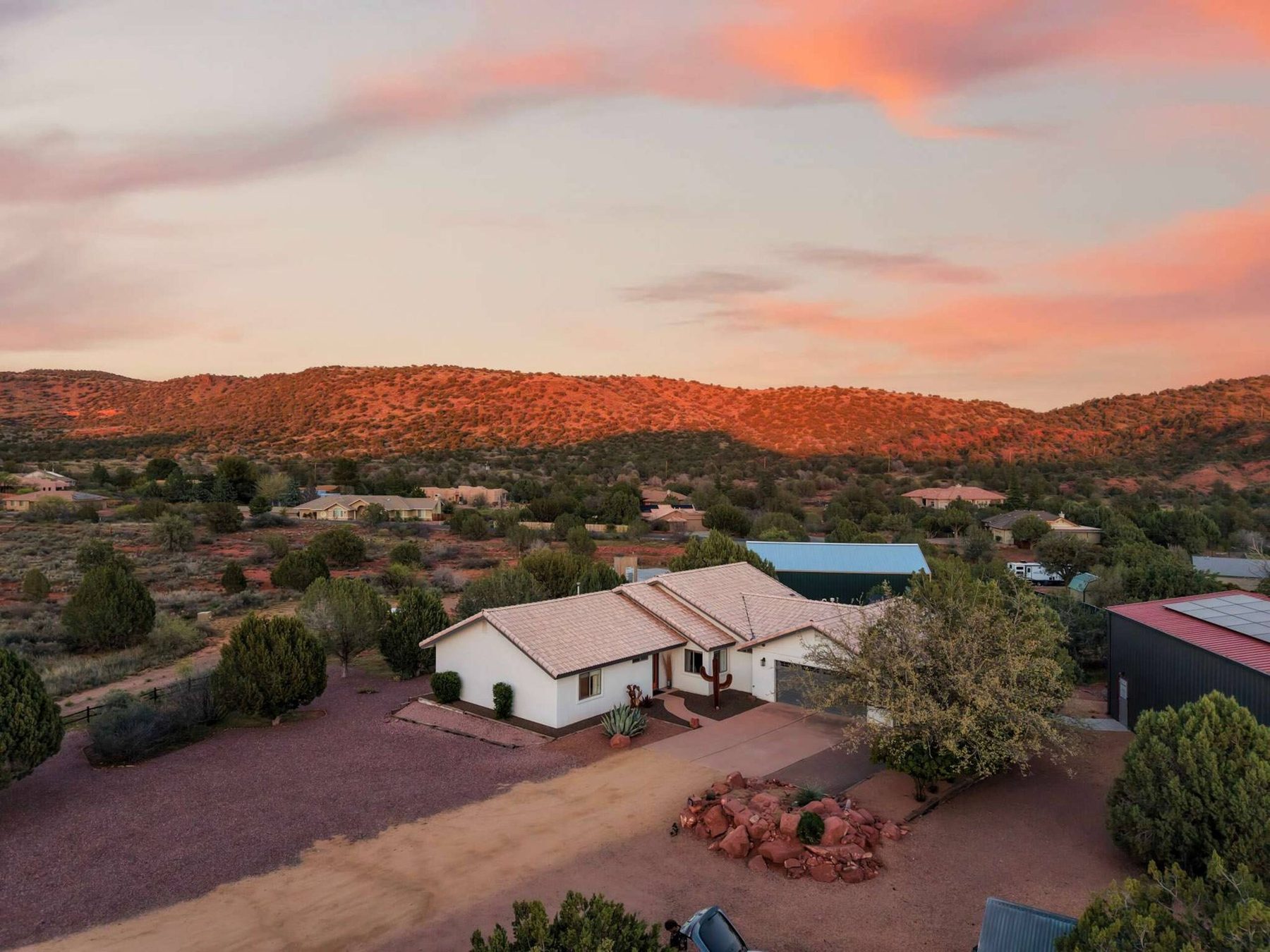
The house is in West Sedona, and its site shows a map with a circle over the general area. The street address is withheld until a reservation is confirmed, and this article leaves it there. The house is on the State Route 89A side of town, the highway that runs west toward Cottonwood, and away from State Route 179 and the Village of Oak Creek to the south.
Guests fill in the distances. One, writing in August 2026, put the drive into town for restaurants and shopping at 10 to 15 minutes. Another, in May 2026, counted twenty minutes to Cottonwood, noted grocery stores and two parks close by, and described driving about a mile along 89A to a free shuttle at the high school that carried his group to the hiking trails. He added that this side of town has less traffic. None of it is walking distance. A stay here assumes a car for every outing, and the driveway holds four.
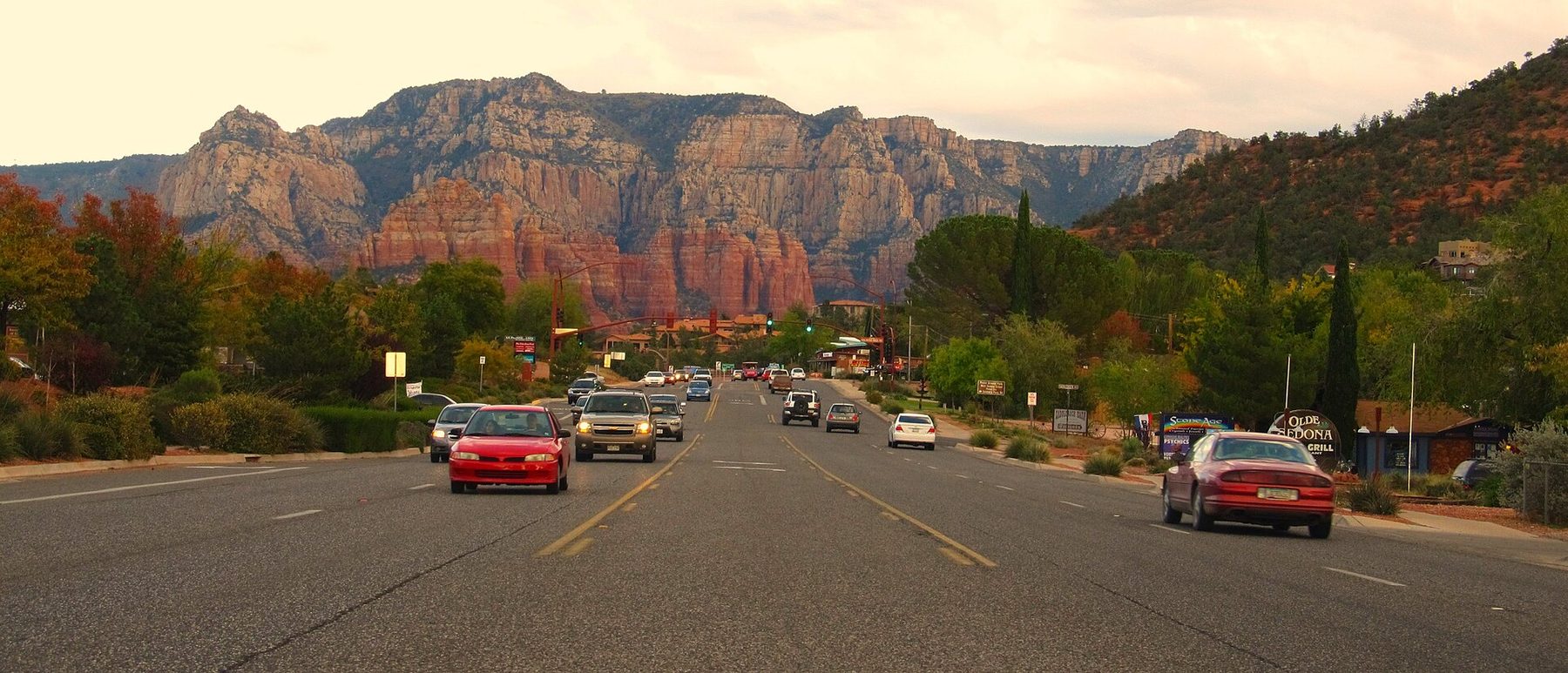
Sedona - Route 89A · Ken Lund · CC BY-SA 2.0 · cropped
Getting to Sedona at all is mostly a matter of driving. The house's site gives about two hours and 116 miles from central Phoenix by Interstate 17, and advises two and a half hours on weekends. It puts Flagstaff about 45 minutes away and Tucson about three and a half hours. The city's own figures show who makes the trip. In the City of Sedona Tourism Program's lodging and spending report for October 2025, Phoenix supplied 48.1 percent of visitors, with Los Angeles at 3.7 percent and Tucson at 3.6 percent. Sixty-seven percent of visitors stayed overnight, 46 percent had been before, and the average visitor spent 1.1 days in the market.
That last figure frames the whole question. Sedona, for most people who see it, is a day and a night. The house asks for a minimum of two nights, and a group that takes it for a long weekend is staying well beyond the average visit. A longer stay needs more than one day's worth of plans, and in a place where the plans are outdoors, it needs something to fall back on. Here the fallback has been given a building of its own and made the main event.
A building for one game
In the photographs the house has published, the court building is a clear-span steel structure: no columns on the floor, dark red rafters and purlins overhead, and white insulation facing across the walls and the underside of the roof. Rows of bright fixtures hang from the frame. Black curtains hang on all four sides to a little above head height, an air-conditioning unit is mounted high on one wall, and the court itself is an orange-red rectangle with white lines on a gray surround. There is a net on a portable-style frame, a ball caddy and a few chairs at courtside.
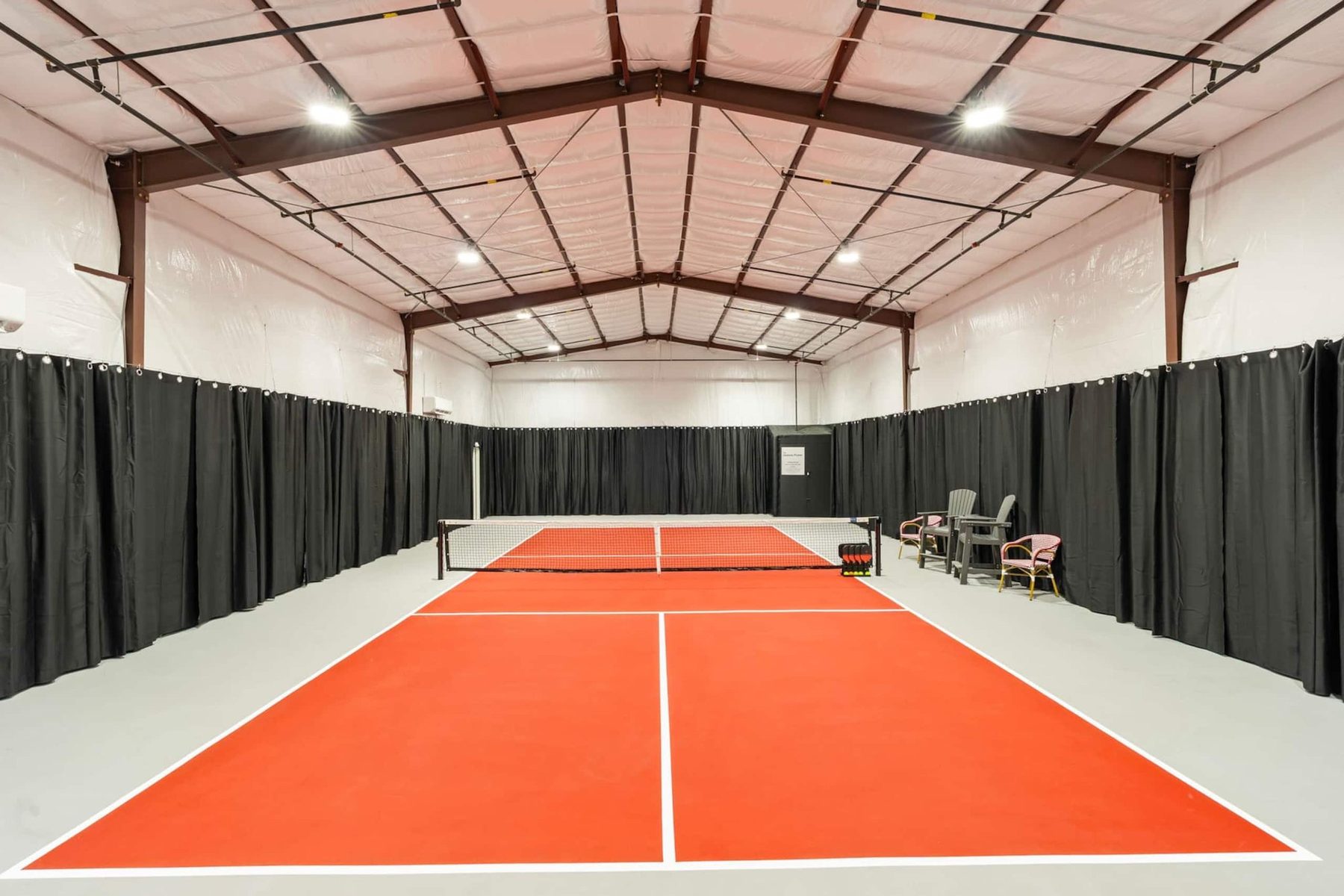
By the house's figures the building is 66 feet long and 36 wide, under walls of sixteen and a half feet and a ceiling that reaches nineteen and a half at its midpoint. The surface is acrylic on a concrete slab, which the house describes as the way an outdoor court is built. The lines of a pickleball court enclose 20 by 44 feet, with a seven-foot non-volley zone, known as the kitchen, on each side of the net; those are the dimensions on the house's own reference page for the sport. Set the lined court in the middle of a building of that size and up to eleven feet remain beyond each baseline and eight along each sideline, less whatever the walls and curtains take. The house calls the court regulation-size.
Those margins are the part worth a traveller's attention, because they separate a court from lines painted wherever a slab happened to fit. Pickleball is played close to the net, but lobs and wide angles send players backward and sideways, and the space beyond the lines and above them decides whether those shots can be played at all. A reader comparing rental houses that advertise a court can ask each of them for the same three figures: the full surface, the clearance overhead, and what the surface is laid on.
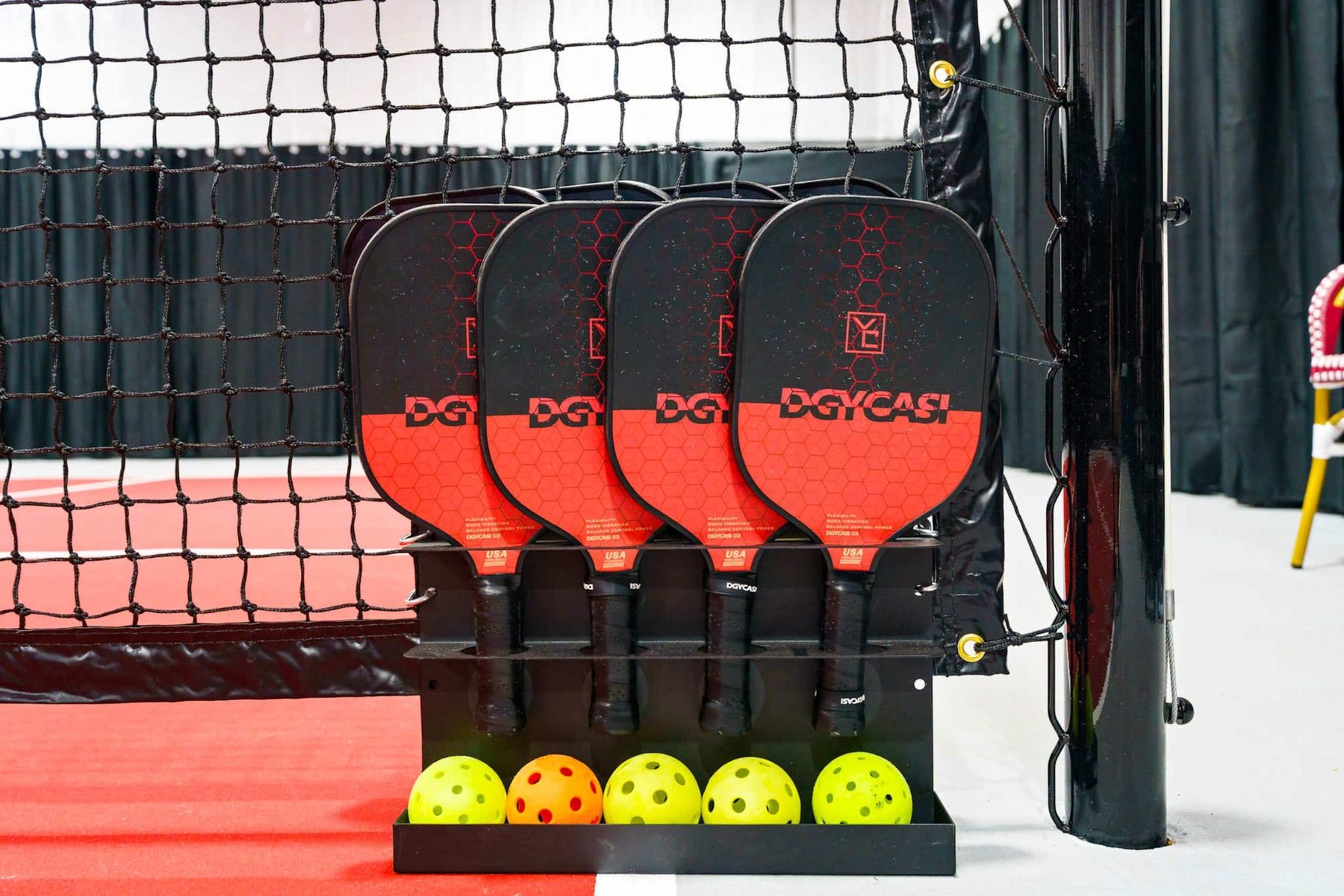
The house says paddles and balls are provided, and a photograph shows four paddles standing in a rack beside the net post with a tray of balls beneath them. Guests are asked to bring their own court shoes, which is the one item to pack. The house says there are no reservations and no fee for a game, and that the court is for the group staying at the house and nobody else. The building is heated as well as cooled.
What changes when the court is on the lot
A game on a public court asks three things of a group. Everyone has to agree on a time, everyone has to get there, and the court has to be shared with whoever else turned up. Together, on a trip with eight people and four cars, they can reduce a sport to one outing a day at most. A court across the yard removes all three, and what is left is closer to how a group uses a kitchen or a pool table: in passing, in whatever combination of people happens to be free. Karen, a guest from Mesa, Arizona, who stayed with children in August 2026, put it this way in a review reproduced on the house's site: “Our family had so much fun being able to play whenever we wanted to.”
The second change is the clock. The court is lit and enclosed, so play does not depend on daylight. An average July afternoon of 97 degrees pushes hiking to the early morning and leaves a long middle of the day with little to recommend it outdoors; an average January high of 58, with colder mornings, does the reverse. An indoor court at 68 degrees fits into whichever half of the day the weather has taken away. That is a reading of a climate table and a set of photographs, and nobody from this magazine has tested it.
The third change is who plays. The Sports & Fitness Industry Association, which surveys Americans about more than 120 activities each year, put the number of pickleball players in 2025 at 24.3 million. A report on that survey by Pickleball.com put 16.8 million of them in the casual group, people who played between one and seven times in the year, against 7.48 million core players, with eight outings or more. The inference for a group trip is this magazine's and not the association's: among eight friends or relatives, a few are likely to be keen and the rest occasional or new. On a private court nobody is waiting for a turn, which suits a group of mixed ability.
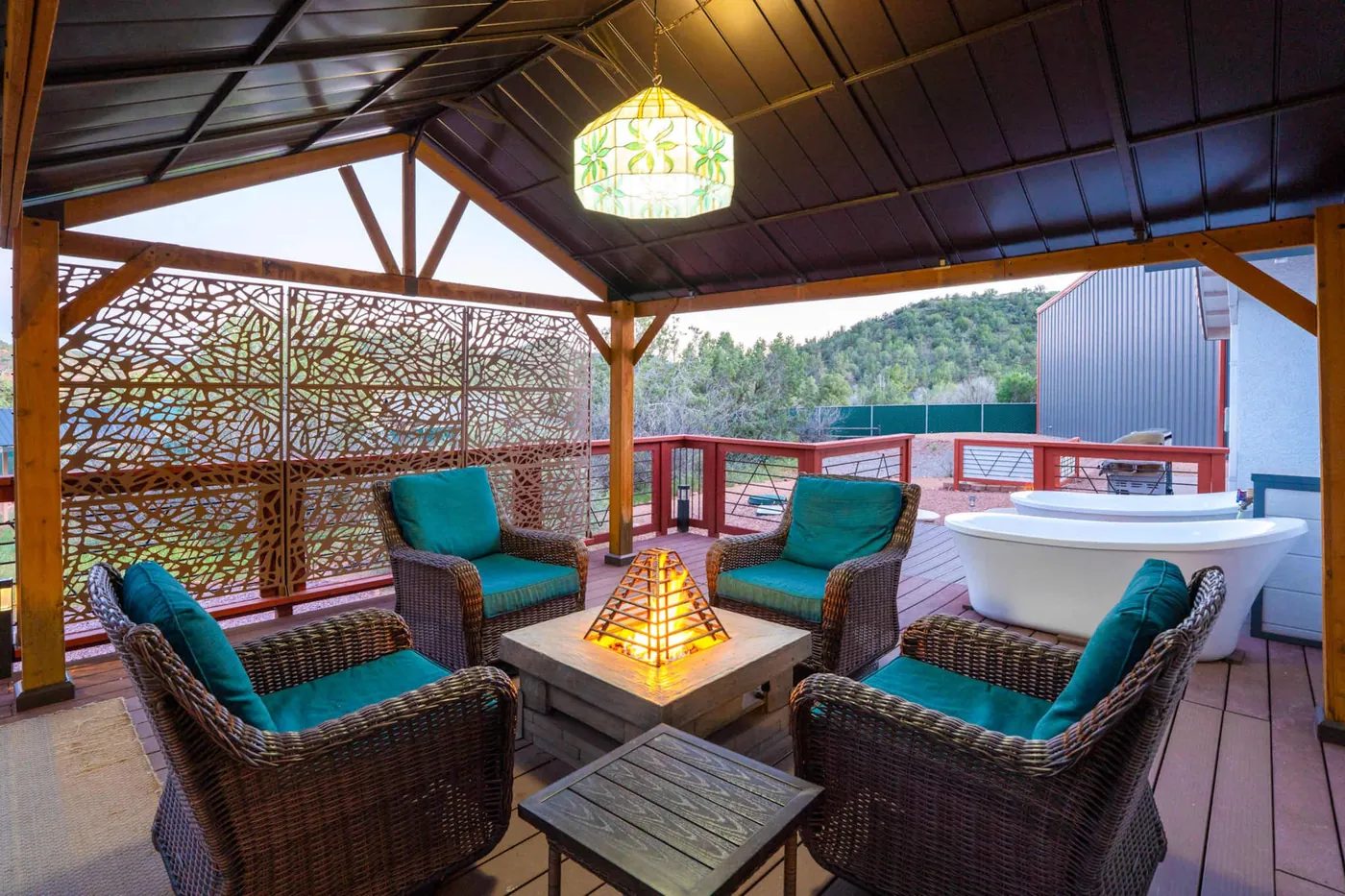
It does not remove waiting altogether. Doubles takes four players, so with one court and a full house, half the group is off at any moment. The photographs suggest where they go. The fire table and its four armchairs sit under a pergola on the back deck, and the metal wall that appears behind them is, judging by the aerial pictures, the court building.
What a private court cannot supply is other people. A public court comes with strangers, which for many players is the point of the game. That is the trade, and Sedona happens to offer both sides of it.
The house around the court
The house is on one level, with no stairs. The listing counts four bedrooms, and the site is plainer about it, describing “three true bedrooms plus a bunk game room.” There is a king bedroom with its own bathroom, a second king, a queen, and the bunk room, which has twin-over-twin bunks and doubles as the game room. That makes five beds for eight people and two bathrooms among them. For three couples and two children the arithmetic is comfortable. For eight adults it means two people in bunks and some planning around the showers after a morning on court.
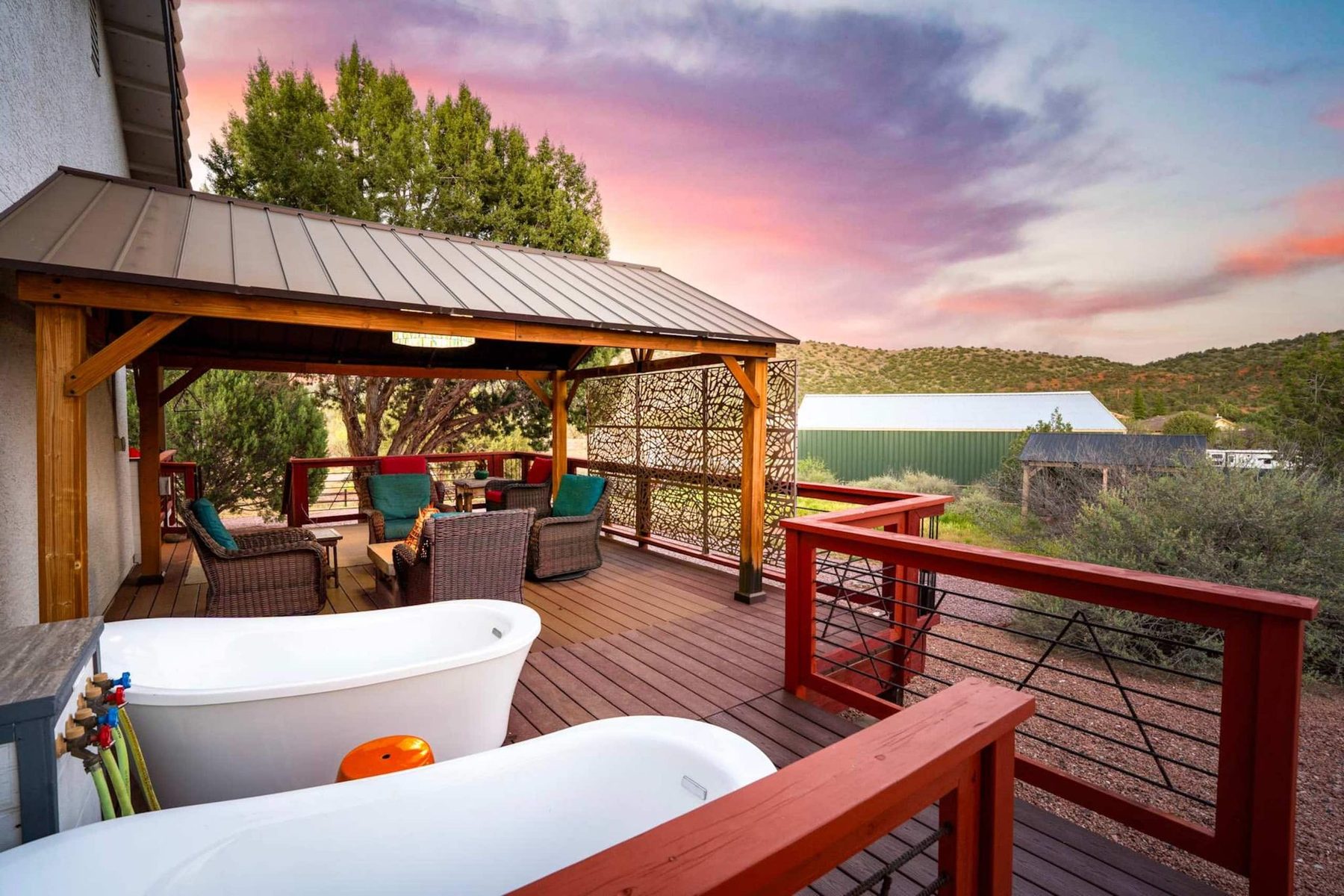
The common rooms are a full kitchen, an indoor dining table and a covered one outside, a media lounge and a laundry. Outdoors there is the covered deck, a gas fire table, a grill, a fenced yard, and the two freestanding soaking tubs, which in the photographs are white bathtubs standing side by side on the deck boards. The site lists the view as a desert one. The living-room window, in the house's own photograph, looks over scrub, juniper and a rail fence to a low hill with a band of red cliff beyond it.
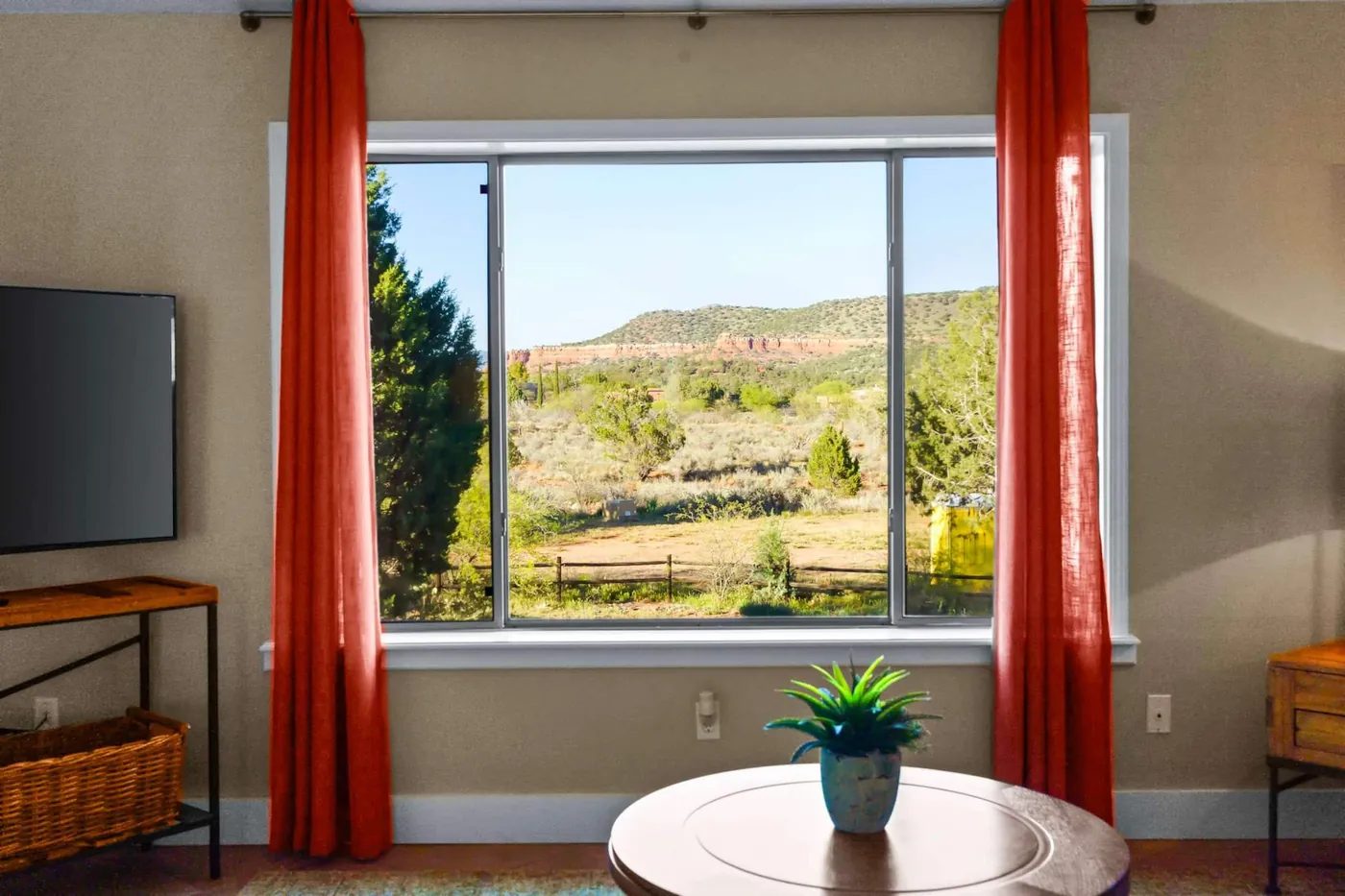
A few limits follow from all this, and they are better known before arriving than after. There is no pool. The red rock formations that bring most people to Sedona are on the horizon here, not at the window, and seeing them close means driving. So does every restaurant meal, by a guest's estimate of 10 to 15 minutes. Whoever makes the reservation has to be at least 25. The house takes no pets and permits no smoking, parties or events, the maximum is eight people, and there is no parking on the street. The site also notes that the area is rural and that wildlife is present.
Check-in is in the late afternoon and checkout in mid-morning, and the minimum stay is two nights. On a two-night stay that leaves one full day at the house, with an evening before it and an early morning after. A third night doubles the number of full days, which is the argument for treating this as a long-weekend house and planning the drive to match.
Sedona's public courts
The city of Sedona decided to build dedicated pickleball courts in the summer of 2023. As the Sedona Red Rock News reported that August, the City Council voted unanimously to budget $100,000 for the design of up to eight lit courts at Posse Grounds Park. The finance director, Cherie White, estimated design at $81,880 and construction at $1.54 million. A local ambassador for USA Pickleball, Christine Sturgeon, told the council the town had 200 to 300 players. The eight courts opened with a ribbon-cutting on October 22, 2024, at a cost the paper later put at $1.6 million.
Sedona has fewer than 10,000 residents, about 3,000 hotel rooms and about three million visitors a year, ABC15 reported in February 2025. A park court there is shared by definition: with the locals who play every week, and with every other visitor who packed a paddle.
For some travellers that is the better court. Two people, or one strong player travelling with a family that does not play, will find partners and opponents at a public park and none at a private house.
What the park cannot offer is control. Outdoor courts, even lit ones, are subject to the same afternoons and mornings as the trails, and to wind and rain. A group of eight that wants two hours of its own rotation, at a time of its choosing, is asking for something a shared facility is not designed to give. The fair comparison is between kinds of trip. If pickleball is something a few members of the party will do once, the public courts are enough and the choice of house can rest on other things. If it is what the whole group came to do, the hours a private court gives back begin to count.
Why the walls matter
When Sedona planned its courts, it planned for the sound. The Red Rock News account of the 2023 vote records the assistant public works director, Sandra Phillips, telling the council that the courts would stand over 400 feet from the closest house, far enough, she said, to bring the sound down to about 58 decibels, and that a sound study would follow. The city, the paper reported, had no complaints on file about the sound of existing play.
A hard paddle meeting a perforated plastic ball makes a sharp, repeated pop. In May 2024 Charles Leahy, an attorney and retired mechanical engineer, told acousticians gathered in Ottawa for a conference of the Acoustical Society of America and its Canadian counterpart that a single court generates about 900 pops an hour, as Phys.org reported. His first recommendation was distance, with courts 600 to 800 feet from homes. Enclosing courts in a building came further down his list, alongside wall barriers and quieter paddles and balls.
A rental house with an outdoor court in a residential area carries the neighbors' patience as an unwritten house rule, and early or late games are the first thing it rules out. Putting the court indoors changes the terms. No sound measurement for this building has been published, so the careful statement is a general one: metal walls, insulation and a ring of heavy curtains stand between the ball and the lot line, where an outdoor court has a fence. On Leahy's ranking an enclosure is a recognized remedy, though not the first. The house's ban on parties and events applies whatever the building contains.
When to come
Sedona's year has a clear shape, and the city publishes it. The Tourism Program's October 2025 report tracks Airbnb listings in the city's residential zones, using data gathered by the firm Key Data. Occupancy in those listings was 30.6 percent in August 2025, 43.1 percent in September and 60.5 percent in October. Vrbo listings followed the same curve at 26.7, 38.5 and 52.9 percent. Hotels in the study area were 74.8 percent full in October.
The rental numbers are scraped from listings and are not tax receipts, and they describe the Sedona market in general, not any one house. Late summer is when the town's rentals are emptiest and October is when they are fullest. In August a group has the widest choice of houses, and the price of that is heat.
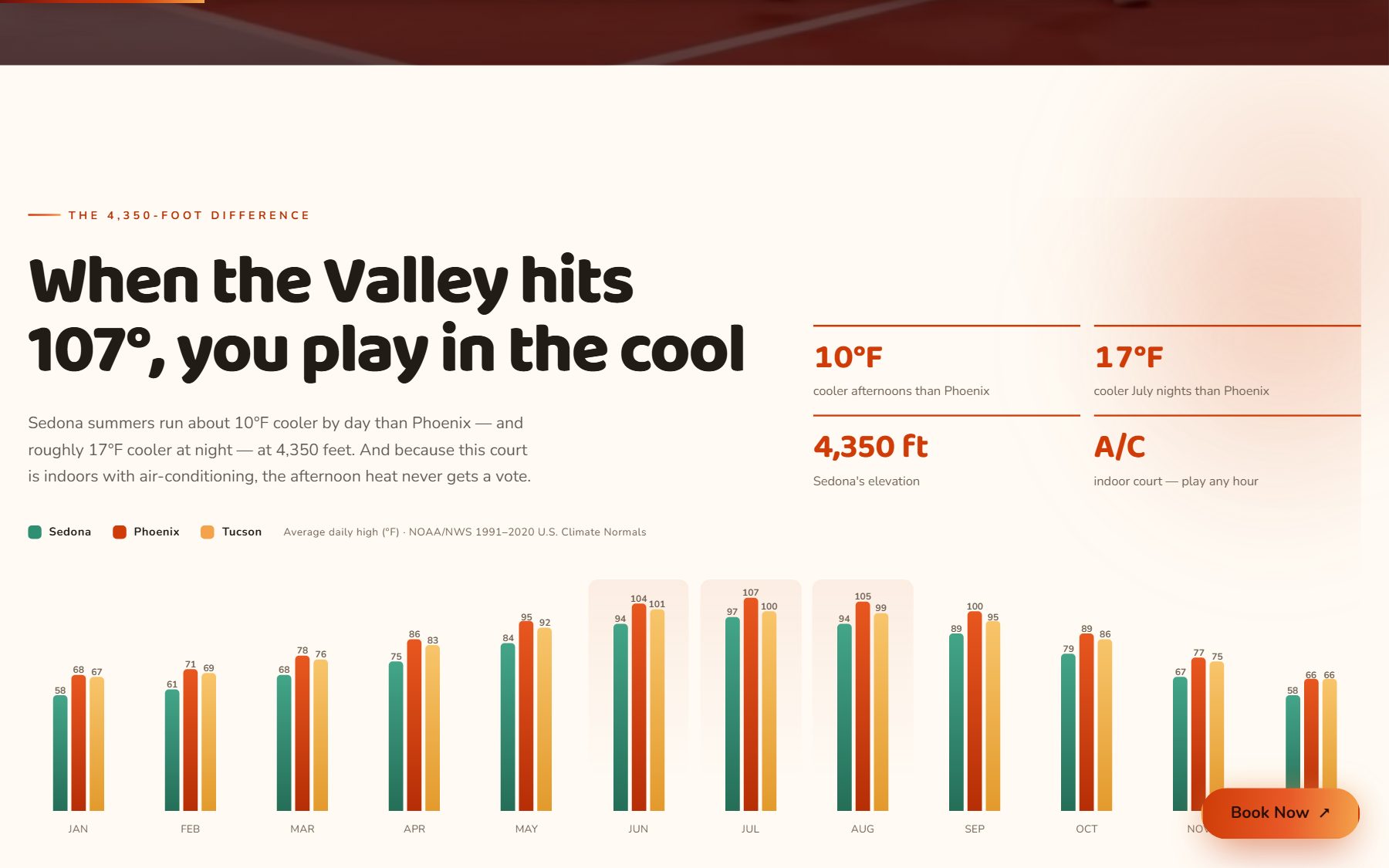
How much heat is on the house's site, in a chart labeled as drawn from the 1991 to 2020 climate normals of the National Oceanic and Atmospheric Administration and the National Weather Service. Sedona's average daily high is 58 degrees in January, 75 in April, 97 in July, 79 in October and 58 again in December. Phoenix, the source of nearly half of Sedona's visitors in the city's October 2025 count, averages 107 in July, and Tucson 100. But ten degrees cooler than Phoenix is still 97, and an outdoor court at midday in July is not an inviting place. This is the season in which an air-conditioned court does the most for a stay, because it gives the hottest hours of the day a use.
October and April are the opposite case. The weather is at its best for trails, the market is at its fullest, and the hours a group would want to spend indoors are fewest. The court still saves the drive and the wait, but the weather argument falls away, and so does the wide choice of dates. Winter sits between. At an average high of 58 degrees a clear afternoon suits a hike, while the early morning and the hours after dark are cold, and then it is the heating in the court building that matters.
West Fork of Oak Creek, reflections · Larry Lane, Coconino National Forest · CC BY-SA 2.0 · cropped
HVS, a hotel consultancy, reported in March 2026 that hotels in Sedona stayed in the high 60s for occupancy in each of the three years to 2025, and that visitor numbers fell by 5 to 10 percent in 2025 at Slide Rock State Park, the Grand Canyon and Glen Canyon, among other northern Arizona sites. The city's report points the same way: hotel occupancy in October 2025 was down 3.7 percent on October 2024.
A fast-growing sport and its courts
A house like this exists because of a few years' change in how Americans spend a free hour. The Sports & Fitness Industry Association's count of 24.3 million players in 2025 compares with about 4.2 million in 2020, a rise of 479 percent by its own calculation. The association draws the figure from an annual survey of 18,000 people aged six and over, and counts anyone who played at least once in the year.
The growth is slowing, which a reader should know before assuming the sport will keep doubling. The association reported a 45.8 percent increase for 2024. For 2025 the increase was 22.8 percent, according to Pickleball.com's account of the latest report in April 2026, with casual players up 23.9 percent and core players up 20.4 percent. That is still fast. It is also about half the pace of the year before.
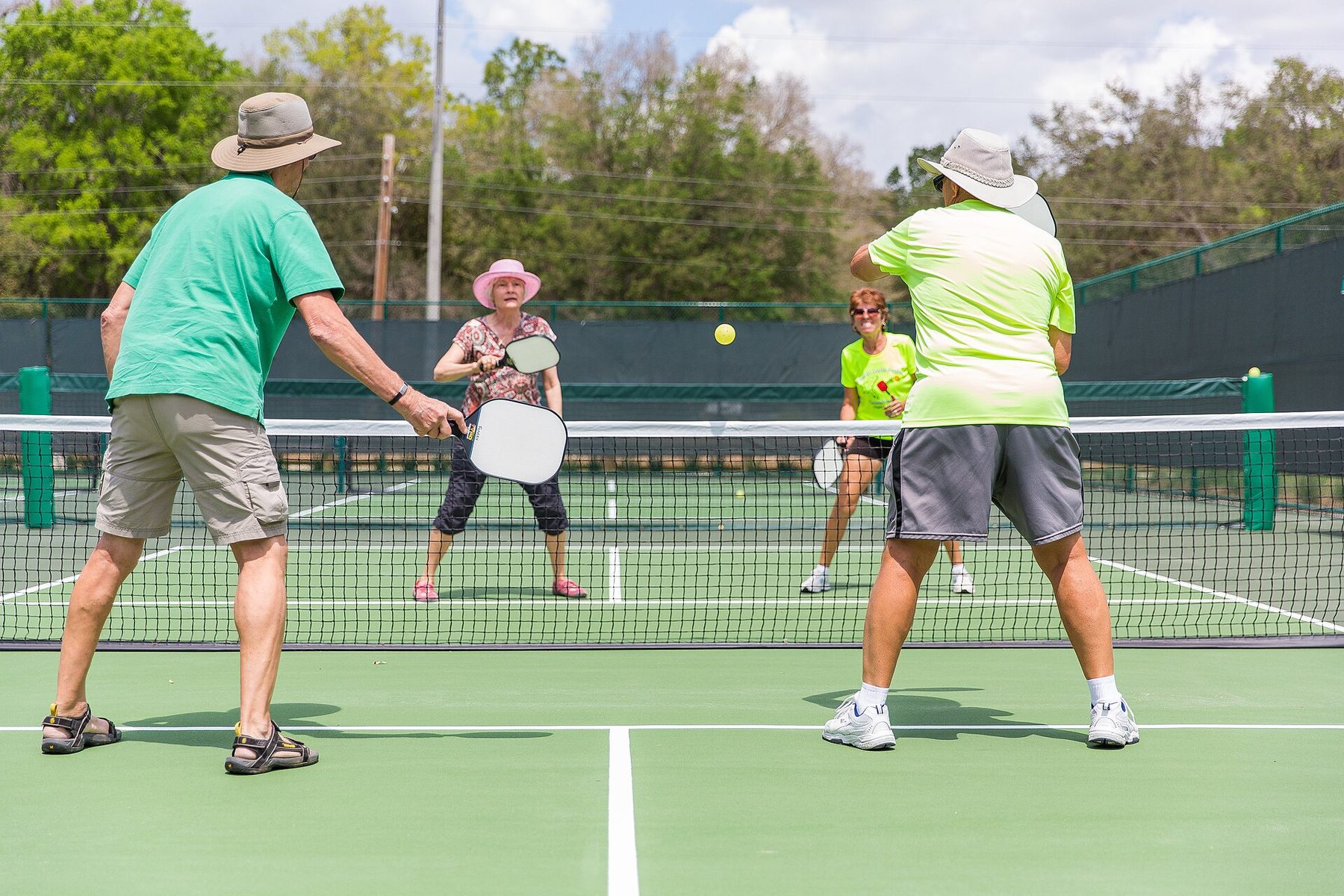
A different survey produced a much larger number. The Association of Pickleball Professionals said in March 2023 that 48.3 million American adults, nearly 19 percent, had played at least once in the previous twelve months. The two surveys do not measure the same thing and cannot be combined, but the second is useful for another reason. It found the average age of avid players, those who play at least monthly, to be 34.8, and more than 70 percent of them to be between 18 and 44. The picture of a retirees' game is out of date, and the groups of friends in their thirties who rent houses together are well represented among the players.
Pickleball Players · TheVillagesFL · CC BY-SA 4.0 · cropped
Courts have been multiplying to match. USA Pickleball's growth report for 2024 counted 68,458 courts at 15,910 places to play in the United States at the end of that year, 18,455 of them added in the twelve months before. A court is no longer a rare thing to find near a rental, or at one. And as courts become ordinary, the features that set one apart shift to those that are harder to build: a roof, climate control, lighting, room around the lines. The research for this article found no public count of rental houses with a court of either kind, so the size of the niche is anyone's estimate.
A house built around one sport is a strong choice for a group that already plays and a weaker one for a group hoping the court will convert the reluctant. By the association's figures, most people who play pickleball play it seven times a year or fewer. A group should count its own regular players before it counts on the court.
A town arguing about rentals
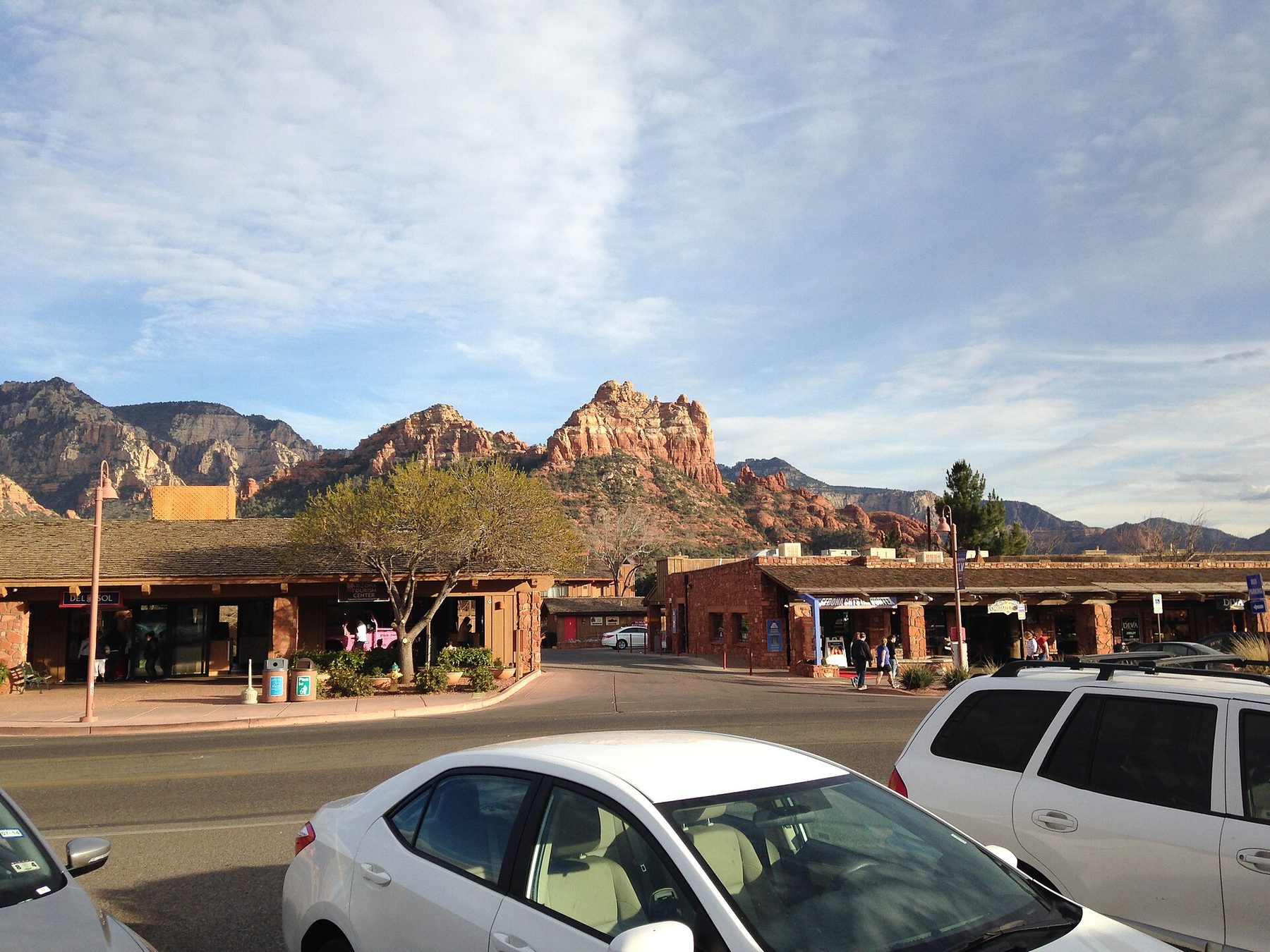
Anyone renting a house in Sedona is stepping into a local argument, and it is worth knowing its outline. In February 2025 AZFamily reported, citing the city, that Sedona's short-term rentals numbered about 400 in 2020 and more than 1,200 by the close of 2024. Scott Jablow, then the city's mayor, told the station that they made up nearly 20 percent of the city's housing. In March 2026 the city's lobbyist, Kathy Senseman, told state legislators the share was a quarter, as KJZZ reported. The figures differ with the speaker and the date. The direction does not.
Uptown Sedona Shopping - panoramio (7) · Jack CameraMan · CC BY 3.0 · cropped
Arizona law limits what a city can do about it. A 2016 statute provides that a city or town “may not prohibit vacation rentals or short-term rentals.” A 2022 amendment let local governments require a permit, notice to neighbors and liability insurance of at least $500,000, fine an owner when a violation is verified, and suspend the permit after repeated ones. It did not let them limit how many rentals there are. Sedona's leaders have asked for that power, and Jablow said in the same interview that he wanted the Legislature to let the city enact a cap. The other side was put to ABC15 in February 2025: a rental operator said rentals generate bed tax in the tens of millions of dollars a year, while Expedia Group said that limiting or banning rentals would not by itself solve a housing shortage.
The 2026 legislative session showed where the argument stands. A bill sponsored by Representative Selina Bliss of Prescott began as a measure to let cities cap rentals, was cut back to a limit on overnight guests, set at two adults for each bedroom and two more, with children not counted, and cleared the House in March. It then stalled in the Senate, according to the Sedona Red Rock News of April 25.
None of this is the traveller's fight, but it explains the tone of the paperwork at rental houses across the state. Occupancy limits, bans on events, requests for identification and a signed rental agreement are how owners in Arizona keep within a law that penalizes verified violations. A group that arrives at the stated number, parks where it is told and keeps the evening on the deck is the kind of guest the system is built to allow. A group that treats a house on a residential road as a venue is the case the whole argument is about.
What it means for where you stay
The case for this house is narrow and clear. It suits a group of six to eight in which most people play, or want to, arriving by car for three nights or more, in a season when the weather would otherwise write the timetable. For that group the court gives the empty hours of a July afternoon or a January morning a use, with no drive and no wait.
It is a weaker choice for others. A couple would have a building they can only half use. A group that wants red rock at the window, a pool, or a walk to dinner will not find them here. A party with a dog, a celebration with outside guests, or anyone under 25 making the reservation is excluded by the rules. And a strong player travelling with people who do not play may have better games at Posse Grounds Park than on a private court with nobody across the net.
The wider lesson applies to any rental built around a single activity, of which there are likely to be more as courts keep going up. Such a house is worth most when the whole group will use the feature, when weather or crowds make the alternatives away from the house unreliable, and when the stay is long enough to need more than one day of plans. It is worth asking for the measurements, the hours, who else may use it and what to bring. And it is worth looking hard at the rest of the house, because the people who are not playing at any given moment are sitting in it.
Planning notes
- Shoes: guests bring their own court shoes. The house supplies paddles and balls.
- Stay: two nights minimum, with check-in after 4 p.m. and checkout before 10 a.m.
- Group: eight guests at most. The guest making the reservation must be 25 or older.
- Not allowed: pets, smoking, parties and events.
- Cars: four spaces in the driveway and no street parking.
- Cancellation: the standard terms are non-refundable after 24 hours. A flexible option allows free cancellation up to about five days before check-in.
- Address: released after a reservation is confirmed.
The house's own pages, with its photographs, its rules and its map of the general area, are at sedonapickler.com.
Sources
- Sedona Pickler, Home page: the house, its rules, guest reviews reproduced from Airbnb, drive times, climate chart and area map (read 11 October 2026)
- Sedona Pickler, Facts for journalists: owners, court building, surface, thermostat and equipment (read 11 October 2026)
- Sedona Pickler, Pickleball court dimensions (reference page) (read 11 October 2026)
- City of Sedona Tourism Program, October 2025 Lodging and Spending Reports (Internet Archive copy) (October 2025)
- Sedona Red Rock News, Sedona approves pickleball courts at Posse Grounds Park, by Joseph K. Giddens (5 August 2023)
- Sedona Red Rock News, Pickleball courts are now open at Posse Grounds, by Joseph K. Giddens (30 October 2024)
- Phys.org, Pickleball courts in a legal pickle over the associated noise (17 May 2024)
- Sports & Fitness Industry Association, U.S. Pickleball Participation (2026)
- Sports & Fitness Industry Association, SFIA releases single sport reports for pickleball and from the team sports category (14 May 2025)
- Pickleball.com, SFIA report confirms over 24 million Americans playing pickleball (4 April 2026)
- Association of Pickleball Professionals, New APP Research Reveals Nearly 50 Million Adult Americans Have Played Pickleball In The Last 12 Months; Average Age Drops To 35 (29 March 2023)
- USA Pickleball, 2024 USA Pickleball Annual Growth Report (14 January 2025)
- HVS, Sedona's Lodging Market: Resilience and Pricing Power (20 March 2026)
- ABC15 Arizona, Sedona leaders say vacation rentals are driving a housing shortage emergency, by Jane Caffrey (3 February 2025)
- AZFamily, Short-term rentals could be to blame for Sedona housing shortage (3 February 2025)
- KJZZ (Capitol Media Services), Arizona short-term rental bill now goes after ‘repeat bad actors’ to limit overnight occupancy, by Howard Fischer (11 March 2026)
- Sedona Red Rock News, Senate stalls Bliss' STR bill indefinitely, by Joseph K. Giddens (25 April 2026)
- Arizona State Legislature, Laws 2016, chapter 208 (Senate Bill 1350), online lodging (2016)
- Arizona State Legislature, Laws 2022, chapter 343 (Senate Bill 1168), vacation and short-term rentals (2022)